







By: Said Arikat
April 3, 2026
News Analysis
Washington, D.C- By any measure, the spectacle was the point. When Donald Trump took to Truth Social to boast that “Iran’s largest bridge has collapsed and will never be used again”—punctuating the claim with footage of fire and smoke and the ominous promise that “more is coming”—he was not merely communicating policy. He was performing power. The problem is that performance is not strategy, and destruction—no matter how dramatic—does not in itself constitute a coherent endgame. It may project dominance in the moment, but it rarely answers the harder question of what comes next.
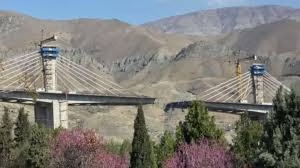
The reported strike on a major bridge linking Tehran to Karaj, allegedly carried out in two waves an hour apart, raises deeply troubling questions. If, as Iranian media claim, the second strike occurred while rescue workers were already on site, then this is not just escalation—it is escalation untethered from restraint. Such patterns—often described in reference to Israeli military operations as “double-tap” strikes targeting the same site after first responders arrive—carry profound humanitarian and legal implications. Even allowing for the fog of war and competing narratives, the optics are stark: critical infrastructure reduced to rubble, lives lost, and humanitarian risks amplified. For Washington, which has long claimed a commitment to rules-based conduct, such images risk eroding credibility faster than any adversary could, particularly among allies already uneasy about the trajectory of events.
What, precisely, is the objective? In a televised address, Trump asserted that operations were on track and that core goals had been met or even surpassed—yet in the same breath threatened “very severe” strikes over the coming weeks. This contradiction is more than rhetorical sloppiness; it suggests either mission creep or the absence of a clearly defined mission altogether. If success has already been achieved, why the need for continued bombardment? And if it has not, what metric will determine when it is? These are not academic questions; they are central to assessing whether policy is being guided by outcomes or impulses.
Equally striking is what was left unsaid. There was no serious articulation of a diplomatic pathway, no renewed timeline for negotiations, and no clarity on previously stated deadlines tied to the Strait of Hormuz. The silence speaks volumes. It suggests an administration leaning almost exclusively on coercive force, wagering that Tehran will yield under pressure. Yet history offers little comfort for such assumptions. Pressure without a credible off-ramp tends to harden positions, not soften them, especially in systems where resistance is politically valorized and compromise can be framed as surrender.
The economic dimension is treated with similar indifference. Energy markets—already jittery—have reacted predictably to the prospect of sustained disruption in one of the world’s most vital transit corridors. Yet the response from Washington has been little more than a shrug: affected countries, Trump suggested, should secure their own supplies. This is not leadership; it is abdication. A military campaign that disregards its global economic reverberations is not merely incomplete—it is reckless. It underestimates the degree to which interconnected markets can transmit instability far beyond the immediate theater of conflict.
Most jarring, perhaps, is the administration’s simultaneous invocation of diplomacy and annihilation. Iran is urged to strike a deal “before it’s too late,” even as threats are issued to target every power station in the country and to unleash devastating missile strikes on any perceived movement toward nuclear sites. This is not a calibrated mix of carrots and sticks; it is a jumble of ultimatums that risks convincing the other side that compromise is indistinguishable from capitulation. In such an environment, even pragmatic actors can find themselves boxed into maximalist positions.
None of this is to deny that deterrence sometimes requires force. But deterrence without clarity becomes indistinguishable from provocation. The current approach appears less like a strategy aimed at a defined political outcome and more like an open-ended campaign of attrition, driven by the logic of escalation itself. Tactical successes—bridges downed, facilities damaged—may accumulate. Yet without a credible political framework, they add up to little more than destruction in search of meaning. Over time, such actions risk normalizing a cycle in which each strike invites another, with diminishing strategic returns.
The Middle East has seen this pattern before: overwhelming force deployed with confidence, followed by a slow realization that the end state was never fully thought through. The danger is not only that this cycle repeats, but that it accelerates, compressing decision-making timelines and increasing the likelihood of miscalculation. When rhetoric outpaces strategy, and when destruction is treated as an end in itself, the space for diplomacy shrinks accordingly.
If there is a strategy here, it remains obscured behind plumes of smoke and bursts of rhetoric. Until Washington can articulate not just what it intends to destroy, but what it intends to build—or stabilize—in its place, these actions will continue to look less like policy and more like spectacle. And spectacle, however forceful, is a poor substitute for strategy in a region where the costs of misjudgment are measured not only in infrastructure lost, but in lives upended and futures foreclosed.
Share your opinion
Bridges to Nowhere: Trump’s Iran Strikes and the Illusion of Strategy