







By: Said Arikat
April 1, 2026
News Analysis
Washington, D.C- Washington’s response to Israel’s newly enacted death penalty law is as telling for what it says as for what it avoids. A senior U.S. official, speaking on condition of anonymity, stated: “The United States respects Israel’s sovereign right to determine its own laws and penalties for individuals convicted of terrorism. We trust that any such measures will be carried out with a fair trial and respect for all applicable fair trial guarantees and protections.” The language is polished, deliberate—and deeply insufficient. It gestures toward principle while carefully sidestepping the troubling realities embedded in the law itself.
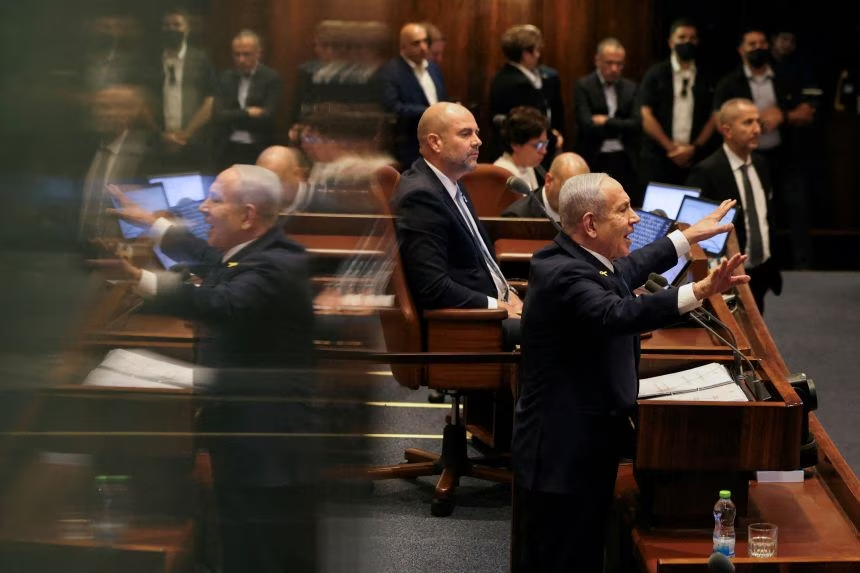
That law, passed by the Knesset with a 62–48 majority, represents a significant escalation in Israel’s legal approach toward Palestinians accused of violence. Backed by Prime Minister Benjamin Netanyahu and driven by National Security Minister Itamar Ben-Gvir, the legislation authorizes the death penalty in cases defined as “terrorism.” While framed in general terms, its application is widely expected to fall almost exclusively on Palestinians, particularly those living under Israeli military rule in the occupied West Bank.
This asymmetry is neither incidental nor ambiguous. Ben-Gvir himself has openly framed the law in identity-driven terms, declaring that those who kill “Jews” should not remain alive. Such rhetoric strips the legislation of any veneer of neutrality, exposing it instead as a tool shaped by ethno-national priorities. Justice, in this framing, is no longer blind—it is calibrated according to identity, with Palestinians facing the harshest possible penalties within a system already criticized for its structural inequities.
Those inequities are central to understanding the law’s broader implications. Palestinians in the occupied territories are tried in military courts, where conviction rates are extraordinarily high and procedural safeguards are widely questioned. Israeli settlers, by contrast, fall under civilian jurisdiction, benefiting from stronger legal protections and more robust due process. Introducing capital punishment into this bifurcated system does not simply raise the stakes—it magnifies the disparities, turning an already unequal framework into one where the ultimate penalty may be imposed without the full guarantees of justice.
Beyond its immediate legal implications, the law lays bare what many human rights observers have long described as an apartheid-like system governing Palestinians under Israeli control. Organizations including B’Tselem have explicitly concluded that the regime between the Jordan River and the Mediterranean Sea constitutes apartheid, defined not only by territorial control but by the systematic privileging of one group over another in law, movement, and political rights. The introduction of the death penalty within this framework sharpens that reality: it is not merely unequal justice, but a system in which the most severe punishment is reserved for a population already deprived of equal protection under the law, reinforcing a hierarchy that is legal, political, and existential.
Human rights organizations have warned precisely of this outcome. B’Tselem has highlighted the near-automatic nature of convictions in military courts and the limited discretion afforded to judges under the new law. It cautions that executions could be carried out swiftly, with minimal opportunity for appeal or clemency. Similarly, Amnesty International has condemned the legislation as a dangerous expansion of capital punishment in a context already marked by discrimination, noting that it undermines both the right to life and the foundational principles of a fair trial.
Against this backdrop, the U.S. statement rings hollow. The invocation of “fair trial guarantees and protections” assumes a level playing field that does not exist. It presumes that the legal system tasked with implementing the law is capable of delivering impartial justice, despite extensive evidence to the contrary. By placing its trust in these assurances without scrutiny, Washington effectively endorses a process that many credible observers view as fundamentally flawed.
This is where the language of sovereignty becomes a convenient refuge. By emphasizing Israel’s right to determine its own laws, the United States avoids confronting whether those laws meet international legal and ethical standards. Yet sovereignty has never been an absolute shield, particularly when it intersects with fundamental human rights. The global movement away from the death penalty reflects a growing consensus that such punishments are incompatible with modern standards of justice. To ignore this trend—and the specific concerns raised by this law—is to retreat from that consensus.
The contradiction is stark. The United States routinely invokes human rights as a cornerstone of its foreign policy, often criticizing adversaries for abuses that fall short of the irreversible finality of capital punishment. But when similar or more severe concerns arise in the context of an ally, the response shifts to one of deference and restraint. This inconsistency does more than undermine U.S. credibility; it signals that the application of human rights principles is contingent, shaped by political alliances rather than universal norms.
For Israel, the costs of this approach may extend beyond international criticism. Laws perceived as discriminatory do not enhance legitimacy; they erode it. In a conflict already defined by deep mistrust and recurring violence, measures that appear to target one population disproportionately are likely to inflame tensions rather than contain them. The belief that harsher penalties will produce deterrence ignores the political and social dynamics that drive the conflict. Instead, it risks reinforcing the very grievances that fuel it.
Ultimately, this law is not an isolated measure but a stark manifestation of a broader political trajectory. Its passage through the Knesset underscores the growing dominance of Israel’s extreme right, a political current that openly advocates annexation of the occupied West Bank and even Gaza, while systematically denying Palestinians the most basic human rights. In such an environment, legal frameworks are no longer instruments of justice but mechanisms of control, codifying inequality and entrenching dispossession. By embedding capital punishment within this already discriminatory system, Israel is not strengthening the rule of law—it is accelerating its erosion, with consequences that will reverberate far beyond the courtroom
Share your opinion
Death by Law: How Israel’s Extremist Turn and Washington’s Silence Are Redefining Justice