







By: Said Arikat
March 30, 2026
News Analysis
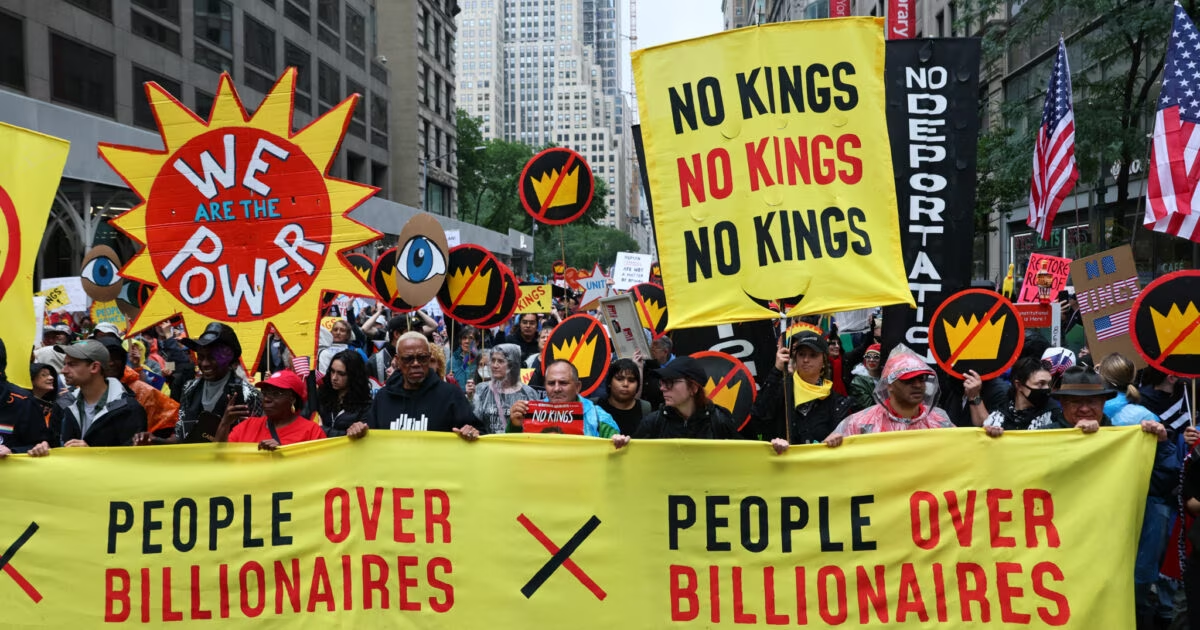
Washington, D.C-The “No King” rallies on Saturday, March 28, culminating in the high-profile gathering in Washington, D.C., have emerged as a striking manifestation of intra-party dissent under President Donald Trump. More than mere protest, they are a vivid declaration that loyalty to a single leader cannot supersede the principles of American democracy. In a political landscape increasingly defined by personality-driven politics, these rallies serve as a collective assertion that the United States cannot function as a monarchy in all but name. The symbolism of holding such a demonstration at the nation’s political epicenter—the capital itself—underscores both the urgency and the audacity of the message.
The Washington event was meticulously orchestrated to maximize visibility and political impact. Participants ranged from grassroots activists to former Republican officials, all united under a banner rejecting authoritarian impulses and defending institutional norms. The choice of Washington, D.C., is itself an unmistakable statement: the protest does not occur on the periphery but at the very locus of power. By placing dissent literally in the corridors of authority, organizers ensure the movement cannot be ignored by media, legislators, or the public. It is a rally designed to confront the heart of Trump’s presidency and to assert the principle that no individual, however popular, is above democratic norms.
The “No King” movement emerges against a backdrop of heightened Republican tension. President Trump’s continued consolidation of influence—through public statements, endorsements, and policy direction—has created a delicate balance for traditional conservatives, who must reconcile loyalty to a widely supported president with responsibility to democratic norms. The rallies exploit this tension, making explicit the stakes of unquestioning allegiance: the potential erosion of the party’s credibility and the weakening of institutions that underpin the republic. This is a cautionary narrative, a public admonition that unchecked loyalty carries consequences beyond electoral politics.
Immediate effects of the Washington rally have been unmistakable. National media coverage has framed the event as evidence of deepening fractures within the Republican Party, highlighting that opposition to Trump is not confined to abstract criticism but extends to organized, vocal factions willing to challenge his authority publicly. Congressional leaders and state party officials are now navigating intensified pressure to define their positions clearly, a tension that may influence legislative agendas, endorsements, and the dynamics of competitive primaries in 2026. In this sense, the rally functions both as a mirror of dissent and a lever for political recalibration.
The democratic significance extends beyond party politics. In a polarized environment, public demonstrations emphasizing limits on power reaffirm the role of civic engagement as a check on executive authority. By framing opposition not as partisan obstruction but as principled resistance to authoritarianism, participants in the “No King” movement articulate a vision of democracy in which institutional integrity takes precedence over personality politics. The very act of mobilizing in the nation’s capital communicates a deeper truth: the vitality of the republic depends on active citizens willing to confront the concentration of power.
Electoral consequences are potentially profound. In Republican-leaning states with competitive primaries, candidates may now be compelled to publicly navigate Trump’s influence, risking alienation of either the loyalist base or moderate voters. Independents and swing constituencies may interpret the rallies as evidence that principled opposition exists within the GOP, a signal that the party is not monolithic and that personality-driven politics can be challenged. As such, the movement may shape voter behavior in midterms, influencing both turnout and candidate positioning.
Long-term implications for conservatism are equally significant. If sustained, the “No King” rallies could form the nucleus of a structured faction committed to resisting centralization of power and reaffirming core conservative principles: limited government, adherence to constitutional norms, and measured leadership. This emergent faction has the potential to influence candidate selection, legislative priorities, and party platforms well beyond the Trump presidency, serving as a counterweight to the populist, personality-driven impulses that have defined recent cycles. In essence, the rallies may represent the initial stages of an ideological realignment within the Republican Party.
Challenges remain. The movement’s influence will depend on translating symbolic protests into sustained political leverage, combining grassroots energy with organizational sophistication, and articulating a coherent policy agenda. Without these elements, the momentum generated by the Washington rally risks dissipating. Moreover, the movement must navigate perceptions: too aggressive a stance risks alienating moderates, while insufficient clarity may render the protest performative rather than consequential. Success lies in striking a careful balance between moral authority and strategic action.
Ultimately, the “No King” rallies represent more than political dissent—they are a democratic litmus test in the Trump era. By confronting the concentration of power in the executive and asserting the primacy of constitutional norms, these events highlight the fragility of personality-driven politics and the enduring need for civic vigilance. While the immediate electoral effects remain uncertain, the rallies have already reshaped the narrative of Republican politics and injected a potent reminder into national discourse: American democracy flourishes not under the dominion of a single leader, but when power is debated, constrained, and held accountable by engaged citizens. In this sense, the “No King” movement is both a warning and a reaffirmation: the republic endures through principled dissent as much as through popular support.
Share your opinion
“No King”: Republican Dissent and the Democratic Test in the Trump Presidency