







By: Said Arikat
March 27, 2026
News Analysis
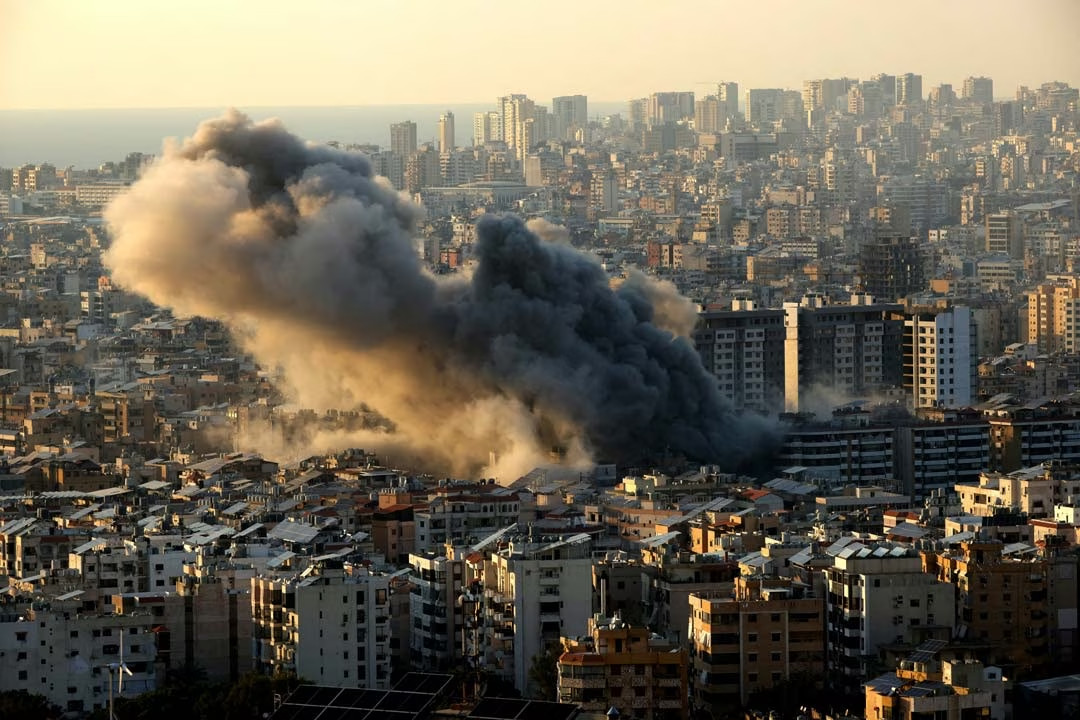
Washington, D.C- As bombs fall on Lebanese villages and bridges across the Litani River collapse, one fact becomes impossible to ignore: Israel’s military operations are not merely defensive measures. They reflect a calculated, expansionist strategy rooted in decades-old ambitions for a “Greater Israel” that stretches beyond its recognized borders into southern Lebanon and even parts of Syria. When civilians are uprooted en masse and infrastructure is deliberately destroyed, the goal is not only to neutralize armed groups—but to reshape the map itself. Forced displacement, village destruction, and rhetoric of occupation reveal a long-standing strategy to extend Israeli control well beyond its internationally recognized territory.
History offers sobering context. Documents submitted by the World Zionist Organization to the Paris Peace Conference after World War I reveal proposed Jewish state boundaries stretching northward to the Litani River. While never ratified, these early maps illuminate a persistent territorial imagination in which military conquest, demographic engineering, and ideological vision were deeply intertwined. Today’s military operations, coupled with explicit political statements, suggest that these ambitions remain influential, guiding contemporary strategies and shaping regional perceptions of Israel’s goals.
The scale and targets of current military operations are profoundly significant. The systematic destruction of villages and infrastructure—roads, bridges, and essential utilities—is not merely tactical. It isolates communities, cripples local economies, and makes civilian return increasingly difficult. By uprooting populations, Israel is employing a method historically associated with demographic transformation: removing inhabitants to facilitate long-term territorial control. When displacement becomes normalized as a tool of war, the line between defense and expansion blurs, raising profound moral and political questions.
Strategically, southern Lebanon and the Litani River hold multiple forms of value. The Litani is more than a geographic marker; it represents water resources, natural defensive boundaries, and a corridor of strategic depth. Its recurring presence in both historical proposals and contemporary military planning is no accident. Similarly, the occasional discussion of extending operations into parts of Syria underscores the wider regional ambitions embedded within Israel’s security doctrine. These are not merely reactions to immediate threats—they are components of a vision of regional dominance that traces back to the earliest Zionist territorial aspirations.
This expansionist logic is reinforced by rhetoric that frames displacement as a security necessity. Such framing obscures the broader intent: to assert control over territories beyond Israel’s recognized borders. The historical resonance is striking. Early Zionist planners envisioned demographic and territorial consolidation as essential to state survival. Today, large-scale forced exiles, infrastructure destruction, and sustained military occupation suggest continuity with that logic. Military action is not only about neutralizing armed groups but about shaping a territorial reality conducive to ideological ambitions.
International law is explicit in condemning collective punishment, forced displacement, and attempts to annex territory by force. Yet beyond legal frameworks, the strategic consequences are equally stark. Displacement fosters enduring hostility, deepens sectarian fault lines, and creates conditions ripe for future conflict. Expansionist war does not secure peace; it ensures resistance. Every demolished village, every uprooted community, compounds historical grievances, making reconciliation far more difficult.
The implications extend beyond immediate borders. Actions along the Litani and in southern Lebanon send signals to the wider Middle East, reinforcing perceptions that Israel’s military campaigns are guided by long-term expansionist objectives. Even without formal annexation declarations, the cumulative effect on the ground is clear: certain territories are being incorporated into the vision of a Greater Israel. This perception, whether accurate or exaggerated, shapes the political calculations of Lebanon, Syria, and regional actors, complicating diplomacy and reinforcing cycles of militarization.
The contemporary iteration of this strategy also underscores a disturbing normalization of demographic engineering as an instrument of policy. When civilian populations are treated as obstacles to territorial control rather than stakeholders in political solutions, the consequences are immediate and generational. Forced displacement is not merely a temporary inconvenience; it transforms social, economic, and political landscapes, hardening conflicts in ways that cannot be undone once military operations conclude.
Critically, the expansionist dimension is inseparable from historical memory. Maps from the early Zionist period, strategic discussions about the Litani, and contemporary military planning together form a continuum: a vision of territorial depth and demographic transformation that persists over decades. Recognizing this continuity does not suggest inevitability, but it does demand scrutiny. The current military logic is not neutral; it is the operational expression of long-standing ideological goals, rendered in the language of security and defense.
Policy choices in the present can still alter the trajectory. Adherence to international humanitarian law, targeted diplomacy, and external pressure could constrain the momentum of expansionist ambitions. Without these interventions, however, displacement, destruction, and occupation risk embedding a reality on the ground that mirrors historical maps—reifying ambitions that were once merely aspirational into tangible territorial change.
The conflict along the Litani is thus not merely a military confrontation; it is a test of whether historical expansionist ideologies will dictate the future of the region. Israel’s current operations serve as both a warning and a blueprint: for civilians, for neighboring states, and for the international community. The question is not only how the war is fought, but why—whether it is about immediate security or about advancing a long-standing project to reshape borders and demographics in pursuit of Greater Israel. Understanding this distinction is critical to analyzing the present and preparing for the post-war landscape.
Share your opinion
Beyond the Litani: Israel’s Expansionist War in Lebanon