







By: Said Arikat
March 25, 2026
News Analysis
Washington, D.C- The question may appear provocative, but it reflects a growing concern in strategic circles: is the United States drifting into another prolonged and costly conflict, this time alongside Israel against Iran, where success is elusive and the burden is measured in endurance, disruption, and global consequences rather than decisive victories?
Since February 28, when U.S. and Israeli forces launched coordinated strikes on Iranian targets, what began as a direct military campaign has rapidly evolved into a broader and more dangerous confrontation. Iran’s response was immediate and expansive, targeting not only Israeli positions but also American assets and allied infrastructure across the Gulf. Within hours, missile and drone strikes reached multiple Gulf Cooperation Council states, including Saudi Arabia, the United Arab Emirates, Qatar, Bahrain, and Kuwait, effectively transforming the conflict into a regional war with far-reaching implications.
At first glance, comparisons to the war in Ukraine remain compelling. In both cases, warfare extends beyond conventional battlefields into the economic systems that sustain modern states. In Ukraine, the conflict evolved into a sustained campaign against infrastructure—power grids, fuel depots, and logistics networks—aimed at weakening the country’s capacity to function. Similarly, in the current war with Iran, energy infrastructure has become a central target rather than a secondary objective.
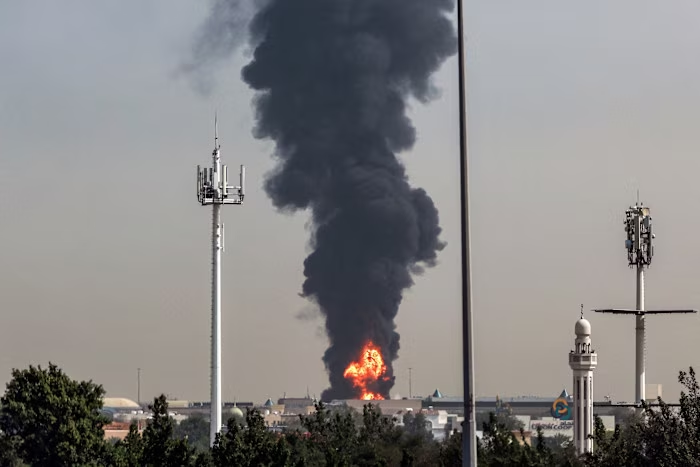
This emphasis is not incidental. Iran occupies a critical position in the global energy system, and its proximity to the Strait of Hormuz gives it significant leverage over the flow of oil and gas. As the conflict has intensified, retaliatory strikes have increasingly focused on energy facilities and shipping routes across the Gulf, amplifying the economic stakes. Iranian attacks on key energy sites in the region have already disrupted supply chains and driven up global prices, underscoring how quickly localized conflict can trigger worldwide consequences.
Yet the analogy to Ukraine begins to break down under closer examination. The war in Ukraine is fundamentally indirect for the United States, which provides military and financial support without engaging directly in combat against Russia. By contrast, the conflict with Iran involves direct participation. American forces are not operating from a distance but are embedded in an active and highly volatile theater, where escalation can occur rapidly and unpredictably.
This distinction significantly raises the stakes. Direct engagement compresses decision-making timelines and increases the likelihood of miscalculation. In Ukraine, escalation has been managed, however imperfectly, through careful calibration. In the case of Iran, the margin for error is much narrower, particularly given the speed and scale of retaliatory actions that have already unfolded across multiple fronts.
Geography further compounds the risk. Ukraine’s war, despite its devastation, has remained largely confined within its borders. In contrast, Iran’s influence extends across a network of regional actors and strategic partnerships. The events since February 28 demonstrate how quickly a bilateral confrontation can expand into a multi-front conflict. Iranian strikes across GCC nations illustrate both the reach of its capabilities and the vulnerability of a region densely packed with critical infrastructure and foreign military assets.
What most closely links the two conflicts, however, is the shift toward attritional warfare. This form of conflict prioritizes endurance over speed and resilience over decisive force. Success depends on the ability to absorb damage, adapt, and continue operating under sustained pressure. Iran has spent decades preparing for precisely this kind of confrontation, developing asymmetric capabilities such as drones, ballistic-missiles, and decentralized networks designed to offset conventional military disadvantages.
For the United States and its allies, this presents a strategic dilemma. Superior military power does not necessarily translate into decisive outcomes in an attritional environment. Strikes on infrastructure may yield temporary gains, but they rarely produce lasting results. Facilities can be rebuilt, supply routes rerouted, and tactics adjusted. Meanwhile, the cumulative costs—financial, political, and strategic—continue to mount.
This dynamic raises the specter of a quagmire. History offers numerous examples of conflicts where initial objectives were clear but became increasingly ambiguous over time, leading to prolonged engagements without resolution. The danger in the current war is not a sudden defeat but a gradual erosion of position—a slow drain on resources, attention, and credibility.
The centrality of energy further amplifies these risks. Unlike Ukraine, where economic consequences have been significant but regionally concentrated, the war involving Iran directly affects the global energy system. Disruptions in the Strait of Hormuz and attacks on Gulf infrastructure have already demonstrated the potential for systemic shocks. Rising oil and gas prices, strained supply chains, and broader economic instability are no longer hypothetical risks but emerging realities.
None of this suggests that the situation is identical to Ukraine. The differences are substantial and must be acknowledged. However, the comparison serves as a warning. It highlights a pattern in modern conflict: a drift toward wars that are difficult to win, costly to sustain, and prone to expansion beyond their original scope.
The more pressing question, therefore, is not whether Iran is becoming America’s Ukraine. It is whether the United States is allowing itself to be drawn into a familiar strategic trap—one defined by unclear objectives, insufficient tools for decisive victory, and an open-ended timeline that invites escalation.
Avoiding such an outcome requires clarity: clear goals, defined limits, and a realistic understanding of consequences. It requires recognizing that military force alone cannot resolve a conflict embedded in complex regional dynamics and global economic interdependence.
Without that clarity, the risk is not simply another prolonged war. It is a broader and more destabilizing crisis—one in which the lessons of recent conflicts are not applied, but repeated on a far more dangerous and interconnected stage.
Share your opinion
Drifting into Quagmire: America’s War of Attrition with Iran