







By Said Arikat – March 21, 2026
News Analysis
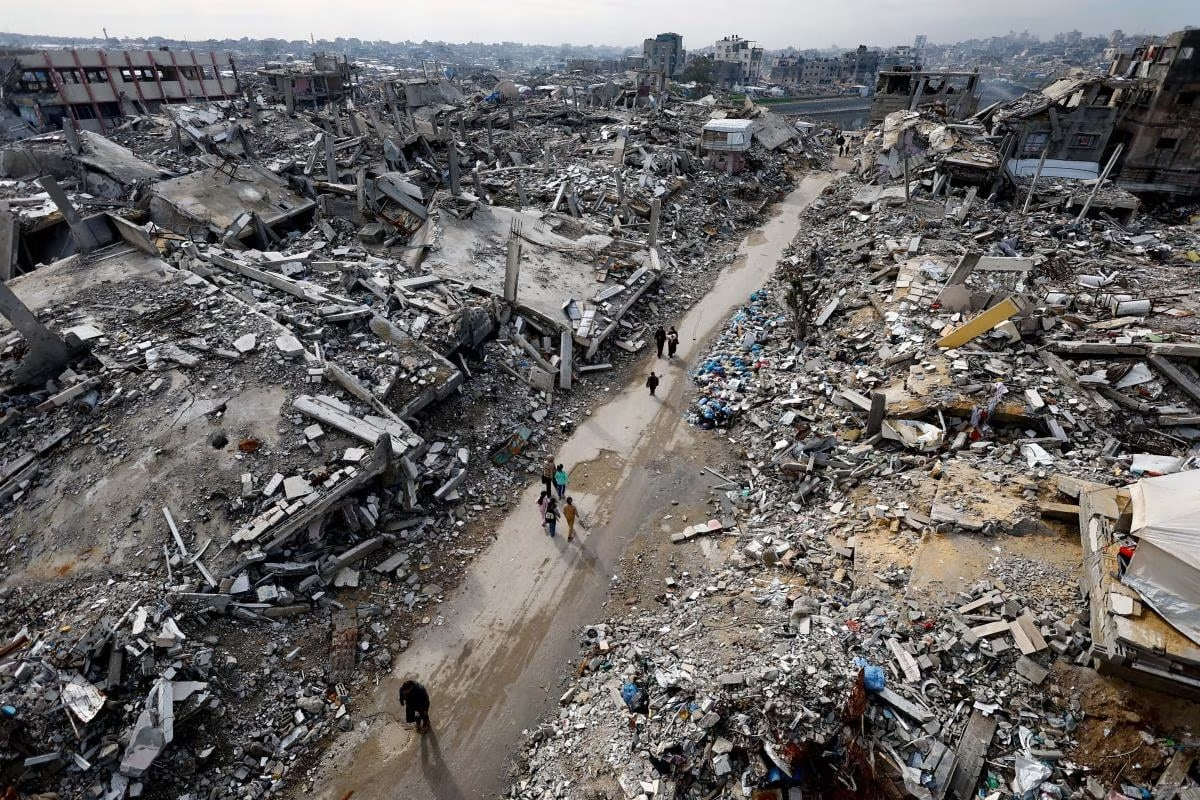
Washington, D.C- Gaza is no longer at the center of international urgency. Even as its humanitarian catastrophe deepens, it has slipped into the margins of global policymaking—particularly in Washington, where strategic bandwidth is increasingly consumed by higher-order concerns. A newly circulated proposal, advanced by a so-called “Peace Council” with regional mediators and tacit Israeli backing, captures this shift with unsettling clarity: disarmament first, reconstruction later. The framing is not incidental; it reflects a broader reordering of priorities in which Gaza is treated less as an emergency than as a problem to be sequenced, managed, and deferred.
The plan outlines a phased process lasting six months or more, beginning with the dismantling of heavy weapons—rockets, launchers, tunnels—before moving to small arms. In parallel, a newly formed Palestinian police force would assume control of “cleared” areas. Hamas members who comply would receive conditional security guarantees, excluding those accused of prior attacks. The architecture is familiar: security consolidation as the gateway to stability. It is a model that privileges control over immediacy, process over urgency, and risk mitigation over human need.
But the sequencing is the story—and the problem. By making reconstruction contingent on full disarmament, the proposal subordinates urgent humanitarian relief to a slow, uncertain political process. Gaza’s civilians, already facing severe shortages of food, water, and medical care, are effectively cast as collateral in a negotiation they do not control. There are no credible safeguards for their protection while the process unfolds, nor assurances that it will succeed. The burden of waiting is placed squarely on a population that has already exhausted its capacity to endure.
This is a narrow, securitized reading of a fundamentally political crisis. It treats weapons as the cause rather than the symptom. Absent a credible political horizon for Palestinians, disarmament risks becoming an end in itself—one that may temporarily quiet violence without addressing the conditions that produce it. In that sense, the proposal does less to resolve the conflict than to stabilize it at a lower intensity. Stability, under such conditions, becomes a substitute for justice rather than a pathway toward it.
The gaps are not only conceptual but institutional. The introduction of a new Palestinian security force raises unresolved questions about legal authority, chain of command, and its relationship to the Palestinian Authority. In a fragmented political landscape, legitimacy is not a technical detail—it is the difference between enforcement and collapse. Without it, any new force may struggle to function, let alone endure. Worse, it may deepen internal divisions, adding another layer of contestation to an already fractured governance structure.
Then there is the matter of money. Despite rhetorical commitments from Washington about mobilizing billions for reconstruction, no meaningful funding pipeline has materialized. The hesitation is telling: donors appear unwilling to invest without prior security guarantees, even as those guarantees depend on the very stability reconstruction is meant to create. The result is a circular logic that traps Gaza in permanent deferral—no rebuilding without disarmament, no disarmament without rebuilding. In practical terms, this translates into prolonged devastation and a growing credibility gap between promise and delivery.
All of this unfolds against a broader strategic backdrop. For the United States, Gaza has become a secondary file, eclipsed by the war on Iran and the wider architecture of regional deterrence. The preference is clear: manage the crisis through intermediaries, limit direct exposure, and avoid the political costs of deeper engagement. In practice, that means less pressure, fewer resources, and diminished urgency. It also signals to other actors that Gaza can be handled incrementally, rather than decisively.
This is not a temporary lapse; it reflects a structural shift. In an era of great-power competition, chronic humanitarian crises struggle to compete for attention unless they threaten wider instability. Gaza, despite its volatility, is increasingly viewed as containable. That perception—whether accurate or not—carries consequences. It creates space for half-measures, for process without progress, for proposals that manage symptoms while deferring solutions. Over time, such an approach risks normalizing crisis as a condition rather than confronting it as a failure.
The disarmament initiative fits squarely within this pattern. It offers the language of stabilization without the substance of resolution. By bracketing the humanitarian emergency and conditioning relief on maximal security compliance, it reinforces the very imbalance that has long defined international engagement with Gaza. It also shifts the moral burden onto those least able to bear it, asking civilians to wait for political outcomes that remain uncertain and contested.
The question, then, is not whether disarmament is desirable, but whether it can meaningfully precede dignity, governance, and political horizon. Experience suggests otherwise. Without addressing the lived reality of Gaza’s population, any security-first framework risks fragility at best, failure at worst. Sustainable calm cannot be engineered in isolation from the conditions that give rise to instability in the first place.
As talks continue in Cairo, the underlying issue remains unchanged: can there be sustainable calm without immediate relief and credible political direction? Or will Gaza remain what it has now become in global capitals—a crisis to be managed, postponed, and periodically revisited, but no longer truly prioritized? The answer will determine not only the trajectory of Gaza, but the credibility of an international system increasingly defined by what it chooses to ignore.
Share your opinion
Gaza Deferred: When Disarmament Replaces Urgency