







Washington — Said Arikat - 3/19/2026
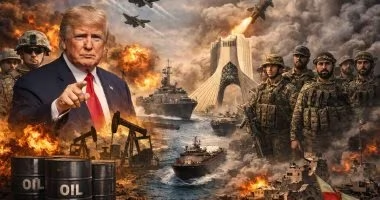
Three weeks after the launch of the war against Iran on February 28, US President Donald Trump continues to suggest that the conflict may end "soon," without providing a clear vision for the objectives or the mechanism for ending the war. In contrast, War Secretary Pete Hegseth affirmed on Thursday that there is no specific timeline for halting operations, indicating that the final decision remains with the President.
It is worth noting that Hegseth requested $200 billion to cover the war on Iran, which some experts considered an indication of an intention to continue the war for a longer period.
Trump's recent statements reflected an approach based on personal judgment rather than specific strategic criteria, as he said the war would end "when I feel it inside." This approach raised questions in political and military circles about the absence of a clear definition of victory or even a realistic timeframe for ending operations.
Moving Targets and a Vague Definition of Victory
Since the beginning of the campaign, the stated objectives have varied between destroying Iran's nuclear capabilities, reducing its military power, deterring its regional influence, and sometimes even hinting at regime change. This multiplicity of objectives, without clear prioritization, has made it difficult to measure progress or determine an end point.
Despite the administration's assertion that the objectives "have not changed," this apparent consistency conceals practical ambiguity: what extent of destruction is sufficient? And when can Iran be considered to have lost its ability to threaten? These questions remain without decisive answers.
Field Escalation Met with Talk of a Near End
On the ground, data indicates continuous escalation, with the number of targets struck exceeding thousands of sites inside Iran, and the scope of operations expanding. The Department of Defense is also considering a request for massive additional funding, reflecting a readiness for the possibility of the war continuing for a longer period.
This contradiction between the rhetoric of a "near end" and preparations for an extended war reinforces doubts about the clarity of strategic vision within the US administration.
Persistent Ambiguity Since Day One
When Trump announced the start of operations on February 28, he indicated that the campaign might last "a few weeks." However, three weeks later, the ambiguity has not dissipated but deepened; fundamental questions remain without clear answers, including what the ultimate goal of the war is, what the precise conditions for its end are, and how success can be defined militarily and politically. This ambiguity reflects a recurring pattern in modern wars where objectives gradually expand without explicit declaration, making it difficult to retreat or re-evaluate and weakening the ability to build internal consensus. Moreover, linking the end of the war to the President's personal judgment reinforces uncertainty among allies and adversaries alike, and encourages behaviors that may increase the likelihood of escalation. At the same time, the discrepancy between political rhetoric suggesting the war's imminent end and military preparations indicating its potential continuation reveals a gap that could affect public trust, especially if the conflict drags on without clear results.
The lack of clarity in American objectives reflects a recurring pattern in modern wars, where objectives gradually expand without official announcement. This "strategic drift" makes it difficult for decision-makers to retreat or re-evaluate. It also weakens the ability to build internal consensus, whether in Congress or among the public. In Iran's case, the complexity is exacerbated by the regional nature of the conflict, making any miscalculation prone to rapid and unforeseen escalation.
Furthermore, Trump's statements linking the end of the war to a personal feeling reflect a striking shift in the style of international crisis management, where institutions recede in favor of individual decision-making. This pattern may provide tactical flexibility, but it creates a state of uncertainty among allies and adversaries alike. The absence of clear criteria makes it difficult to predict American behavior, which may prompt other parties to take preemptive steps, increasing the likelihood of escalation instead of containment.
The contradiction between political rhetoric and military preparations raises questions about the messages directed to the American public. While it is said that the war may end soon, figures and budgets indicate the opposite. This discrepancy may be an attempt to contain internal anxiety, but it carries the risk of eroding trust if the conflict prolongs. Historically, such a gap between rhetoric and reality has been a major factor in the decline of public support for foreign wars.
Share your opinion
Ambiguity of Objectives in the American War on Iran Reveals Lack of Clear Vision for its End