







By: Said Arikat
March 18, 2026
News Analysis
The war on Iran appears less a reluctant necessity than the culmination of years of political ambition, ideological fixation, and strategic distortion. Initiated under President Donald Trump at a moment when diplomatic channels remained open and were showing measurable progress, the decision to wage war reflects a deliberate rejection of negotiation in favor of force. The assertion that military action represented a last resort collapses under scrutiny; it was instead a chosen course, privileging spectacle and decisiveness over restraint, patience, and the disciplined practice of statecraft.
At the center of this trajectory stands Israeli Prime Minister Benjamin Netanyahu, who has for decades portrayed Iran as an existential threat. By his own account, this concern has defined much of his political life. Yet repetition alone does not confer accuracy. Netanyahu’s framing has functioned less as a calibrated assessment and more as a sustained strategic narrative, steadily narrowing policy alternatives and conditioning allies, particularly the United States, to perceive confrontation not as a choice but as an inevitability that must ultimately be faced.
Under Trump, that narrative encountered an unusually receptive political environment. His administration did not simply align with Israeli security concerns; it amplified them, often discarding the caution and nuance that traditionally accompany decisions of war. The outcome was not a balanced reassessment of risk, but an accelerated movement toward conflict, shaped as much by political affinity and external pressure as by rigorous analysis. In such an environment, dissenting perspectives were marginalized, and diplomacy was recast not as leverage, but as weakness.
This convergence of agendas raises uncomfortable questions about agency and national interest. The resignation of Joe Kent, Director of the National Counterterrorism Center, brought these concerns into sharper focus. In his reported communication to the president, Kent suggested that the war was being prosecuted not primarily in defense of core American interests, but under pressure linked to Israeli priorities and lobbying influence. Whether accepted fully or partially, the claim underscores a deeper unease within the national security apparatus regarding the coherence and independence of the war’s rationale.
At its core, the campaign rests on a familiar yet repeatedly discredited assumption: that military force can engineer political transformation. History has consistently demonstrated the limits of this belief, yet it persists in moments of strategic impatience. Airstrikes may degrade infrastructure and disrupt capabilities, but they rarely produce stable or favorable political outcomes, particularly in a country as large, complex, and internally resilient as Iran. More often, such actions entrench the very forces they are intended to weaken, reinforcing resistance rather than inducing compliance.
That pattern is already becoming evident. Iranian domestic politics has hardened in response to external attack, with hardline factions gaining strength and more moderate voices increasingly sidelined. What might once have been an internal debate has been reframed as a national struggle against foreign aggression. By choosing war, the United States has inadvertently strengthened the internal dynamics it seeks to counter, transforming political fragmentation into unity against a common external adversary and narrowing the space for reformist discourse.
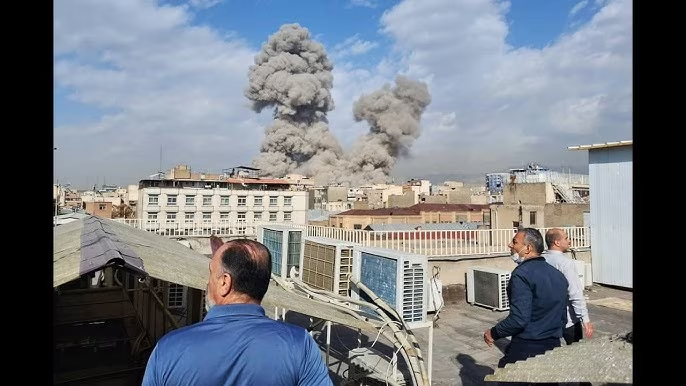
Beyond Iran’s borders, the consequences are spreading outward with increasing intensity. The conflict has exacerbated regional instability, disrupted global energy markets, and introduced new volatility into an already fragile international system. Oil prices have surged, inflationary pressures have widened, and critical trade routes, particularly the Strait of Hormuz, have become zones of persistent risk. These developments are not unforeseen side effects, but predictable outcomes of a military campaign initiated without a credible or sustainable strategy for containment.
Equally concerning is the erosion of legal and moral constraints governing the use of force. The justification for war relies on an expansive and highly questionable interpretation of imminence, effectively lowering the threshold for military action. This redefinition risks normalizing preventive war as an instrument of policy, undermining international norms designed to restrain unilateral escalation. In doing so, the United States not only diminishes its own credibility, but also creates a permissive environment in which other states may adopt similar justifications.
Domestically, the war has revealed a widening disconnect between leadership and public sentiment. Many Americans, shaped by the legacy of prior interventions, view the conflict with skepticism and unease. The parallels to earlier wars, including ambiguous intelligence, inflated threat assessments, and unclear objectives, are difficult to ignore. Yet these concerns have had limited impact on policy direction, reinforcing the perception of a decision-making process increasingly insulated from public accountability and democratic constraint.
Ultimately, the most damning critique of Operation Epic Fury lies not only in its risks, but in its strategic incoherence. There is no clearly defined measure of success, no realistic pathway to achieve stated objectives, and no credible exit strategy. If regime change is the goal, it remains unattainable without catastrophic cost. If deterrence is the aim, escalation may well produce the opposite effect, entrenching hostility and inviting sustained retaliation across multiple fronts.
In this light, the war represents the convergence of two deeply flawed approaches: Trump’s preference for forceful, high-visibility action untethered from long-term planning, and Netanyahu’s decades-long effort to frame Iran as an unavoidable target of confrontation. Together, they have produced not a coherent strategy, but a collision in which political narratives have overtaken strategic logic and prudence has been subordinated to urgency and alignment.
Operation Epic Fury is therefore not simply a policy misstep, but the foreseeable outcome of years of escalating rhetoric, political calculation, and the systematic sidelining of diplomacy. It reflects a deeper dysfunction in decision-making, where ideology and alignment eclipse careful analysis, and where the costs of war are treated as secondary considerations. In repeating the errors of the past with diminished justification, it risks becoming not only another costly conflict, but a defining example of avoidable failure in modern statecraft.
Share your opinion
Operation Epic Fury: From Shock and Awe to Strategic Failure