






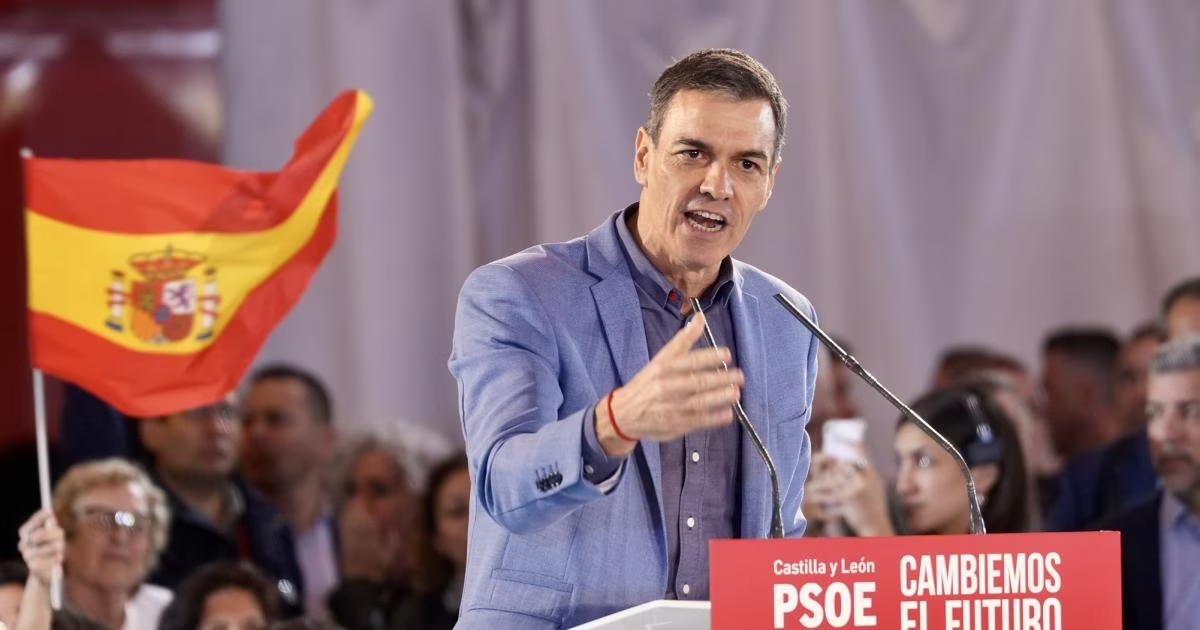
Amidst the accelerating pace of military escalation in the Middle East, a striking Spanish stance has emerged, breaking the traditional Western consensus regarding armed conflicts. Spanish Prime Minister Pedro Sánchez explicitly announced that his country would not engage in any military adventure targeting Iran, emphasizing the necessity of adhering to international law and UN legitimacy.
This position comes in the wake of widespread attacks launched by the United States and Israel against Iranian targets, and the subsequent retaliatory responses that affected facilities in several countries. These developments have put Madrid in direct confrontation with the administration of US President Donald Trump, which had expected full logistical and political support from its NATO allies.
During a public address in the city of Valladolid, Sánchez affirmed that Spanish memory still recalls the lessons of the 2003 invasion of Iraq, and the disasters it caused as a result of bypassing Security Council resolutions. He clarified that rejecting authoritarian regimes cannot be a justification for violating international laws or igniting devastating regional wars.
The Spanish government did not limit itself to political statements but moved to decisive procedural steps by preventing US forces from using military bases on its territory. The decision included the strategic 'Rota' and 'Morón' bases, where any logistical facilities for operations directed against Tehran were refused.
Informed sources reported that this sovereign decision forced 15 US military aircraft to change their course and immediately leave Spanish airspace. These aircraft were compelled to head towards 'Ramstein' Air Base in Germany and other bases in Europe, disrupting US logistical plans in the region.
In Washington, White House spokeswoman Karoline Leavitt tried to downplay the situation by claiming there was last-minute Spanish cooperation. However, Spanish Foreign Minister José Manuel Albares quickly denied these claims, asserting that his country's position remained steadfast and had not changed 'an inch' regarding its rejection of war.
The American reaction was angry and sharp, with President Donald Trump describing Spain as a 'terrible ally' that cannot be relied upon in major crises. Trump hinted at imposing economic sanctions and cutting trade relations with Madrid, in an attempt to pressure the Sánchez government to backtrack on its recent decisions.
For his part, Sánchez responded with a clear challenge, considering that true leadership requires protecting the interests of the people and adhering to principles, not practicing 'blind obedience'. Observers noted that Trump's threats might hit a European wall, as Spain is a member of the single market, and any targeting of it is a targeting of the European Union.
Spain's position on Iran is closely linked to its policy towards the Palestinian issue and the ongoing aggression against the Gaza Strip. Madrid has taken unprecedented diplomatic steps by withdrawing its ambassador from Tel Aviv, in protest of what it described as genocide and Israeli participation in regional escalation.
Furthermore, the Spanish Parliament approved a historic legislation imposing a permanent and comprehensive ban on the export of all types of weapons and military technology to Israel. This step reflects a Spanish desire to exert actual pressure to stop the bloodshed in the region, away from the language of traditional diplomatic statements.
Domestically, Sánchez's approach enjoys broad popular support, with opinion polls showing that about 68% of Spanish citizens oppose any external military intervention. This popular backing gives the coalition government the necessary strength to face external pressures and political blackmail that major powers might exert.
On the international interaction front, Sánchez warned of the danger of 'war economics' and the impact of military-industrial complexes in pushing the world towards the abyss. He called on major powers to stop 'playing Russian roulette' with the destinies of millions of people, emphasizing that the only option to save lives is to say 'no' to war.
These positions sparked a sharp division on social media platforms between supporters who see Sánchez as a rare 'moral leader' and opponents who accuse him of weakness. Some analysts believe that Spain is trying to chart a new course for European foreign policy, based on strategic independence and prioritizing dialogue over the language of weapons.
In conclusion, the confrontation between Madrid and Washington remains open to all possibilities, given Spain's insistence on its principled stance. With continued tension in the Middle East, it seems that Spain has decided to be a voice for de-escalation and international legitimacy, even if it means a direct clash with the most powerful country in the world.
Spain will not support a war outside the framework of international legitimacy, and true leaders do not practice blind obedience for fear of retaliation.
Share your opinion
Challenging Trump.. Spain Closes Its Bases to US Aircraft and Rejects War on Iran