







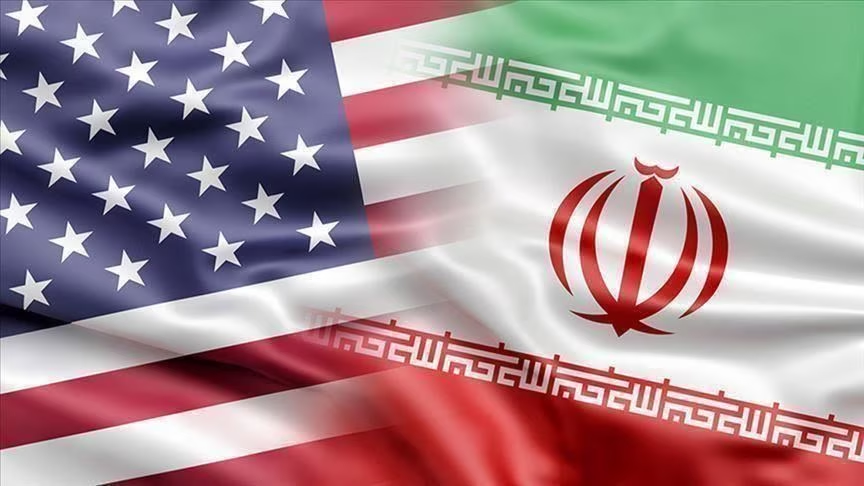
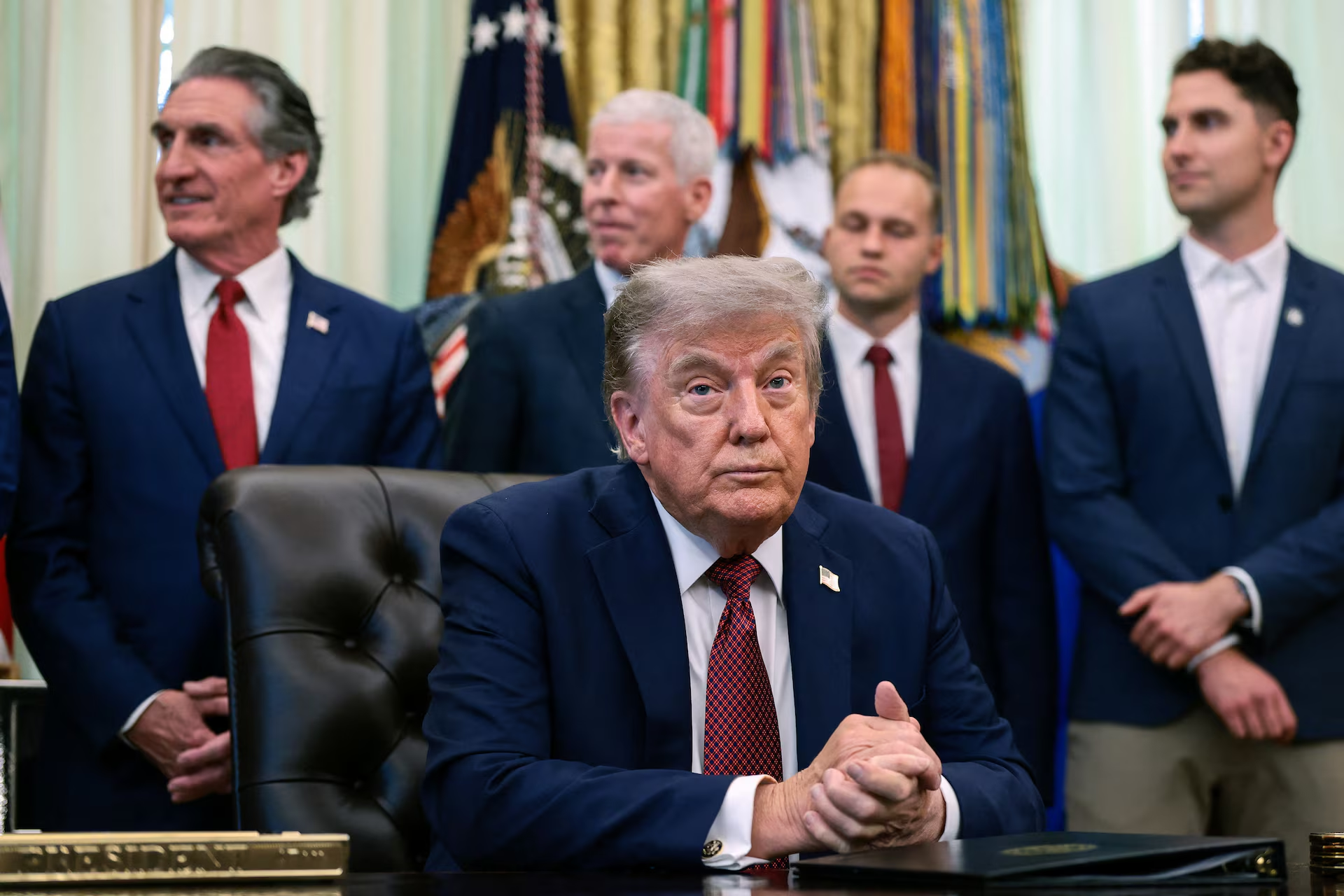
The crisis between Washington and Tehran is heading towards a sharp turn, after CBS News reported that senior US national security advisers informed President Donald Trump that the US military could be ready to launch strikes on Iran starting Saturday, if Trump issues the order. However, the decision, according to the same sources, has not yet been made, with expectations that the timeline for making it will extend beyond the end of this week.
This hesitation does not necessarily mean an absence of intent, but rather may reflect the nature of the Trump administration, which tends to keep the final decision in its hands until the last moment, and to use ambiguity as a pressure tool. The current scene suggests that Washington is holding two threads at once: brandishing force to compel Iran to make political concessions, and keeping a diplomatic window open to prevent a slide into an open war whose repercussions cannot be easily controlled.
While these preparations are presented publicly as "precautionary measures," the accompanying details go further. CBS News reported that the US Department of Defense intends to temporarily relocate some of its personnel from the Middle East in the coming days, in anticipation of an Iranian counterattack if the United States launches a strike. Other leaks indicated that US forces deployed in the region are required to be at the highest levels of readiness by mid-March. In deterrence calculations, such steps are not usually taken merely for show, but to reduce the cost of surprise if the doors of confrontation are opened.
At the same time, the Israeli dimension of the crisis is strengthening. The Times of Israel website quoted a US official as saying that US Secretary of State Marco Rubio will visit Israel on February 28 to meet with Israeli Prime Minister Benjamin Netanyahu, at a moment when estimates within the Israeli security establishment are growing that Trump may resort to the military option soon, especially after the failure of nuclear negotiations. The visit here appears to be more than just a diplomatic stop, but rather part of a political and security coordination intended to appear cohesive to Tehran, and to send a message that any potential American strike will not be isolated from Tel Aviv's position, according to the website.
However, the scene is not limited to military signals. Following the US-Iranian talks in Geneva, a senior US official told Reuters that Iran is expected to submit a written proposal on how to avoid confrontation with the United States. In a political sense, submitting a written proposal means not only a desire to negotiate, but an attempt to reframe the crisis according to clearer rules, or at least to prevent the language of threat from turning into a final decision. Nevertheless, Israeli estimates indicate that the gaps remain wide, especially with regard to Washington's basic demand: abandoning uranium enrichment within Iranian territory, a demand that Tehran considers a crossing of red lines.
In Israel, preparations are proceeding at a pace that suggests military scenarios are being seriously considered. Hebrew media reported that Israel is preparing for the possibility of receiving an American "green light" to launch an attack on Iran's ballistic missile system. The Israeli Broadcasting Corporation reported that targeting missiles is linked to a potential American decision regarding striking Tehran, while Haaretz newspaper spoke of close coordination between the two countries in the areas of intelligence, air defense, and military communications. This type of coordination, if true, indicates that military options are being discussed as a joint or intertwined operation, not just a separate strike by one party.
This impression is reinforced by what Yedioth Ahronoth published about Netanyahu instructing the Home Front Command and rescue agencies to prepare for war, coinciding with the postponement of the meeting of the Ministerial Committee for National Security (the "Cabinet"). Internal mobilization is not only read as a defensive measure, but as part of managing public opinion and preparing the home front for the possibilities of escalation. Israel Hayom also reported predictions of a long-range Iranian missile response if a wide strike is carried out, with expectations that Israel may not hesitate to join Washington if operations begin.
However, the fundamental dilemma is that the strike, if it occurs, may not remain "limited" as is usually promoted. Iran possesses a network of response options that are not confined to one front: from targeting interests and bases, to activating regional allies, to expanding the scope of engagement so that it transforms from a punitive strike into a long escalatory path. Here lies the paradox of deterrence: what is supposed to be pressure to prevent war may itself become the spark that ignites it.
Politically, the escalation cannot be separated from the broader regional and international scene. While the Sultanate of Oman continues to play the role of mediator, having sponsored a round of negotiations in Geneva after a previous round in Muscat, US military buildups in the Middle East are increasing. In contrast, joint maneuvers between Russia, China, and Iran are emerging in the Arabian Sea and the northern Indian Ocean, sending a message that Tehran is not completely isolated, and that it has room to maneuver within a network of international relations counter to US influence. This parallel between diplomacy and military buildup makes the crisis closer to a game of "brinkmanship" than to a traditional negotiating path.
Amidst this picture, some observers believe that Washington and Tel Aviv may be engaged in a calculated "war of nerves" against Iran, based on raising the threat level and leaking indications of military readiness, with the aim of pushing Tehran to make more concessions without the need to ignite the spark of war. However, this approach carries a double risk: on the one hand, it may push Iran to harden its positions instead of retreating, and on the other hand, it gives Israel greater scope to influence the American decision, which may cause the escalation to feed on itself, and turn the strike from a political option into a semi-inevitable outcome of an accelerating path.
The Trump administration appears to be negotiating from a logic of power, not a logic of compromise. But power, in a charged regional environment, is not a neutral pressure tool; it is a gamble on reactions that are difficult to predict, and on the ability of the parties to control the limits of fire. In light of the intertwining of interests and alignments, any decision to strike could turn into a comprehensive test for the region, not just for Iran.
Share your opinion
Trump told by advisers that the US is ready to attack Iran on Saturday if ordered