







By: Said Arikat
February 15, 2026
News Analysis
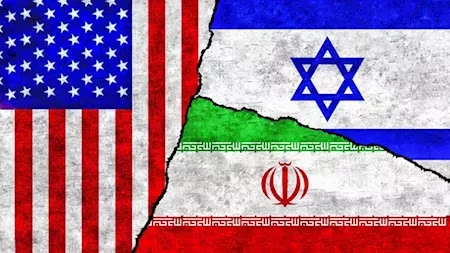
The United States insists it has learned the lesson of the post-9/11 era: that the Middle East is a strategic sinkhole, absorbing attention, treasure, and credibility while yielding diminishing returns. In official doctrine and public rhetoric, Washington now claims a different horizon. The priority is the Western Hemisphere, the Indo-Pacific, and the long competition with a rising China. Yet the reality on the ground tells a different story. The U.S. remains tethered to the Middle East not by deliberate design, but by a cycle of crises that repeatedly overrides its own declared strategy. The confrontation with Iran, now approaching a dangerous crescendo, is the clearest proof that America’s “pivot” is more aspiration than policy.
Today’s military posture is not subtle. Two aircraft carrier groups in the region, tens of thousands of American troops, and an expanding network of air defense deployments do not signal routine deterrence. They signal readiness. They suggest that Washington is positioning itself for escalation even as Tehran, at least rhetorically, continues to signal openness to a deal. This is the paradox at the heart of the current moment: the U.S. is preparing for war at precisely the time when Iran appears to be searching for an exit ramp. The mismatch is not merely diplomatic; it is structural. It reveals that Iran is not the only variable shaping the outcome. A third actor sits between Washington’s strategy and its behavior, repeatedly converting negotiation into collapse.
That actor is Israel.
The pattern has become familiar. Every time the outlines of an agreement with Iran begin to emerge—whether on nuclear constraints, sanctions relief, or regional de-escalation—an event intervenes. Sometimes it is a provocation. Sometimes it is a strike. Sometimes it is a new political demand, framed as non-negotiable. The result is always the same: the diplomatic window narrows, mistrust hardens, and the U.S. returns to military signaling. Iran, in turn, concludes that Washington cannot deliver. The negotiations fail not only because Iran and the U.S. distrust each other, but because Israel’s interests are fundamentally misaligned with any durable détente.
Since October 7, 2023, Israel has pursued something larger than retaliation. It sought to reorder the region. The goal was to crush Hamas decisively, to neutralize Hezbollah, to exploit Syrian fragmentation, and to dismantle the Houthis as a strategic nuisance. Beneath these operational objectives lay a grander ambition: to restore an era in which Israel could impose outcomes through overwhelming force, and in which regional actors would internalize Israel’s deterrence as a permanent fact.
But the record, two years on, is far less triumphant than the rhetoric. Israel waged a savage, devastating war in Gaza—one that many observers describe as genocidal in effect—yet it failed to deliver a clean, decisive victory. It expanded pressure on Lebanon, but did not break Hezbollah’s capacity to fight or secure lasting stability on its northern front. It struck repeatedly in Syria, but has not achieved the deeper objective of dividing the country into manageable spheres. It participated in campaigns against the Houthis, yet the movement’s operational resilience and political symbolism remain intact. Most importantly, Israel did not achieve what it implicitly promised: a reassertion of regional control in the aftermath of October 7.
Strategic failure creates a political problem. When a project built on escalation stalls, leaders must either reduce their ambitions or escalate further. For Israel’s current posture, lowering ambition is difficult. The wars have been justified in existential terms; the public has been told that the stakes are survival and the enemy is absolute. In that framework, compromise looks like defeat. The temptation, therefore, is to seek a single, dramatic act that can retroactively validate the entire campaign and restore deterrence at a higher level.
That act is war with Iran.
Iran is not simply another adversary. It is the gravitational center of Israel’s preferred narrative: the sponsor, enabler, and architect of the “axis of resistance.” If Israel cannot conclusively defeat Hamas, cannot neutralize Hezbollah, cannot silence the Houthis, and cannot reshape Syria, then striking Iran—or pushing the U.S. to do it—becomes the one remaining lever that might restore the perception of Israeli dominance. It is the strategic “reset button,” the only escalation large enough to change the story from failure to unfinished mission.
For Washington, this is where alliance management becomes strategic entrapment. The U.S. has legitimate concerns about Iran’s missile capabilities, nuclear thresholds, and regional proxy networks. But those concerns do not automatically justify a major war—especially at a time when American grand strategy demands conserving resources for the Indo-Pacific. A full-scale conflict with Iran would consume munitions, strain logistics, spike energy risk, destabilize global markets, and drain political attention. It would also hand China and Russia a gift: an America once again distracted, overextended, and forced to fight in a theater peripheral to its stated priorities.
Iran understands this logic. Its willingness to negotiate is not surrender; it is calculation. Tehran knows it cannot defeat the U.S. conventionally, but it can make war unbearably costly through asymmetric escalation: attacks on bases, pressure on shipping lanes, regional mobilization, and nuclear acceleration. Iran’s objective is not to conquer, but to outlast—to raise the price of American action beyond what Washington can sustain politically.
This is why deals keep dying on the threshold of completion. A workable agreement would serve U.S. interests by reducing nuclear risk, lowering regional temperature, and freeing American bandwidth for China. But it would undermine Israel’s current strategic narrative, which depends on permanent crisis and the portrayal of Iran as an imminent, uncontainable threat. In other words, a deal strengthens American strategy while weakening Israel’s leverage.
The U.S. now faces a choice it has postponed for decades: whether it will have a Middle East policy, or merely a Middle East reflex. Policy requires defining achievable interests and resisting being drafted into maximalist wars of domination. Reflex means reacting to each escalation as if it were isolated, until the accumulated logic produces a war no one can control. If Washington truly intends to pivot, it must reclaim strategic autonomy. Otherwise, Iran will become the war America drifts into—not because it chose it, but because it could not say no.
Share your opinion
Israel’s Shadow War: How Iran Became the Conflict Washington Cannot Escape