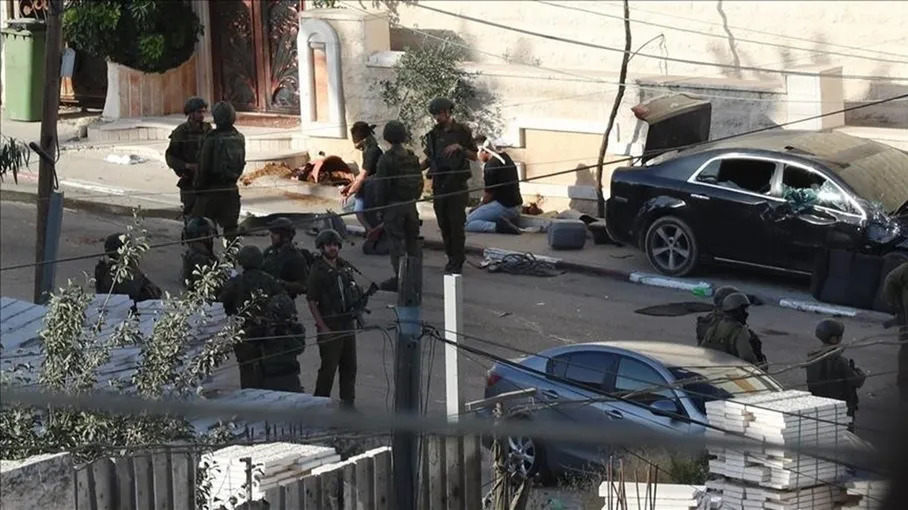







As the occupation becomes increasingly entangled in the Gaza Strip, draining its army through resistance operations, the West Bank does not seem very different for it, in light of the growing warnings from its circles, indicating that the current relative calm there may deceive it. The threat is escalating, fueled by the genocide in Gaza, with the latest evidence being the Jerusalem operation.
This assessment concludes that these developments may pave the way for the collapse of the Palestinian Authority, without the occupation being prepared for this scenario, which may necessitate an immediate reinforcement of its security forces along the contact line.
Shalom Ben Hanan, a former senior official in the Israel Security Agency "Shabak" and a researcher at the Institute for Counter-Terrorism Policy at Reichman University, stated that "the deadly shooting attack yesterday morning in Jerusalem reminds us of the challenges posed by the rising resistance in general, and the challenge faced by Israel in the West Bank in particular, despite the strong security campaign there that began even before the Iron Swords War."
He added in an article published by Channel 12, translated by "Arabi21," that "the relative calm, if we can call it that, is primarily due to the intensive security campaigns launched by the Shabak, the army, and the police, and the intense offensive activity, especially in light of the Palestinian Authority's incapacity. During the past year, 2024, significant armed infrastructures were thwarted in the West Bank, particularly in Hebron, and this was thwarted a few months ago, during which 60 activists were arrested, and dozens of weapons and a large amount of their money were confiscated. The size of this infrastructure and its immediate thwarting indicate the depth of the security threat."
He clarified that "data on thwarted attacks indicate that security forces have thwarted more than 1,000 major attacks since the beginning of the year, a number equivalent to the total number of attacks thwarted in all of 2024. In analyzing the data, more than 550 shooting attacks were thwarted, like the deadly attack carried out yesterday morning, and more than 450 bombing attacks. In cases where the security system failed to prevent execution in advance, 10 settlers were killed, and 3 others in attacks carried out by Palestinians from 1948."
He pointed out that "in 2024, for comparison, 37 settlers and Israeli soldiers were killed in attacks launched from the West Bank, where the security escalation there is based on deep-rooted hatred for Israel, fueled by the inspiration of the war in Gaza. This level of hostility, which is likely the highest in recent years, is met with a Palestinian Authority in a state of stagnation, diminishing its security contribution. This stagnation stems from serious economic problems, a decline in its popularity in the Palestinian street, preparations for succession conflicts after Mahmoud Abbas, and a decline in popular will."
Ben Hanan conveyed warnings from "Israeli sources" that the Authority is in a state of disintegration, which poses a real danger to its survival, and it is highly likely that it will cease to be an important factor in thwarting armed operations against Israel. Despite the focus of occupation forces in Gaza, offensive activity in the West Bank corresponds to the level of threat. In this context, it is worth noting the intense activity in the refugee camps in the north, which has reduced the level of its local brigades.
The writer posed the question of "what can be done to reduce the number of attacks in the West Bank as much as possible, and those that originate from it and succeed in reaching other parts of the State of Israel. Although most security recommendations have been discussed extensively, not enough effort has been made so far, despite the rising level of threat. Among the most urgent steps is first to reinforce some weaknesses to enhance the intelligence and offensive capabilities of the security system by tightly closing the contact area, preventing militants from entering central Israel by sealing these gaps, and developing a strict and effective crossing system."
He emphasized that "the deadly attack that occurred in occupied Jerusalem originated from the Ramallah area, clearly demonstrating the relative ease of infiltrating Jerusalem and other areas throughout the state, which requires the second urgent step, which is to implement a large-scale campaign against all those involved in supporting the phenomenon of infiltrators, including employers, drivers, and escorts, and imposing deterrent penalties. The third step is to secure various infrastructures, such as public transportation and other public gatherings, because during the difficult years of terror in the second intifada, armed security guards were deployed on buses, in shopping centers, restaurants, and elsewhere."
He added that "the fourth step is to expand the campaign against the production of weapons in the West Bank, as the Jerusalem attack was carried out with a locally made Carlo Gustav weapon.



Share your opinion
An Israeli reading of the Jerusalem operation: Is resistance in the West Bank escalating and the authority collapsing?