






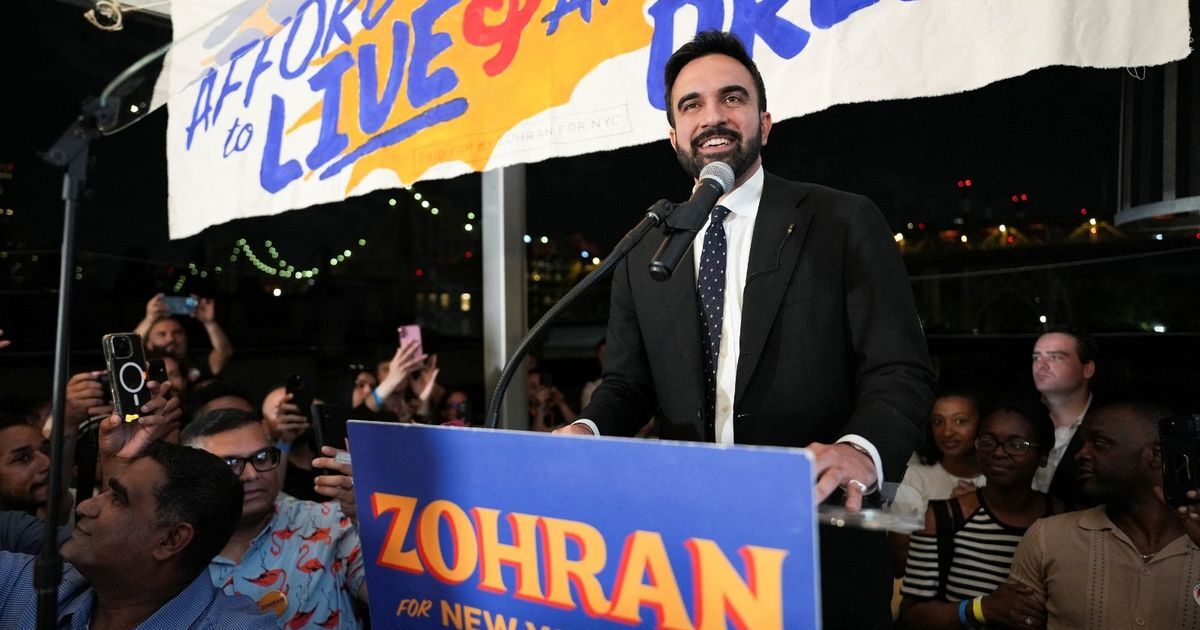
New York State Assembly member Zahran Mamdani is leading by 17 points among Jewish voters in the upcoming New York City mayoral race, according to recently published polls.
The poll conducted by "Zenith Research Company" and the "Public Advance Solutions" Foundation showed that Mamdani's support among Jewish voters surpassed all other candidates, reflecting a complex realignment following his decisive victory over former Governor Andrew Cuomo in the Democratic primary.
New York City is home to the largest Jewish population outside of Israel, and political analysts have long considered this demographic crucial in mayoral races.
Mamdani's support among Jewish voters comes despite repeated accusations from opponents and some community leaders that his criticism of Israel represents anti-Semitism.
His performance indicates a growing acceptance among segments of Jewish voters—particularly younger and less religious voters—of candidates who hold critical views of Israeli policy, which may signal a shift in the priorities of one of the city's most influential voting blocs.
The poll conducted by Zenith Research and Public Advance Solutions included 1,453 New York City residents between July 16 and 24. Among Jewish participants likely to vote in the mayoral election in November, 43% supported Mamdani, compared to 26% for Cuomo, his closest competitor who is now running as an independent after losing in the Democratic primary.
Despite his outspoken criticism of Israel and refusal to disavow phrases associated with Palestinian activism, Mamdani outperformed pro-Israel candidates, including Mayor Eric Adams—who chose to run for re-election as an independent before the Democratic primary—and Republican Curtis Sliwa, among both Jewish and non-Jewish voters.
Mamdani's strong performance follows his victory in the Democratic primary, where he received 56% of the total citywide vote, while Cuomo trailed with 44%. Rabbi Shimon Hecht of the Bnei Yaakov congregation in Brooklyn said last month after the Democratic primary in a statement to Newsweek: "I think, as is the case in every election that stirs up unrest, it serves as a wake-up call for people... I firmly believe that [Mamdani] will not be elected our next mayor, but it will take a lot of unity among Jews and others who care about these issues. We need to unite."
Ayana Leung Kanour, a 35-year-old Jewish waitress in Brooklyn who supported Mamdani, told the same magazine: "The primary elections are New Yorkers, many of whom are Jewish, saying we care about providing affordable prices for the city more than stirring division... Many of us feel deeply offended by the use of our history as a weapon against us... Jews around the world have legitimate concerns for their safety, but Jews in New York are generally safe." Zahran Mamdani stated in a statement following his primary victory: "I am humbled by the support of over 545,000 New Yorkers in last week's primary. This is just the beginning of our expanding coalition to make New York City accessible to all. We will achieve this together."
The general election for the New York City mayoral position is scheduled for November 4, 2025.
Both Cuomo and Adams could influence the final outcome if they continue in the race, while Sliwa (the Republican candidate) hopes for a surprising, albeit slim, victory amid fierce competition.
Jewish New Yorkers support Zahran Mamdani more than any other candidate for mayor, but they strongly disagree among themselves about how his election (as mayor) would affect them, according to a new poll conducted by a pro-Israel nonprofit organization.
Mamdani has the highest percentage of Jewish voters at 37%, while the remainder is divided among his competitors, Mayor Eric Adams (25%), former Governor Andrew Cuomo (21%), and Republican candidate Curtis Sliwa (14%), according to the poll conducted by the New York Solidarity Network and carried out by the GQR firm close to Israel.
The results largely align with a poll conducted by Zenith Research and Public Advance Solutions earlier this week, which showed Cuomo leading Adams, but still indicated a significant lead for Mamdani without a majority of Jewish support.
Among the 800 people surveyed, 74% expressed concern about anti-Semitism. However, they disagreed on the source of this threat—about half said they believe Mamdani is anti-Semitic, while nearly all of his Jewish supporters opposed this view.



Share your opinion
Jewish voters in New York prefer Mamdani over the other candidates for mayor.