OPINIONS

Mon 11 May 2026 6:09 am - Jerusalem Time

Netanyahu’s Familiar Script: Dragging America Deeper Into War While Avoiding Accountability


By: Said Arikat


May 11, 2026


News Analysis


Washington, D.C. — Benjamin Netanyahu’s appearance on 60 Minutes on May 10 was not a serious interview. It was a political infomercial disguised as journalism, built on fear, selective facts, and strategic manipulation. Netanyahu once again demonstrated why he remains one of the most skilled propagandists in modern politics: he speaks with confidence, repeats false claims relentlessly, avoids moral accountability, and relies on compliant interviewers who rarely challenge the foundations of his arguments.


The real scandal, however, was not Netanyahu’s performance. It was the collapse of journalistic scrutiny by Major Garrett, who failed at virtually every crucial moment to confront the Israeli prime minister with the questions defining the Middle East today.


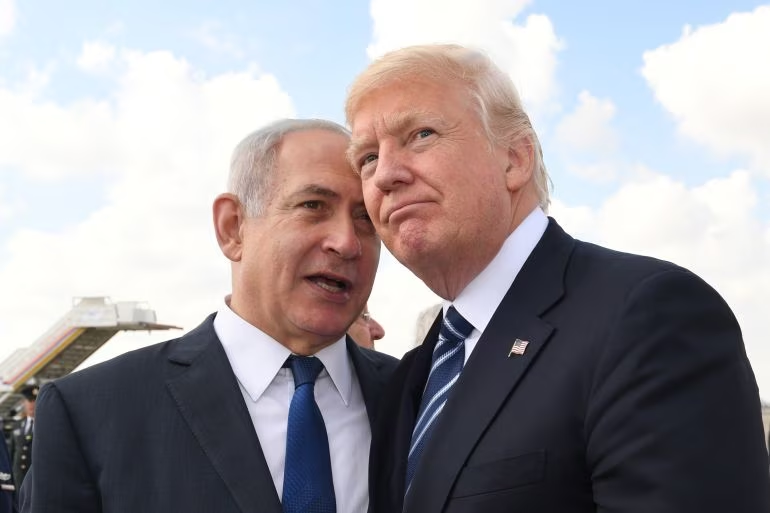
Netanyahu’s objective throughout the interview was unmistakable. He wants the United States permanently tied to Israel’s confrontation with Iran. More specifically, he wants American military power to accomplish what Israel either cannot or will not do alone: “forcefully seize” or neutralize Iran’s enriched uranium wherever it may be. Beneath his carefully crafted warnings about the Iranian nuclear threat was a direct appeal for deeper American intervention, potentially involving American troops and special forces operating inside Iran itself.


This is precisely the trap many Americans fear after decades of catastrophic wars across the Middle East. President Donald Trump has repeatedly signaled discomfort with another endless regional conflict. Netanyahu, by contrast, continues trying to maneuver Washington toward direct military confrontation with Tehran, regardless of the long-term consequences for the United States, the region, or global stability itself.


Netanyahu framed the issue in familiar apocalyptic terms: Iran represents evil; Israel represents civilization. Therefore, every Israeli military escalation automatically becomes America’s moral responsibility. It is the same formula he used before the Iraq war, the same formula deployed during repeated assaults on Gaza, and the same formula now being used to justify broader regional escalation.


Perhaps the most dishonest aspect of Netanyahu’s interview, however, was his repeated implication that Arab governments secretly support Israel’s agenda against Iran and are eager for normalization under Israeli terms. This narrative has become central to Netanyahu’s political mythology. According to him, the Arab world quietly accepts Israeli domination and is merely waiting for the right diplomatic moment to formalize alliances against Tehran.


Reality tells a different story.


Saudi Arabia reportedly refused to allow the United States to use American bases on Saudi soil to enforce a blockade against Iranian ports or support naval operations through the Strait of Hormuz. That decision alone exposed the hollowness of Netanyahu’s claims. Gulf governments may distrust Iran, but they also understand that continued war with Tehran could ignite the entire region, devastate energy infrastructure, cripple shipping routes, and threaten their own survival.


Netanyahu deliberately obscures this reality because it undermines his broader narrative that Israel already enjoys regional legitimacy while Palestinians have become politically irrelevant. Yet even governments pursuing cautious diplomacy with Israel remain deeply aware that Israeli military escalation carries enormous risks for the entire Middle East.


Garrett failed completely to challenge these contradictions. He never pressed Netanyahu on why Arab governments remain unwilling to openly participate in his confrontation with Iran. He never asked why Israel expects Americans to fight wars that many regional actors themselves refuse to join directly.


Even worse was Garrett’s silence regarding Israel’s own nuclear arsenal. Netanyahu spent considerable time discussing Iranian uranium enrichment, yet Garrett never raised the obvious question recognized across much of the world: Israel itself possesses nuclear weapons. Israel also possesses advanced missile systems and its own nuclear infrastructure. Yet American television journalism continues to treat this reality as forbidden territory.


This double standard lies at the center of the regional crisis. Iran’s nuclear capabilities are presented as uniquely intolerable, while Israel’s undeclared arsenal remains politically untouchable. The message is unmistakable: one state may possess overwhelming strategic weapons without scrutiny, while another becomes the target of sanctions, isolation, sabotage, and war.


The interview’s moral emptiness became even more glaring when the Palestinian issue surfaced only marginally. Garrett never seriously confronted Netanyahu over the destruction of Gaza, the ongoing occupation of the West Bank, settlement expansion, or whether Palestinians possess any legitimate right to freedom and statehood. Instead, Netanyahu was allowed to recycle the increasingly absurd claim that Israel’s collapsing international image is merely the result of misinformation and propaganda.


The world is not reacting to misinformation. It is reacting to destroyed neighborhoods, starving civilians, and images of devastation broadcast daily across global media.


No amount of polished rhetoric can erase that reality.


The interview also reinforced growing criticism that CBS has undergone a profound editorial transformation following the growing influence of Larry Ellison and David Ellison, alongside the prominent role of (CBS News boss) Bari Weiss as a leading force in shaping the network’s news direction. Critics argue that the result has been a visibly more ideological and aggressively pro-Israel editorial culture, one in which critical scrutiny of Israeli state violence increasingly gives way to narrative management and political deference.


In the end, Netanyahu once again succeeded in turning American television into a platform for fear-driven militarism and political mythmaking. Garrett, meanwhile, failed in the most basic obligation of journalism: challenging power rather than amplifying it. The result was not an interview. It was a warning about how deeply sections of the American media establishment have surrendered their critical independence whenever Israeli power is involved.


The broader danger extends far beyond a single television appearance. Netanyahu’s political survival increasingly depends on permanent conflict, perpetual emergency, and the constant expansion of external threats. War delays accountability inside Israel, suppresses international pressure over the occupation, and keeps Washington emotionally and militarily invested in Israeli priorities. That is why every crisis eventually becomes existential in Netanyahu’s rhetoric. Lebanon, Gaza, Syria, Iran, and even global student protests are folded into a single narrative of civilizational struggle.


The objective is clear: to ensure that American policymakers, journalists, and voters view Israeli military escalation not as a political choice, but as an unavoidable historical necessity — forever.

ISRAELI AFFAIRS

Sun 10 May 2026 1:58 pm - Jerusalem Time

Financial Empires and a System of Slavery.. Economist Reveals the Inner Workings of the Haredi 'Parallel State'

Israeli lawyer and economist, Naomi Abraham, painted a grim picture of the internal structure of the ultra-Orthodox Haredi community, asserting that what appears publicly is merely an outer shell concealing a tightly controlled economic and social system of influence. Abraham, who grew up in this environment before leaving it, explained that the religious establishment has created a system characterized by cruelty and discrimination, primarily aimed at keeping vulnerable groups, especially Eastern women, in a state of perpetual dependence on the elite.

Sources indicated that the liberal and secular currents in Israel are unaware of what truly goes on behind the walls of this system, as Haredi leaders are not as concerned with theology as they are with controlling real estate and financial institutions. Abraham considered that the key to understanding this society lies in 'reading the balance sheets' rather than in the declared religious discourse, emphasizing the existence of parallel economic influence networks to official state institutions.

The expert reviewed her personal experience in the 'Beis Yaakov' schools in Jerusalem, where girls are denied the opportunity to take matriculation exams to ensure they do not reach university education. She described this policy as a deliberate tool to crush professional aspirations and keep women at the lowest rung of the social ladder, making their exit from the system almost impossible due to a lack of educational and linguistic tools.

Abraham spoke about her experience working within the Ministries of Finance and Justice, where she discovered the stark contradiction in the behavior of religious leaders who impose strict restrictions on women in their community, while dealing with complete flexibility with non-Haredi women to achieve economic interests. She believed that the essence of the system is not 'holiness' as promoted, but rather a mechanism for social control and the perpetuation of power relations and financial dependence.

She described the Haredi structure as a 'parallel state' that possesses its own education, housing, media, and judicial sectors, away from the oversight of the Israeli state. She gave the example of the influential 'Karlitz' family, whose influence extends to areas comparable in importance to the Supreme Court, the Ministry of Education, and major real estate companies, creating a frightening authoritarian centralization within the extremist community.

Regarding the financial aspect, Abraham revealed that some religious institutions have transformed into massive investment empires, such as the 'Mir Yeshiva' school in Jerusalem, which is managed as a company worth billions of shekels. This institution owns extensive real estate assets and residential complexes in the heart of the city, and benefits from enormous tax exemptions and financial concentration that serves a single family that has managed it for over a century.

Analyses confirmed that social mobility within this community is almost non-existent, as the ruling elite is keen to confine power and wealth within a closed circle through family intermarriage. Abraham was shocked to find that most members of the 'Council of Torah Sages' are directly related, which reinforces an 'oligarchic' structure that perpetuates corruption and monopoly under the guise of religion.

Abraham held the secular political elite responsible for the continuation of this reality, considering that they chose to coexist with this 'parallel state' in exchange for ensuring political loyalty and government coalitions. She pointed out that parties like 'Shas' and 'Degel HaTorah' blackmail Israeli governments to impose their conditions, exploiting the need of coalitions for their votes in the Knesset to pass huge budgets that serve their private interests.

The expert criticized the normalization of Israeli society with conditions of poverty and dependence within the Haredi community under the guise of 'cultural specificity'. She considered that this environment forces thousands to live in forced isolation, where an individual finds themselves unable to integrate into general society if they decide to leave, due to their lack of basic professional and linguistic skills that they were deprived of in their youth.

Abraham touched upon the systematic ethnic discrimination against 'Mizrahi' (Eastern) Jews in elite schools, where girls are denied admission based on their ethnic origins. She recounted how she was personally humiliated in her childhood due to these practices, emphasizing that the state was aware of these violations but preferred silence to maintain its political alliances with Haredi leaders.

She described what is happening as a kind of 'internal colonialism', where Haredi community leaders ally with secular political elites to maintain the status quo. While religious leaders guarantee a stable voting bloc for the political system, they receive in return complete freedom to manage their closed society away from any modern democratic or human rights standards.

In conclusion of her vision, Abraham pointed to the manifestations of extreme wealth enjoyed by Haredi leaders who travel around the world and live luxurious lives, while their followers are mired in debt and abject poverty. She concluded that these leaders do not represent the rights of their public, but rather their economic and authoritarian interests, turning the general Haredi population into victims of a closed system that feeds on their poverty and ignorance.

Understanding the Haredim is not through religious discourse, but through reading balance sheets and monitoring control over real estate and land.

OPINIONS

Sun 10 May 2026 10:40 am - Jerusalem Time

When Elections Become a Burden in Times of Political Incapacity

In the narrow alleys of Palestinian cities, and on the sidewalks of cafes bustling with heavy conversations, citizens do not seem overly concerned with who will win in this or that organizational region, nor with who will occupy the highest seat within the frameworks of the Fatah movement.

People here have enough daily worries: a delayed salary, a sudden checkpoint, soaring prices that devour what little remains of their ability to endure, and a political horizon that appears more nebulous than ever before.

Yet, with every internal election season, the temperature of political discourse rises to a degree that almost becomes detached from the true pulse of the street. Suddenly, councils are filled with names, alliances, and leaks, and social media turns into arenas of alignment, betrayal, and settling old scores, while the ordinary citizen stands wondering: What will change in his life after all this noise?

In a Palestinian moment burdened by moral defeat and political deadlock, the scene of fierce competition for leadership positions seems closer to a shocking paradox. What drives this number of aspirants to jostle for leadership seats that, practically, lack the ability to change the scene or reshape reality? And what real authority can be spoken of in a Palestinian situation that stagnates between crises, divisions, and subservience to regional and international circumstances?

The paradox is that the Palestinian, who has lived through long years of division and postponed promises, no longer views elections as a celebratory event as much as a new test of the political class's ability to understand the deep transformations in public sentiment. New generations, specifically, are no longer captivated by traditional language or grand slogans, but rather seek a political model that is less noisy and more capable of producing real solutions.

Within the Fatah movement itself, the importance of any renewal or internal reorganization process cannot be denied. Political movements that stop reviewing themselves gradually enter a cycle of stagnation. But the problem begins when organizational competition turns into an open power struggle that directly reflects on the Palestinian street, creating a state of tension and polarization that extends beyond the organization to the entire society.

Palestine today is not in a position of political action as much as it is in a position of reactions. And even the reactions themselves have receded to their lowest limits: condemnation statements, angry declarations, exchange of accusations and blame, without a real ability to impose new equations or change the imposed realities on the ground.

Amidst this scene, the question becomes legitimate: Why all this electoral fever?

What exactly is everyone competing for?

Is the competition for an authority with inherently limited powers? Or for organizational positions that have lost a large part of their popular influence? Or is it a power struggle within a political structure that fears a vacuum more than it possesses a clear vision for the future?

People do not reject politics, but they are tired of politics that revolves only around itself. There is a big difference between elections that produce a clear national project, and elections that turn into a show of force within organizational frameworks. In the Palestinian case, where national, economic, and living crises accumulate, any excessive preoccupation with internal conflicts resembles a negative message telling the citizen that his priorities are not at the top of the agenda.

The painful truth is that the Palestinian citizen, observing this scene from afar, no longer expects much. The gap between political discourse and daily reality has widened unprecedentedly. People seek protection for their livelihood and national dignity, while political elites seem engrossed in their internal calculations, as if fighting battles in a world separate from public sentiment.

No one denies the importance of institutions, organizational frameworks, or internal rotation of leadership positions, but the value of any elections is measured by their ability to produce action, not merely by changing names or redistributing influence. However, when the political horizon is absent, tools of influence erode, and leadership itself turns into crisis management instead of solution-making, then competition loses a large part of its national meaning.

Perhaps the greatest danger lies in this atmosphere widening the gap between the street and traditional political forces. The more the bickering increases, the more people feel alienated from the public scene, and the more convinced they become that Palestinian politics sometimes lives within its own world, far from the harsh details of daily life.

Today, the Palestinian does not need more political noise as much as he needs a discourse that restores some trust. A discourse that balances the right of organizations to internal renewal with the right of people to stability, clarity, and respect for their daily suffering.

For the Palestinian street, already burdened by all this fatigue, can no longer endure long seasons of open political tension. And unless political forces realize this, the gap between them and the people will continue to widen silently, but it is a silence that carries within it much anger and postponed questions.

In such a time, the problem is not in the multitude of competitors for leadership, but in the absence of the harder question: Leadership to where?"

OPINIONS

Sun 10 May 2026 10:28 am - Jerusalem Time

Abraham Accords: How the Illusions of Normalization Led to the Engineering of New Middle East Wars

Washington's Message

Said Arikat – 10/5/2026

News Analysis

The Abraham Accords, signed at the White House on September 15, 2020, under the patronage of US President Donald Trump (in his first term), marked a major turning point in the structure of regional alliances in the Middle East, after being marketed as a "gateway to peace" between Israel and the Arab world. However, an analytical article published by Matt Duss and Zuri Linetsky in Foreign Policy magazine last Thursday presented a completely opposite picture, arguing that the agreements did not establish lasting peace, but rather contributed to producing a more violent and turbulent phase in the region, and provided political and military cover for expanding Israeli wars against Palestinians and Iran.

The authors believe that the Trump administration, and later the Biden administration, treated the agreements as a strategic achievement capable of bypassing the Palestinian issue by building a security and economic alliance between Israel and the Gulf states. However, what actually happened, according to the article, was a shift in the center of gravity from "peace for political solution" to "peace for military alliance," a transformation that deepened regional polarization instead of alleviating it.

The Abraham Accords were not merely a diplomatic normalization process between Israel and some Arab countries, but a complete redefinition of the region's priorities according to a shared American-Israeli vision. The Palestinian issue was treated as a burden that could be bypassed through security and economic alliances, rather than as the core of the conflict in the Middle East. This shift opened the door for Israel to expand its settlement and military policies without fear of genuine Arab isolation. It also reinforced the belief within the Israeli establishment that normalization with Arab regimes was more important than any settlement with the Palestinians, which later led to a wider explosion of violence and instability throughout the region.

The article indicates that the agreements were linked from the outset to a clear strategic goal of building a regional axis against Iran, which was later embodied in the laws passed by the US Congress to enhance defense cooperation between Israel and the Gulf states, especially in the areas of air and missile defense. The transfer of Israel to the US Central Command's area of responsibility also facilitated military and intelligence coordination with the UAE, Bahrain, and other countries.

According to the authors, this new military structure was not limited to defense, but also contributed to making long-range Israeli military operations easier, whether through Gulf airspace or through monitoring systems and security cooperation. Israeli arms exports to the signatory countries of the agreements also increased unprecedentedly, transforming the new relations into an integrated military partnership that goes beyond the traditional diplomatic nature.

Experience reveals that military alliances built on ignoring the roots of conflict do not produce long-term stability, but rather lay the groundwork for larger explosions later. Instead of using normalization to pressure Israel to end the occupation, the new relations turned into a political and military protection network for it. This reality encouraged successive Israeli governments to escalate their policies in the West Bank and Gaza, because they felt that their Arab relations were no longer tied to any political cost towards the Palestinians. With the absence of international accountability, Israeli military power became an open tool for redrawing regional balances by force, rather than through political and diplomatic settlements.

The article emphasizes that Palestinians were the biggest losers from the Abraham Accords, as their issue was marginalized in favor of regional security priorities. Despite promises that normalization would later lead to improved conditions for Palestinians, the West Bank witnessed a significant escalation in settler attacks, expansion, and settlement violence after the agreements were signed. Gulf aid to UNRWA also declined, a clear indication of the diminishing centrality of the Palestinian issue in official Arab calculations.

The authors point out that Hamas viewed the normalization path as a direct strategic threat to the Palestinian cause, which explains, according to Israeli documents cited in the article, one of the motives for the October 7, 2023 attack, which sought to disrupt the normalization process and prevent Saudi Arabia from joining it before any political progress for Palestinians was achieved.

With the outbreak of the war of annihilation in Gaza, and then the expansion of the confrontation between Israel and Iran, the results of the new alliances became clearer. The Gulf states that forged advanced security relations with Israel participated, to varying degrees, in information exchange and aerial monitoring during missile confrontations with Iran, while Washington continued to strengthen the joint military structure established after the Abraham Accords.

The fundamental paradox is that the agreements, presented as a peace project, gradually transformed into a platform for managing wars. Instead of reducing tension, Israel was integrated into a regional security system that gave it a sense of permanent strategic superiority, and supported the tendency for military decisive action within the Israeli political establishment. In contrast, Iran and its axis of allies felt that they were facing an alliance that targeted their existence, pushing the region into a continuous escalation race. Thus, the region became less stable and more militarized, while the Palestinian issue, which is supposed to be the core of the conflict, remained without any real solution or viable political horizon.

The Abraham Accords did not achieve a "new Middle East" as Trump promised, but rather contributed to producing a more dangerous reality, based on military alliances, arms deals, and the marginalization of Palestinian rights. According to the article, ignoring the roots of the real conflict made the agreements incapable of achieving peace, because lasting stability cannot be based on force alone, but on addressing the Palestinian issue as the primary entry point for any sustainable regional settlement.

The accumulated facts since the signing of the Abraham Accords reveal that one of their goals was to redefine the Palestinian issue as a humanitarian and administrative matter, not a matter of national liberation and ending occupation. Maps, economic projects, and trade corridors were promoted as alternatives to Palestinian political rights, in an attempt to divert attention from settlement and the gradual annexation of occupied territories. At the same time, Israel continued to entrench the reality of isolated and besieged Palestinian enclaves in the West Bank and Gaza, preventing the establishment of a geographically contiguous and viable Palestinian state. Thus, normalization practically transformed into a tool to grant the occupation long-term regional legitimacy and liquidate the essence of the Palestinian issue politically and historically.

ISRAELI AFFAIRS

Sun 10 May 2026 10:27 am - Jerusalem Time

Former Knesset Speaker: Israel Drowning in a Quagmire of Failure, Solution in 'Strategy of Loss'

Former Israeli Knesset Speaker, Avraham Burg, launched a scathing attack on current military and political policies, asserting that Israel is living a reality far more difficult than portrayed. Burg explained that the wars the state has fought since 1967 have proven that winning isolated battles does not necessarily mean winning the entire war, which is evident today in the abysmal failure on the Gaza, Lebanon, and Iran fronts.

Burg considered every battlefield to have turned into a quagmire that drains human and material resources, claiming lives without achieving tangible results. He pointed out that the gap between the promises of the political leadership and the daily reality of Israelis has become a deep chasm threatening a comprehensive collapse, describing the slogan of 'absolute victory' as a farce that leaves behind nothing but graves and the wreckage of life.

Regarding the northern front, the former official noted that promises to defeat Hezbollah were nothing but hell for the residents of the north who have become exiles from their homes. He affirmed that these residents demand the minimum security to return to their homes, but they face a complex military reality that offers them nothing but hollow promises and a long wait.

Burg described the confrontation with Iran as 'the great deception' that has begun to explode in the face of Israeli society, warning that continuing this approach represents real suicide. He explained that the effects of the war with Tehran are not limited to mutual bombardment but extend to impacting the global economy and energy prices, weakening the position of international partners that Israel needs.

The article touched upon the American position, indicating that the Washington administration finds itself facing unplanned dilemmas related to reconstruction costs and who will assume security responsibility after the war. Burg warned that the growing resentment within Congress and the American public towards Israel is not just transient noise, but a political force crystallizing to threaten Israel's remaining political capital.

The former Knesset Speaker proposed a controversial concept of 'investing in loss' as an alternative national strategy to clinging to blind force. He likened the current situation to 'sumo' wrestlers stuck, where one calculated step backward can unbalance the opponent and lead to a real and sustainable victory away from direct bloody confrontation.

Burg invoked historical examples to support his vision, noting that the United States won battles in Vietnam but lost the war, while Menachem Begin knew how to concede Sinai to achieve strategic peace. He considered Begin's step, despite being described as surrender at the time, to be the most important in Israel's history, while the current leadership lacks the flexibility to protect the state from falling.

Burg described the current leadership as 'hollow,' directing sharp criticism at Finance Minister Bezalel Smotrich and National Security Minister Itamar Ben-Gvir, describing the former as ignorant and the latter as a reckless boy. Prime Minister Benjamin Netanyahu also received his share of the attack, with Burg describing him as weak and detached from reality, accusing him of focusing on political showmanship and seeking attention.

The author believes that a real alternative to the ongoing confrontation with Iran requires a new agreement that recognizes regional reality, emphasizing that Iran and its ideological power will not disappear. He called for the necessity of developing direct and indirect diplomatic channels to deal with Tehran, just as major historical nations that experienced bloody conflicts, such as France and Germany, did.

Burg stressed the need to distinguish between the nuclear threat, which requires non-military treatment, and the illusions of 'regime change' that bombs have never succeeded in achieving. He affirmed that the Middle East in the coming years will be forced to accommodate everyone, and that Israel, capable of managing complex relations, is the only one with a future in the region.

The article explained that 'calculated loss' is not surrender, but rather the leadership's ability to discern the moment when continuing the war becomes detrimental to the supreme national interest. He considered that timely concession might be worth more than a blood-stained victory, an alternative strategy that successive Israeli governments have not dared to try.

Burg warned that the real enemy is not in Gaza or Beirut, but in the closed rooms where leaders make decisions to expand wars to save themselves from the failure of their previous administration. He pointed out that 'narcissistic' leaders refuse to admit that continued confrontation is in itself the greatest loss that closes the doors of the future to coming generations.

The author affirmed that every additional day of fighting closes a new opportunity for rapprochement and reconciliation, while those inciting war in government corridors pay no price from their lives or stability. He called for the necessity of taking a step back to allow the warring forces to lose their balance, considering Netanyahu's departure as the necessary first step in this path.

In conclusion of his analysis, Burg called on Israeli society to realize that the victory promoted by the government comes at a price that increases daily without a real horizon for an end. He concluded that recognizing reality and seeking diplomatic paths is the only way to avoid a fatal collision with the deep abyss of identity on whose edge Israel now stands.

Sometimes the only way to win is to know how to lose, and Israel today has not won on any front between Gaza and Tehran.

PALESTINE

Sun 10 May 2026 10:27 am - Jerusalem Time

ElBaradei attacks 'illusory international community' and warns of plans to liquidate the Palestinian cause

The former Director-General of the International Atomic Energy Agency and former Egyptian presidential candidate, Mohamed ElBaradei, launched a scathing attack on the international system, describing it as an 'illusory international community'. ElBaradei expressed his shock at the absence of a resounding reaction to the humanitarian tragedy and the genocide faced by the Palestinian people, emphasizing that what is happening is occurring before the eyes of the entire world without real action.

In a post on the 'X' platform, ElBaradei expressed deep disappointment at the state of silence and stagnation dominating the scene, considering that the inability to stop this suffering indicates the death of a part of the inner human conscience. These statements came in the context of his commentary on the successive developments in the Gaza Strip and the West Bank, which he sees as exceeding the limits of human endurance.

ElBaradei warned that the Israeli occupation authorities are exploiting the current circumstances to implement a comprehensive plan aimed at definitively liquidating the Palestinian cause. He pointed out that this move comes amidst the global powers' preoccupation with other issues, foremost among them what he described as the aggressive and illegitimate war targeting Iran, which provides cover for the continuation of violations in the occupied territories.

The prominent Egyptian politician also noted that the situation in the Gaza Strip is becoming more tragic day by day, while the situation in the occupied West Bank is no less serious. He explained that the West Bank is witnessing an unprecedented acceleration in the pace of settlement expansion, in addition to the escalation of forced displacement policies aimed at emptying the land of its original inhabitants and changing the demographic reality.

ElBaradei strongly criticized the mere issuance of daily condemnation and denunciation statements by countries and international organizations, considering them merely tools to throw dust in people's eyes. He stressed that these entities lack the necessary credibility to translate their words into actions, emphasizing that the absence of deterrent practical measures encourages the continuation of crimes against Palestinians.

ElBaradei concluded his vision by affirming that relying on the international community in its current form has become a losing bet in the absence of genuine political will. He called for a review of Arab and international positions regarding what is happening, warning that history will not forgive those who fail to support the rightful owners in the face of the relentless war and settlement machine.

It seems that a part within us has died; the international community is illusory, content with condemnation statements without the courage to take practical measures.

ARAB AND WORLD

Sun 10 May 2026 10:27 am - Jerusalem Time

Trump hints at 'Freedom Plus' project against Iran: Potential military escalation in Gulf waters

US President Donald Trump has returned to a language of threats and warnings against Tehran, hinting at the launch of a new military project named 'Freedom Plus'. This move comes in the context of pressuring the Iranian side if no tangible progress is made in the ongoing negotiations between the two parties.

Despite the absence of precise details about the new plan's provisions, leaks from the White House indicate that a failure of diplomacy will push Washington towards more stringent options. This step is considered a return to the policy of direct confrontation that characterized previous periods of tension in the region.

To understand the dimensions of 'Freedom Plus', one must consider the first version of the 'Freedom' project, which the US military previously launched to secure navigation in the Gulf. At that time, Washington affirmed that the goal was to protect commercial vessels, while Tehran viewed it as a military deployment targeting its sovereignty in the Strait of Hormuz.

The previous project included the participation of destroyers equipped with guided missiles, in addition to more than 100 aircraft and unmanned missile platforms. Approximately 15,000 US troops were also deployed to ensure the escort of stranded commercial vessels and secure their passage under the threat of military force.

Sources reported that the new 'Freedom Plus' plan might go beyond mere naval escort to include a strict naval blockade on Iranian ports. This measure aims to completely paralyze Iranian commercial traffic to impose Washington's conditions at the negotiating table.

Security experts believe that Trump is awaiting Iran's final response before deciding on a comprehensive escalation in the Gulf waters. If Tehran rejects the proposed American formula, the region could witness an unprecedented expansion of direct US military presence.

The next phase is expected to include a significant increase in the number of deployed US naval assets, with continuous and direct air cover. Observers also do not rule out pre-emptive strikes against Iranian targets if Washington perceives an imminent threat to its interests.

In contrast, estimates suggest that Iran will not stand idly by in the face of these moves, which could lead to reciprocal military reactions. This potential escalation would derail negotiations and put the region on the brink of an open confrontation.

The major challenges for the American plan lie in the difficulty of securing oil tankers in a highly hostile maritime environment. With rising insurance costs and risks facing naval crews, the success of 'Freedom Plus' depends on complex on-the-ground understandings.

Trump's current strategy relies on the principle of 'maximum pressure' to extract fundamental concessions from the Iranian leadership in record time. The White House believes that any easing of restrictions at this time could give Tehran an opportunity to maneuver and gain more time.

Domestically, Trump faces a cautious American public opinion regarding any new military involvement in the Middle East. Despite the absence of widespread protests so far, concern about the human and material costs of wars remains present in political calculations.

Ultimately, it appears that the US President is betting on managing this crisis as a foreign policy issue that serves his election campaign. Trump seeks to achieve a diplomatic or limited military victory that ensures his superiority before the American voter ahead of the ballot.

Trump awaits Iran's response, and if it does not come in the form Washington desires, the project may involve a clear expansion of military deployment within the Gulf.

PALESTINE

Sun 10 May 2026 10:27 am - Jerusalem Time

Dramatic Shift in Europe: Towards Imposing Tariffs on Settlement Products and Sanctions Against Ben Gvir and Smotrich

The Israeli occupation faces a critical diplomatic dilemma on the European continent, as European Union foreign ministers will meet next Monday in Brussels to discuss a series of strict decisions. These moves come amidst a changing European political landscape, especially after the loss of strategic ally Viktor Orbán in Hungary, which opened the door for opponents of Israeli policies to pass previously stalled sanctions.

France and Sweden are leading a movement within the Union to demand the imposition of comprehensive customs duties on all products originating from Israeli settlements. According to diplomatic sources, these tariffs will not be limited to West Bank settlements but will also include the occupied Golan Heights and East Jerusalem, which means raising the prices of these goods by 20% to 30% in European markets.

Reports indicate that the escalating European anger stems from several issues, most notably the rise in settler violence in the occupied territories and unprecedented settlement expansion. European diplomats also believe that recent Israeli trends, such as hinting at the application of the death penalty and withdrawing from international agreements, represent a dangerous departure from the core values of the partnership agreement with the European Union.

These economic sanctions are expected to affect vital sectors in the settlements, including date exports, Golan wine, and personal care products extracted from the Dead Sea. The European Union views this step not as direct punishment, but as a legal correction that deprives settlements of customs exemption privileges granted only to products manufactured within the 1967 borders.

On the political front, European ministers are considering imposing personal sanctions on the extremist ministers Itamar Ben Gvir and Bezalel Smotrich, a step that requires full consensus. With the absence of an automatic Hungarian veto, Israeli circles are anxiously awaiting Budapest's new stance, as Prime Minister-elect Péter Magyar seeks to improve his relations with Brussels in exchange for the release of billions of euros in funding.

In a notable development, Israel appears to have lost the support of Italy, which was considered a strong ally, following repeated attacks by Jewish extremists on churches and monks in Jerusalem. These incidents, in addition to the desecration of Christian landmarks in southern Lebanon, have caused widespread indignation in Rome, making the Italian position more inclined to support European punitive measures.

Attention is now turning to Germany, described as the 'last stronghold' that could prevent or mitigate the severity of these decisions. Israeli Foreign Minister Gideon Sa'ar made an urgent visit to Berlin in an attempt to persuade German officials to object to the imposition of customs duties, or at least to settle for limited sanctions against individuals instead of comprehensive economic measures.

Countries such as Spain, Ireland, and Slovenia plan to exploit the new political climate to exert more pressure on Tel Aviv in international forums. Sources confirm that the coming days will be 'difficult' for Israeli diplomacy, as it is no longer possible to rely on European division to obstruct decisions that affect the core of the settlement project in the Palestinian territories.

The current political situation in Europe makes the likelihood of approving customs duties on settlement products very high, which represents a severe blow to the settlement economy.

PALESTINE

Sun 10 May 2026 10:26 am - Jerusalem Time

Israel Deports 'Freedom Flotilla' Activists After Forced Detention and Human Rights Violations

The Israeli Ministry of Foreign Affairs announced today, Sunday, the deportation of Spanish activist Saif Abu Kishk and his Brazilian colleague Thiago Avila, after a period of detention and investigation due to their participation in the 'Freedom Flotilla'. This decision came after the Israeli Navy intercepted boats participating in an attempt to break the siege on the Gaza Strip in international waters off the Greek coast at the end of last April.

Israeli authorities claimed in an official statement that Abu Kishk was suspected of belonging to a terrorist organization, while Avila was accused of engaging in illegal activities, accusations both activists denied outright. Official sources confirmed that Israel would not tolerate any attempts to breach the naval blockade imposed on the Strip, noting that the deportation process was carried out without disclosing the activists' final destination.

For his part, Youssef Ajissa, head of the International Committee for Breaking the Siege, revealed shocking details regarding the detention conditions of the flotilla participants, confirming that they were subjected to brutal and systematic violations. Ajissa explained that the violations included physical and sexual violence, in addition to handcuffing and blindfolding, and severe beatings on sensitive areas of the body, which constitutes a blatant violation of international laws.

Activist Saif Abu Kishk had begun a dry hunger strike since May 5th, coinciding with a hunger strike he undertook with Avila in protest of their illegal detention conditions. The suffering of Brazilian activist Thiago Avila intensified during his detention, as he received news of his mother's death while behind Israeli bars, which increased the psychological pressure exerted on him.

In the context of international reactions, the Spanish Foreign Minister affirmed that Madrid had not received any concrete evidence from the Israeli side supporting the accusations against its citizen, describing the detention as unjustified. Both the Spanish and Brazilian governments also considered the interception of ships in international waters and the forced transfer of passengers to Israeli interrogation centers to be a violation of sovereignty and international maritime law.

On the ground, the 'Freedom Flotilla' administration announced the arrival of its ships at Marmaris port in Turkey, after Israeli forces intercepted a number of boats at one of the furthest geographical confrontation points. The positioning in Turkey aims to complete the necessary technical and logistical arrangements to ensure the continuity of the humanitarian mission, which began with the participation of hundreds of solidarity activists from various countries around the world.

The current version of the flotilla includes more than 50 ships carrying 345 participants representing 39 countries, in the largest international gathering to break the siege in years. During the recent operation, the Israeli army detained approximately 21 boats and arrested nearly 175 activists, most of whom were later released and returned to Greece, with the exception of Abu Kishk and Avila, who remained in detention until today.

It is expected that the flotilla leadership will announce the action plan for the next phase in the coming days, amid the organizers' insistence on continuing efforts to deliver humanitarian aid to Gaza. These developments come amidst the ongoing devastating war and the strict restrictions imposed by the occupation on the entry of relief, which has prompted international activists to organize these naval convoys to highlight the suffering of the Strip's residents.

Israeli authorities will not allow any breach of the blockade imposed on the Gaza Strip, and the activists were deported after investigations into illegal activities.

OPINIONS

Sun 10 May 2026 10:25 am - Jerusalem Time

Between Gaza and Frankfurt!

Dr. Ibrahim Melhem

Editor-in-Chief

The least that can be said is that if the distance between Gaza and Frankfurt is far in terms of kilometers, it is close in terms of the number of victims among the population and the destruction of homes that befell the city at the hands of the Allies during World War II, as close as Frankfurt is to its river, and as close as Gaza is to its sea and to the tents of the displaced in its streets.Inside the only church that survived the war, a picture was hung showing the extent of what befell the city, while the church, with its towering columns and beautiful architecture, stood like a mountain amidst the rubble of burnt houses, so much so that the viewer might think the picture came from Gaza.Germany's first capital rose from its slump, left its pains behind, regained its health, and much water flowed in its river.The city seemed reconciled with itself and with the immigrants who constitute 65 percent of its population, and it includes the largest institutions concerned with development and reconstruction in developing countries."KfW" is one of those official state institutions, headed by the Minister of Finance, and from it branch executive arms in partnerships with international institutions, extending a helping hand with grants and soft loans to developing countries; Palestine is one of the countries that receives grants, not loans, but the kind director shyly said: only one loan remained pending, which was given to the Authority in the 1990s. I said to myself: "God will compensate you."In the meeting room, the director apologized for not offering hospitality other than water, due to the austerity policy adopted by the institution, and asked if we knew the institution before, but she quickly burst into laughter when I told her: Of course, we know "KfW", but we did not know that you are so poor that you have nothing to offer but water.In some neighborhoods of the city, you see shop names written in Arabic, and in a wide square in the middle of the city, crowded with vendors and shoppers, a statue symbolizing the goddess of justice stands between the church and the municipality building, holding a sword in one hand and scales in the other, with her eyes directed towards the municipality building, in a sign of constant oversight of its performance and correcting its deviations with the scales of justice and the sword of truth... I believe that elected municipal councils need to replicate the experience, if not with the statue, then with the ideals that prevent corruption before it occurs.

OPINIONS

Sun 10 May 2026 10:25 am - Jerusalem Time

78 Years of the Nakba… “Fatah”: From Memory to Impact

The Nakba is no longer a historical event recalled in memory every year; rather, it has become an ongoing reality. What we witnessed in Gaza, a genocide, was nothing but a harsh reminder that the Nakba has not ended, but is renewed within a colonial structure that seeks to reshape geography and demography, and impose realities that transcend international law and empty concepts of justice of their content. What is happening today—accelerated settlement, forced displacement, arrests, and field executions—cannot be separated from an extended historical context; rather, it is a continuation of the same colonial project that began decades ago, and is being reproduced with more complex tools.In this context, the challenge is no longer in preserving memory, but in transforming it into a real tool for impact. Palestinians have largely succeeded in entrenching the Nakba's presence in their national consciousness, but the most important question today is whether this presence has translated into a political force capable of influencing and changing realities on the ground.Here arises the need for fundamental transformations. The first is the transition from narrative to legal framework, by framing the Nakba within concepts of international law, including genocide, forced displacement, and the right to self-determination, not as theoretical concepts, but as tools for legal and political accountability. The second is the transition from internal discourse to global diplomacy, by translating the Palestinian narrative into a language the world understands—the language of museums, theaters, artists, academics, institutions, law, and policies—making it part of international discussion, not just an expression of national sentiment. The third transformation is the transition from documentation to political action, by linking produced knowledge with clear mechanisms for accountability, and building international alliances capable of transforming the narrative into effective political pressure.Transforming the Nakba into a tool for impact requires redefining actors and their roles. Universities are no longer just educational institutions, but centers for knowledge and policy production, capable of influencing international discourse. Research institutions also play a pivotal role in documenting, analyzing, and developing the narrative. Culture and museums, from the Palestinian Museum to the Yasser Arafat Museum, remain essential incubators for national memory and its re-presentation to generations and to the world. In contrast, diplomacy and official visits are tools for reintroducing the Palestinian issue into the international decision-making agenda, while youth represent a digital force capable of breaking the monopoly of the narrative, and women emerge as central actors in reshaping political discourse. As for technology, it has transformed from a supporting tool into a strategic means to expand influence and internationalize the Palestinian narrative.In light of these transformations, the Eighth Conference of the Fatah movement comes at a pivotal moment that transcends the organizational framework, despite its extreme importance, to raise the question of its role in an unprecedented phase in terms of the magnitude of challenges. Since its inception, the movement has been a model of strategic flexibility, transitioning from a national liberation movement to a political actor, from armed struggle to negotiated action, then to internationalization, reaching what can be described today as a "tsunami of recognition" that reflects shifts in international sentiment, despite the gap between legal recognition and the reality imposed on the ground. This flexibility was not a retreat, but an expression of the movement's ability to adapt to a changing international environment without abandoning national constants. UNRWA's mandate is not reduced to its humanitarian dimension; rather, it represents continuous international recognition of political responsibility for the refugee issue. The right of return is not a negotiable demand, but a legal and historical right that does not lapse with time. While the right to self-determination remains the core of the issue, prisoners and Al-Aqsa are the daily expression of the continued structure of occupation.The challenge today is not in choosing a single tool of struggle, but in managing a strategic mix capable of confronting an integrated colonial project, combining political and diplomatic action, strengthening the Palestinian narrative, activating international accountability tools, and linking legal achievements with political reality on the ground.Ultimately, the Nakba is no longer just what happened in the past, but what is imposed today as a reality that requires a comprehensive political, legal, and strategic confrontation. Moreover, the Fatah movement will not be measured only by its legacy, but by its ability to transform this legacy into a renewed political project, capable of leading the stage and asserting Palestinian presence. The Eighth Conference is an opportunity, either to mark the beginning of regaining its role, or a continuation of managing a reality that is no longer sustainable. At this crossroads, the real challenge becomes transforming memory from a historical burden into a political force capable of reshaping the future with new tools.

OPINIONS

Sun 10 May 2026 10:25 am - Jerusalem Time

On the anniversary of the victory over Nazism.. Palestine faces the new fascism

On the ninth of May each year, humanity recalls the great victory over fascism and Nazism, when in 1945 the victory of the Soviet Red Army over Nazism led by Adolf Hitler was announced, after a global war during which the peoples of the world, foremost among them the peoples of the Soviet Union, led by the Soviet Communist Party, paid a huge price that exceeded more than twenty million martyrs, in defense of all humanity in the face of one of the most heinous racist and criminal ideologies in modern history. That victory was not just a military event, but rather a pivotal historical moment that saved the world from a fascist project based on extermination, racial superiority, and mass enslavement. Jews themselves were among the most prominent victims of Nazism, as they were subjected to a horrific Holocaust that constituted a stain on the forehead of humanity. However, many studies and historical documents also indicated the existence of forms of complicity and intersection between the Zionist movement and the Nazi authorities in the 1930s, through agreements aimed at encouraging the emigration of Jews to Palestine, in the context of the Zionist colonial project. But the most tragic paradox today is that the descendants of the victims of the Nazi extermination are transforming, under the Zionist project based on occupation, racism, and settler colonialism, into executioners who practice policies of mass killing, siege, starvation, and ethnic cleansing against the Palestinian people, especially in the Gaza Strip, where the occupying state is committing an open war of extermination before the eyes of the world and its silence. What we are witnessing today of the growing rise of fascism in Israel, whether through racist discourse, exclusionary laws, or the practices of the army and settlers, confirms that fascism is not just a memory from the past, but a renewed danger that can wear new faces and different slogans. When massacres are justified in the name of "security," and the occupation is given absolute immunity to kill children, destroy cities, and displace populations, then the world is facing a contemporary version of the fascism it claimed to have defeated eighty-one years ago. The true loyalty to the victims of Nazism is not by justifying the crimes of the occupation, but by standing against all forms of racism, colonialism, and extermination wherever they are, foremost among them what the Palestinian people are subjected to today. The values that triumphed on May 9, 1945, are the same ones that compel the free people of the world today to build a global humanitarian and moral front to confront the fascism of the Zionist occupation, and to defend the right of our Palestinian people to freedom, dignity, self-determination, and the establishment of their independent state with Jerusalem as its capital. History has proven that fascism can be defeated militarily, but it returns when the world remains silent about injustice, when the victim turns into an executioner, and when mass killing becomes an acceptable policy under the guise of power and influence. Therefore, our people's battle is not only a battle for national liberation, but also part of the greater human battle against fascism, racism, and all forms of extermination.

ARAB AND WORLD

Sun 10 May 2026 10:25 am - Jerusalem Time

Tehran Wields Strait of Hormuz Card, Threatens US Bases with Severe Response

The naval forces of the Iranian Revolutionary Guard issued strong warnings via social media platforms, asserting that any aggression against Iranian oil tankers or ships would be met with an immediate response. Sources clarified that Iran's target bank includes US military bases deployed in the region, as well as US naval vessels.

In a related context, the Aerospace Force Command of the Revolutionary Guard announced the completion of coordinate targeting for hostile objectives and vital American sites. The command indicated that missiles and drones are at maximum readiness, awaiting direct military orders to commence launch operations should any transgression occur.

For its part, the Iranian army entered the verbal confrontation, warning some neighboring countries against engaging in military cooperation with US forces. The army stressed that countries contributing to sanctions or following US policies would face severe difficulties in crossing the strategic Strait of Hormuz, threatening severe reactions.

These field developments come at a time when international circles are awaiting Iran's official response to recent US de-escalation proposals. Tehran views the recent movements at the Strait as a test of its combat readiness and an attempt to pressure its political decision in ongoing negotiations.

The Iranian leadership holds onto the Strait of Hormuz issue as a strategic pressure tool, describing it as an 'alternative nuclear bomb' that has proven effective in the international balance of power. Tehran links the stability of navigation in the Strait to reaching a comprehensive agreement to end the war, considering global energy security dependent on the extent to which its interests are respected.

On the diplomatic front, Qatar and Pakistan are leading diligent efforts to bridge viewpoints and prevent the region from sliding into a direct military confrontation. These mediations aim to find a way out of the crisis that ensures energy flow and reduces the escalating tension between Washington and Tehran amidst mutual threats.

Domestically in Iran, signs of official recognition of the magnitude of economic challenges left by recent confrontations on the energy sector and infrastructure have begun to emerge. The Iranian Vice President, Saqab Esfahani, stated that the country needs at least two years of reconstruction and rationalization to overcome the effects of destruction.

Sources indicate that Esfahani's statements reflect a difficult reality faced by the Iranian public, who are now leaning towards diplomatic solutions to alleviate the burden of sanctions. The average citizen seeks living stability that ensures life returns to normal, away from the specter of continuous wars that have drained the state's vital resources.

Despite the escalatory rhetoric of the Revolutionary Guard, the possibility of mutual concessions remains if US guarantees for a gradual lifting of economic sanctions are provided. However, observers believe that US President Donald Trump's statements about increasing military pressure may complicate the task of mediators and lead to further escalation.

The Strait of Hormuz remains the hottest arena in this conflict, where the interests of major powers intertwine with complex regional calculations. Tehran affirms that this card will not be dropped from its hand until tangible political and economic gains are achieved, ending the state of siege imposed on it for years.

Iran considers the Strait of Hormuz an alternative nuclear bomb, a strategic card that cannot be withdrawn in the face of major powers.

ARAB AND WORLD

Sun 10 May 2026 10:25 am - Jerusalem Time

Qatari-American moves to defuse the crisis with Iran and a 14-point proposal for de-escalation

US Secretary of State Marco Rubio held extensive discussions with Qatari Prime Minister and Foreign Minister Sheikh Mohammed bin Abdulrahman Al Thani, focusing on ways to enhance security and stability in the Middle East region. The US State Department, in an official statement, expressed Washington's deep appreciation for the strategic partnership with Doha, emphasizing the necessity of continuous coordination to confront increasing regional threats.

These diplomatic moves come at a sensitive time witnessing a significant escalation in tensions between the United States and Iran, with Doha seeking to play a mediating role to bridge viewpoints and avoid the outbreak of a comprehensive military confrontation. Informed sources reported that the Qatari meetings in Washington were not limited to the State Department but extended to include the US President's envoy to the Middle East, Steve Witkoff, to discuss potential understandings with Tehran.

Discussions also covered ways to activate and strengthen the joint security defense agreement signed between the United States and Qatar last year, ensuring the protection of common interests in the region. These Qatari efforts intersect with other diplomatic endeavors led by Pakistan, all aimed at opening indirect communication channels between the two parties to reduce mutual military and economic escalation.

On the ground, the continued closure of the Strait of Hormuz has led to severe disruptions in global energy markets, prompting institutions and companies associated with the oil and gas sector in Qatar to declare a state of 'force majeure'. This decision came as a result of the extreme difficulties facing export operations amid direct security threats surrounding the world's most important maritime passages.

Estimates in Washington indicate that the current crisis is no longer limited to military repercussions but has extended to create immense global economic pressure due to the disruption of energy supplies. This pressure has prompted the administration of President Donald Trump to put forward a new proposal that includes an initial framework for an interim agreement, currently awaiting an official Iranian response to begin a broader negotiation process.

The leaked American proposal consists of 14 points, primarily aimed at establishing a gradual de-escalation period extending for thirty days, during which mutual measures will be taken to ease restrictions on navigation. This de-escalation coincides with the start of detailed negotiations addressing the fundamental contentious issues that have caused the strained relationship between the two countries in the past period.

The American 'understanding paper' places the Iranian nuclear program at the forefront of priorities, stipulating strict restrictions on uranium enrichment levels and reducing Tehran's highly enriched stockpile. The proposal includes a complete freeze on enrichment activities for a long period, potentially up to 15 years, as a fundamental condition for moving forward with confidence-building measures.

In return, the American proposal offers a gradual easing of economic sanctions imposed on Iran, in addition to the release of a portion of frozen Iranian funds abroad to encourage Tehran to engage in the agreement. However, Washington remains committed to hinting at alternative options, including tightening the naval blockade or expanding military operations if the diplomatic path fails.

In a related context, American efforts to form an international coalition to secure navigation in the Gulf face logistical and political challenges, especially with clear European reservations. A number of European allies refuse direct involvement in a potential military confrontation, considering that they did not participate in the decisions that led to the exacerbation of the current crisis in the Strait of Hormuz.

Rubio stressed the importance of continued close coordination between Washington and Doha to deter threats and enhance security and stability in the Middle East.

PALESTINE

Sun 10 May 2026 10:25 am - Jerusalem Time

The Breaking of American Bets: How Did Trump Retreat Before Iranian Steadfastness in the Strait of Hormuz?

The contradictions that characterize US President Donald Trump's policy no longer cause surprise, but the recent retreat in the confrontation with Iran revealed the extent of the confusion in the White House. Just a few days after the announcement of what was called the 'Freedom Project' in the Strait of Hormuz and the mobilization of a huge military arsenal, Trump was forced to retreat under the weight of field realities and international rejection of engaging in an adventure with uncertain outcomes.

Field sources confirmed the falsity of American claims regarding securing the passage of commercial ships under the protection of destroyers; facts proved that Tehran imposed its own navigation rules. This military field failure pushed the American administration to seek a political exit that would save face, which was evident in leaks about a comprehensive de-escalation agreement brokered by Pakistan.

The leaked agreement, consisting of 14 points, appears closer to the Iranian vision, which stipulates a complete cessation of war and lifting of the blockade before entering into detailed negotiations. Tehran insists on rejecting zero enrichment or handing over its enriched uranium stockpile, while showing flexibility in transferring it to a third country such as Russia to ensure the continuity of its peaceful program.

On the internal Iranian front, the regime showed unexpected cohesion after the departure of Ayatollah Ali Khamenei, with the new Supreme Leader Mojtaba Khamenei taking the reins firmly. Mojtaba shows great harmony with the Revolutionary Guard commanders, which foiled American bets on an internal collapse or a change in the structure of the political system.

American material and human losses were a decisive factor in curbing the escalation, as media reports revealed damage to 16 American bases in the region. Despite attempts by the US Secretary of Defense to downplay the costs, independent press estimates confirmed that the bill exceeded $50 billion, which created enormous political pressure within Washington.

The Russian and Chinese roles emerged as an international bulwark against American ambitions, not only through the use of the veto in the Security Council, but also through technical and intelligence support. This strategic cooperation contributed to strengthening Iranian air defense capabilities and developing the accuracy of missile strikes that targeted sensitive sites belonging to the occupation and the American administration.

In the diplomatic track, Iranian Foreign Minister Abbas Araghchi succeeded in building an international front supporting his country's position through tours that included Muscat, Moscow, and Beijing. These moves confirmed that Tehran is not internationally isolated, and that major powers reject the policy of force that Washington is trying to impose outside the framework of international law.

As for the Lebanese front, the Resistance imposed new deterrence equations using fiber optic drone technology that confused the calculations of the occupation army. This field development made the idea of separating arenas or isolating Lebanon far-fetched, despite persistent American attempts to drag Beirut towards suspicious normalization agreements.

The American plan to involve the Lebanese army in an internal conflict or confrontation with the Resistance faced popular and political awareness that prevented the country from sliding into civil war. Opinion polls indicate widespread Lebanese rejection of any normalization path, emphasizing the priority of protecting national sovereignty in the face of Israeli expansionist ambitions.

In conclusion, the regional scene shows that the balance of power has shifted in favor of the parties that showed strategic steadfastness in the face of threats. Trump's retreat from his project in Hormuz is not just a political maneuver, but an implicit acknowledgment of the end of an era of unilateral hegemony and the ability to impose will by mere military force.

Iran succeeded in shattering Trump's excessive narcissism, making his talk of absolute victory ridiculous in light of the field realities.

PALESTINE

Sun 10 May 2026 10:24 am - Jerusalem Time

Palestinian martyred in Jabalia, and the number of casualties from occupation violations rises to 850 martyrs

Medical and field sources reported the martyrdom of young Iyad Al-Matouq and the injury of several citizens with varying degrees of wounds, as a result of an Israeli drone targeting a motorcycle west of Jabalia camp in the northern Gaza Strip. The attack occurred in an area outside the deployment range of the occupation army forces specified under the ceasefire agreement in effect since last October, representing a new violation of existing understandings.

In a related context, Israeli artillery launched intermittent shelling targeting the eastern outskirts of the Al-Tuffah neighborhood in eastern Gaza City, causing panic among residents without immediate reports of casualties in that attack. These field movements are part of a series of daily violations carried out by the occupation army in various areas of the Strip, targeting infrastructure and what remains of signs of life.

In its latest data issued on Saturday, the Ministry of Health revealed that the death toll from Israeli violations since the ceasefire agreement came into effect on October 10, 2025, has risen to about 850 martyrs and 2,433 injured. Sources explained that these figures reflect the systematic sniping and shelling policy pursued by the occupation despite the declared relative calm, with 770 bodies recovered from under the rubble during this period.

Regarding the total toll of the genocide war that began on October 8, 2023, medical records registered the martyrdom of 72,736 Palestinians and the injury of more than 172,000 others. This war has caused widespread destruction affecting about 90% of vital facilities and civilian infrastructure, while the United Nations estimates the cost of reconstruction at about $70 billion to address the scale of the humanitarian catastrophe.

Recent days have witnessed a significant escalation in the pace of targeting, with the past 48 hours recording the martyrdom of 5 Palestinians and the injury of 15 others in various areas of the Strip. Violations included the destruction of residential homes and the targeting of security rooms, as happened in Al-Shati camp and at the gate of the Governor's Palace, which places the ceasefire agreement before major challenges in light of the continued Israeli aggressions.

The occupation continues its daily violations of the ceasefire agreement, targeting civilians in areas supposedly outside the scope of military operations.

ARAB AND WORLD

Sun 10 May 2026 10:24 am - Jerusalem Time

The Disintegration of Britain's Two-Party System: Will Rising Nationalisms End the Unity of the Kingdom?

The results of the recent local elections in Britain and Northern Ireland were not surprising to observers, as opinion polls had previously reflected a noticeable decline for the ruling Labour Party. Analysts believe that the party's current leadership, headed by Keir Starmer, lacks solid principles and political charisma, making its previous victories seem like an exploitation of opponents' mistakes rather than genuine success.\n\nLooking at the historical figures for the 2024 elections, the Labour Party secured a majority of parliamentary seats with a voting percentage that did not exceed 34%, the lowest share for any winning party since World War II. This percentage does not represent a real increase from the party's results during its defeat in 2019, confirming that the popular mandate was fragile and based on punishing the Conservatives.\n\nIn contrast, the Conservative Party witnessed a dramatic collapse in its electoral base, with its vote share plummeting from 44% to 20% in just five years. This loss of votes did not necessarily go to the center, but rather benefited the far-right represented by the Reform Party, which adopts anti-immigrant and anti-EU rhetoric.\n\nKeir Starmer benefited from the fragmentation within the right-wing camp to reach the premiership, but instead of strengthening national unity, he engaged in internal score-settling. He led a widespread campaign to marginalize the party's left wing, relying on the influence of the Labour right-wing current associated with the Tony Blair era and his former advisors.\n\nThe crisis was not limited to Labour but extended to deeply affect the Conservative Party, which is suffering from major defections towards more extremist currents. The irony is that some former ministerial figures who joined the Reform Party come from immigrant backgrounds, reflecting the complexity of Britain's new political and social landscape.\n\nHistorically, British politics has been based on a two-party system that began in the 18th century and evolved in the 20th century to be confined between Labour and the Conservatives. However, the recent results clearly indicate the breakdown of this traditional system in the face of the rise of alternative political forces that are strongly asserting themselves on the electoral map.\n\nThe phenomenon of nationalism is the most prominent driver of the current change, taking two contradictory forms; one isolationist in England represented by the Reform Party, and the other liberationist in Scotland, Wales, and Northern Ireland. These nationalist tendencies in the non-English regions seek to shed the old colonial legacy and dependence on the decision-making center in London.\n\nThe Reform Party is no longer just a marginal phenomenon; it has become the biggest winner in the local elections, followed by the Green Party, which has become a reliable alternative for the left-wing public disgruntled with Starmer's policies. This shift reflects the voter's desire to escape from traditional parties that no longer meet their economic and social aspirations.\n\nThe rise of the far-right in Britain is linked to a similar global wave extending from India to the Americas, passing through the European continent, which is witnessing a growth of new fascist movements. In this context, the imprints of Margaret Thatcher's era cannot be ignored, as she laid the foundations for hostility to a common European identity and fought against the welfare state.\n\nThe heirs of Thatcher's policies finally succeeded in realizing her dream of separating from Europe, but they put the country in the face of unprecedented geopolitical complexities. While London enjoyed a special relationship with Washington during the Reagan era, it now appears more isolated given the changing American priorities and the emergence of more right-wing European capitals.\n\nThe fall of the two-party system in London will have a long-term impact on the internal stability and national unity of the United Kingdom. It is difficult to imagine Scottish and Welsh nationalists accepting to remain under the umbrella of a government that might in the future be dominated by extremists from the Reform Party or influenced by their isolationist agendas.\n\nIn conclusion, Britain faces a fateful test of its political identity, as rising nationalisms clash with a decaying old system. The absence of inspiring leadership in the major parties opens the door wide to the possibilities of disintegration, making the future of a "United Britain" a serious question in an era of major transformations.\n\nThe Labour Party did not win the 2024 elections because it offered a comprehensive alternative, but because it benefited from the chaos and divisions at the top of the Conservative hierarchy.

ARAB AND WORLD

Sun 10 May 2026 10:24 am - Jerusalem Time

China's Shadow Diplomacy: Will Beijing Succeed in Orchestrating a Historic Handshake Between Trump and Khamenei?

Attention is turning towards the Chinese capital, Beijing, which is preparing to host a major summit bringing together the American and Chinese presidents, at a pivotal moment that could determine the course of the conflict in the Middle East. This summit comes at a time when China is seeking to solidify its role as an international player capable of managing major crises away from the language of direct military confrontation.

Since the spark of tension between Washington and Tehran ignited, Beijing has pursued a quiet policy aimed at containing the conflict and preventing its spread to global shipping lanes. The Chinese leadership believes that any comprehensive confrontation in the Gulf would directly affect its energy security and disrupt vital oil flows for its economy.

Beijing considers that American pressure on Iran essentially targets the historic 'Silk Road' project, as Iranian territory represents an indispensable geographical link. Therefore, breaking the economic alliance between China and South Asian countries represents a red line that Chinese diplomacy is trying to protect with all its might.

China's 'shadow diplomacy' has recently been active through shuttle visits between Beijing and Tehran, carrying clear messages to the American administration about the necessity of finding a political solution. These moves coincided with serious security threats witnessed in the Strait of Hormuz, prompting China to intervene to de-escalate military tensions.

Informed sources reported that China's role was crucial in pushing President Trump to backtrack on the military 'Operation Freedom' just 24 hours after its launch. This retreat reflects the success of diplomatic pressure in convincing Washington that the military option would drag the world into an unpredictable security and economic unknown.

In the Islamabad negotiations, China played a pivotal role in narrowing the gaps between the American and Iranian sides, setting a general framework for negotiation that ensures the interests of all. This mediation contributed to building common ground that could pave the way for a comprehensive political agreement ending the long-standing hostility.

Through its actions, China seeks to reach an agreement that ensures the rearrangement of American-Iranian relations on sovereign foundations that respect the interests of both parties in the region. The ultimate goal is to move away from a state of perpetual war and return to the negotiating table, which guarantees the stability of global energy markets.

For its part, Tehran is looking for significant international guarantees, including China, Russia, and the Security Council, to ensure the seriousness of any future agreement with Washington. Iran insists on its right to possess nuclear technology for peaceful purposes, while stipulating the lifting of economic sanctions and the unfreezing of its financial assets.

Current data indicate that the Iranian side may not object to a historic meeting or handshake between the Supreme Leader and the American President within the framework of a comprehensive settlement. However, the Iranian position remains firm in rejecting any presence of Israel or Netanyahu within these new regional arrangements.

China's position enjoys broad support from regional and international powers, including Russia and the European Union, in addition to the Quad axis comprising Saudi Arabia, Egypt, Turkey, and Pakistan. This international consensus pushes towards prioritizing quiet diplomatic solutions over military confrontation options.

In contrast, Israel stands out as the most prominent opponent of Chinese and Pakistani mediation efforts, with Benjamin Netanyahu seeking to push the American administration towards activating the military option. Lobbying groups in Washington are working to obstruct any potential rapprochement that could alleviate pressure on the Iranian regime.

Netanyahu is trying to activate military coordination with Washington and mobilize forces in the Strait of Hormuz region to ensure the continuation of the state of tension. Observers believe that the Israeli Prime Minister fears losing his influence if Trump decides to resort to unilateral American decision-making away from Israeli dictates.

The big question now is the extent of Trump's ability to free himself from the constraints of the alliance with Netanyahu and move towards an independent diplomatic option. The success of the Beijing summit in achieving a real breakthrough would mean a radical shift in international policy towards Middle East crises.

In conclusion, Chinese diplomacy remains the biggest bet to prevent the explosion of the situation in the region, where economic interests are intertwined with political ambitions. The results of the anticipated meeting in Beijing will have a wide resonance, determining whether the world will move towards new stability or another round of conflict.

Iran does not object to a handshake between the Supreme Leader and the American President, but it completely rejects any role for Netanyahu in the new regional arrangements.

OPINIONS

Sun 10 May 2026 5:57 am - Jerusalem Time

Netanyahu’s Fatal Deception Led to Trump’s Blunder in Iran


By: Said Arikat


May 10, 2026


News analysis


Washington, D.C- For decades, the United States cultivated the image of an invincible global power capable of reshaping nations, toppling governments, and imposing political realities through overwhelming military force. From Washington’s perspective, wars were not merely battles over territory or security, but demonstrations of American supremacy itself. Yet the war with Iran may ultimately be remembered as the moment that illusion finally collapsed.


Political scientist John Mearsheimer has argued with unusual bluntness that the conflict represents an unmistakable defeat for the United States and that President Donald Trump has no viable exit except admitting failure. His assessment is sobering not simply because of its severity, but because it reflects a growing reality that even many within Washington’s foreign policy establishment can no longer ignore: the United States entered another war it could begin easily, escalate recklessly, but could not win politically.


Central to this catastrophe was Israeli Prime Minister Benjamin Netanyahu, whose decades-long obsession with confronting Iran helped push Washington toward a disastrous confrontation. Reports surrounding a February 11, 2026 meeting in the White House Situation Room suggest Netanyahu personally pressed Trump to embrace military escalation against Tehran, arguing that eliminating the first and second tier of Iranian leadership would trigger the collapse of the Islamic Republic. 


It was a seductive fantasy, and a familiar one. Iraq was supposed to become a democratic model after Saddam Hussein fell. Libya was expected to stabilize after Muammar Gaddafi’s overthrow. Syria was repeatedly predicted to collapse under pressure. Instead, each intervention unleashed chaos, fragmentation, and long-term instability that strengthened anti-American sentiment throughout the region.


Iran proved even more resistant because its political system, despite internal divisions and widespread public frustration, possesses institutional depth, ideological cohesion, and nationalist resilience developed through decades of sanctions, isolation, and external threats. The assumption that assassinating senior leaders would produce state collapse reflected not strategic sophistication, but a profound misunderstanding of Iranian society and political history.


That miscalculation now defines the war itself.


Washington’s objectives were sweeping. Iran was supposed to be weakened into submission, its regional influence dismantled, its missile capabilities neutralized, and its government forced either into surrender or collapse. Some within the administration and allied circles appeared convinced that the killing of senior military and political figures would create panic, fragmentation, and eventual regime implosion. Instead, the opposite occurred. The Iranian state survived. Its leadership structure adapted. Its military institutions absorbed severe blows without disintegrating. And perhaps most dangerously for Washington, the conflict transformed into a prolonged confrontation that steadily exhausted American political credibility while strengthening Iranian resolve.


The deeper problem is not merely that the United States failed to achieve decisive victory. It is that the conflict exposed structural weaknesses in American power that Washington has spent decades trying to conceal.


Since the end of the Cold War, American policymakers operated under the assumption that no regional actor could meaningfully resist U.S. military supremacy. Iraq descended into catastrophe. Afghanistan became the longest war in American history before ending in humiliating withdrawal. Libya collapsed into fragmentation after Western intervention. Yet despite these failures, Washington continued behaving as though military dominance guaranteed political outcomes.


Iran shattered that illusion more forcefully than any conflict before it.


Unlike weaker states previously targeted by the United States, Iran possessed strategic depth, regional alliances, missile deterrence capabilities, and the political will to endure extraordinary punishment. More importantly, Tehran understood something Washington repeatedly failed to grasp: survival itself can constitute victory against a stronger adversary. Iran did not need to defeat the United States militarily. It merely needed to deny Washington its objectives while imposing mounting economic, political, and geopolitical costs.


Energy markets were shaken. Global shipping routes faced disruption. American allies in Europe and the Gulf grew increasingly anxious over Washington’s judgment and unpredictability. China and Russia seized opportunities to deepen diplomatic and economic influence while presenting themselves as comparatively stable actors.   Meanwhile, within the United States itself, public fatigue deepened as the costs of another endless Middle Eastern war became impossible to ignore.


This is precisely why Mearsheimer argues that Trump has no genuine path forward. Escalation risks regional catastrophe without guaranteeing success. Retreat without achieving objectives appears indistinguishable from defeat. Claims of victory ring hollow because Iran remains standing, defiant, and capable of continued resistance. The White House therefore appears trapped between an unattainable military triumph and the political humiliation of acknowledging strategic failure.


Perhaps the most alarming aspect of this war is what it reveals about the intellectual exhaustion of American foreign policy thinking. Washington’s political class has spent years recycling the same assumptions despite repeated collapse. Every failure is treated not as evidence that the strategy itself is flawed, but as proof that previous wars were insufficiently aggressive, prolonged, or ruthless. The result is a dangerous cycle in which lessons are never truly learned.


Empires rarely recognize the moment of decline while living through it. They continue projecting confidence long after credibility erodes. They mistake rhetoric for power and military expenditure for strategic wisdom. The danger for the United States is not simply that it may lose one war. It is that it may continue launching wars to deny the reality that the world has fundamentally changed.


Netanyahu’s illusion of regime change, and Trump’s willingness to believe it, may enter history beside Vietnam and Iraq: not as demonstrations of strength, but as warnings about arrogance, deception, and the consequences of leaders who confuse power with reality.

ARAB AND WORLD

Sat 09 May 2026 6:23 pm - Jerusalem Time

Cracks in the Wall of Alliances: How the War with Iran Reshaped Washington's Relationship with its Partners?

The United States' historical alliances are facing their toughest test in decades, as President Donald Trump's policies during the military confrontation with Iran are causing deep concern in Western, Asian, and Gulf capitals. Doubts are growing about Washington's commitment to defending its partners in future crises, especially after a series of decisions that allies considered to be undermining the foundations of collective security.

Since the outbreak of the war about ten weeks ago, the American administration's approach has seemed to lean towards conditional isolationism, with Trump linking military support to the extent of allies' financial and political contributions. This trend has pushed relations with traditional partners into a phase of tension and complexity, amidst questions about the fate of the Washington-led international order.

Despite indications that the United States and Iran are slowly moving towards a diplomatic exit from the crisis, the damage to mutual trust appears to be far-reaching. Observers believe that the White House's fluctuations since Trump's return have created a state of uncertainty among leaders in Europe and East Asia alike.

Some allied countries have already begun exploring alternative paths and building parallel alliances to reduce their complete reliance on the American security umbrella. Meanwhile, international powers such as Russia and China are seeking to exploit these gaps to enhance their strategic influence and present themselves as more stable alternatives on the global stage.

Tension with the European continent peaked after Washington joined the military strikes against Iran in late February, a move made without sufficient public evidence regarding Iran's nuclear program. The Iranian response of closing the Strait of Hormuz caused an energy crisis whose economic repercussions directly affected the European heartland.

The disagreements were not limited to the military aspect but extended to previous economic and political issues such as tariffs and reduced aid to Ukraine. These accumulations have made European capitals more cautious in dealing with American demands and more eager to achieve a kind of strategic independence.

The decision to withdraw five thousand American soldiers from Germany caused a shock within NATO, especially since it came in response to German criticism of American policy towards Tehran. The cancellation of the deployment of 'Tomahawk' missiles also reflected a decline in military coordination that was previously considered the cornerstone of European security.

Trump did not stop there; he also hinted at the possibility of reducing military presence in Italy and Spain due to their opposition to the war, questioning the usefulness of his country remaining within NATO. These statements raised fears of selective activation of the collective defense clause, threatening the historical unity of the alliance.

In contrast, European countries have begun to intensify their efforts to enhance internal defense cooperation and increase national armament budgets. This trend aims to develop joint military capabilities that ensure the protection of the continent should Washington decide to proceed with a policy of withdrawal or reduced commitments.

In the Gulf region, the American administration's handling of threats to vital facilities in the UAE caused frustration. Trump downplayed the seriousness of these attacks, giving the impression that American security guarantees were no longer as robust as they had been in past decades.

Countries in the region fear that secret or public negotiations between Washington and Tehran could lead to an agreement that does not take into account the interests of regional allies. This concern is prompting some capitals to re-evaluate their diplomatic options and seek new balances that ensure their national security away from American electoral fluctuations.

In Asia, Japan and South Korea are watching this shift with great concern, given their significant reliance on American deterrence against rising regional powers. Tokyo has already begun to strengthen its security partnerships with countries such as Britain and Australia to compensate for any potential decline in the American role.

Russia and China are observing this scene with great interest, as Moscow has benefited from rising energy prices and the West's preoccupation with the Iranian issue. Meanwhile, Beijing is trying to portray itself as a reliable international partner, exploiting the state of confusion suffered by traditional Western alliances under the Trump administration.

In conclusion, experts believe that the war with Iran may not be just a passing crisis, but a historical turning point in the shape of the international order. The way Trump managed this crisis has left deep wounds in the body of alliances, which could lead to a multipolar world where American hegemony diminishes.

Trump's current approach continues to undermine the international order based on traditional alliances, especially with his escalating anger towards NATO countries.

ARAB AND WORLD

Sat 09 May 2026 6:23 pm - Jerusalem Time

Military Gates and Smart Bases: Details of Israel's Rapid Expansion in Southern Syria

Field reports and human rights data have revealed an unprecedented escalation in the pace of violations carried out by Israeli occupation forces in the areas of southern Syria. Sources documented more than 1670 violations during the period between August 2025 and May 2026. These movements included ground incursions and the construction of smart military gates, in addition to the confiscation of vast areas of agricultural and forest lands belonging to local residents.

Statistics indicate that March 2026 witnessed the operational peak of the occupation, with more than 320 diverse military operations, including dozens of airstrikes targeting strategic locations. These operations also directly affected civilians through arrest campaigns targeting dozens, reflecting an escalating strategy that coincided with increasing regional tensions in the area.

Israeli forces have explicitly crossed the ceasefire line signed in 1974 in the occupied Golan Heights, penetrating deep into the demilitarized zones supervised by the United Nations. This incursion extends along a strip of up to 75 kilometers, where the occupation has extended its control over vital parts of the Quneitra countryside and the western Daraa countryside, transforming them into areas of direct military influence.

Following recent political and field changes in Syria, Israel quickly moved to control approximately 350 square kilometers of land extending from Mount Hermon in the north to the Yarmouk Basin in the south. This ground advance was accompanied by an intensive aerial campaign aimed at destroying Syrian military infrastructure, including airports, air defense systems, and strategic weapons depots.

Informed sources confirmed that the occupation army established nine new military bases in the region, with preparations underway for a tenth base to strengthen its permanent presence. These bases rely on a carefully planned geographical distribution that ensures full fire and visual control over the commanding hills and vital passages connecting Syrian villages, thus impeding the movement of local residents.

Recently, Israel has been pursuing what is called the 'silent strangulation' strategy, which relies on swift incursions and the establishment of sudden checkpoints instead of major confrontations. This policy aims to impose a new security reality in the 'Triangle' area, which extends 15 kilometers deep into Syrian territory, turning border villages into isolated military barracks.

In Quneitra Governorate, which received the largest share of violations, exceeding 80%, occupation forces bulldozed thousands of dunams of forest land in the Jabata al-Khashab area. They also demolished residential homes in the town of Al-Hamidiyah to construct a fortified military base in record time, leading to the forced displacement of a number of Syrian families who lost their homes and livelihoods.

'Tal Al-Ahmar Al-Gharbi' stands out as one of the most dangerous military points established by the occupation, given its strategic location overlooking the countrysides of Quneitra, Daraa, and Damascus. This site has been equipped with advanced visual surveillance systems and long-range firing capabilities, making it an advanced command and control center that penetrates Syrian depth permanently and unprecedentedly.

As for the Daraa countryside, Israeli operations are characterized as 'qualitative and selective,' relying on night raids and concentrated artillery shelling on specific targets. Villages in the Yarmouk Basin, such as Ma'ariya and Jamla, face continuous pressure through repeated incursions and the detention of residents, in an attempt to intimidate the population and prevent any activity that might hinder Israeli military movements.

Sources documented the existence of four main military gates connecting the occupied Golan to the Syrian interior, each with a specific logistical function for the passage of heavy vehicles and armored personnel carriers. These gates serve as supply arteries for the newly established bases, facilitating rapid military maneuvering and ensuring that Israeli forces remain on constant alert within Syrian territory.

In a related context, accusations have emerged against the occupation of practicing 'environmental genocide' by spraying unknown chemical substances over agricultural lands and pastures, leading to the drying up of vast areas of vegetation cover. Observers believe that these practices aim to destroy the livelihoods of farmers and shepherds, to push them towards voluntary migration from areas adjacent to the new border strip.

On the technological front, Israel announced the 'Eastern Border Security Barrier' project at a massive cost of 1.7 billion dollars, to extend along 500 kilometers. This project includes the construction of 'smart borders' that rely entirely on artificial intelligence technologies, autonomous drones, and ground robots, to reduce reliance on human elements in protecting the new fortifications.

These military movements coincide with announced political plans to expand settlement in the occupied Golan, where the Israeli government seeks to relocate thousands of new families by 2030. The city of 'Katzrin' is considered the primary center for this settlement expansion, which aims to consolidate Israeli sovereignty and permanently change the demography in the border region.

Amidst this escalation, signs of field movements by Syrian authorities have begun to appear to repair some damaged roads and support resilient residents in border villages. Despite continuous complaints of marginalization, international pressure and demands in the Security Council have begun to shed light on the scale of the humanitarian and sovereign catastrophe imposed by the occupation in southern Syria.

Israel has shifted from large-scale ground operations to a 'silent strangulation' strategy through raids, incursions, and the establishment of permanent checkpoints.

PALESTINE

Sat 09 May 2026 6:22 pm - Jerusalem Time

5 Martyrs in Gaza within 48 Hours: Occupation Escalates Violations of Ceasefire Agreement

Medical sources in the Gaza Strip reported today, Saturday, the martyrdom of five Palestinians and the injury of 15 others due to a series of aerial attacks carried out by the Israeli occupation army over the past forty-eight hours. The Ministry of Health clarified that medical teams were able to retrieve the body of a fifth martyr from under the rubble, adding to the list of victims of the continuous violations of the internationally sponsored ceasefire agreement.

Official data issued by the Ministry revealed a dangerous escalation in the number of casualties since the truce agreement came into effect on October 10th, with the total number of martyrs resulting from Israeli violations reaching 850. Hospitals also recorded approximately 2,433 injured citizens, while 770 bodies were recovered from under the rubble of destroyed homes and in previously inaccessible streets.

In details of the field attacks, sources in the Civil Defense stated that Israeli warplanes targeted a populated home belonging to the Al-Adham family in Al-Shati Camp in the central Gaza Strip, resulting in injuries to nine citizens, including a child. The bombing completely destroyed the house and caused severe damage to dozens of neighboring buildings, leading to widespread fires that threatened the lives of families residing in the residential block.

Local sources quoted eyewitnesses saying that the occupation army exerted psychological pressure and intimidation on residents before the bombing, issuing orders to evacuate the targeted residential block. The operation began with a missile launched from a reconnaissance plane that initially did not explode, before warplanes returned to bomb and completely destroy the site. This falls within the policy of destroying infrastructure and displacing civilians from their homes despite a declared agreement to cease military operations.

In a related context, overall statistics indicate that the toll of the genocide war waged by the occupation on the Gaza Strip since October 2023 has risen to 72,736 martyrs, amid the destruction of approximately 90% of vital and civilian facilities. These developments coincide with UN estimates indicating that the cost of rebuilding what the Israeli military machine destroyed in the Strip could exceed 70 billion US dollars.

In the context of regional escalation, field sources reported that the occupation army did not limit itself to violating the truce in Gaza, but also expanded its targeting to include southern Lebanon and the Beqaa, where it carried out 85 airstrikes in one day. These raids included the demolition of homes in the Al-Jabbana neighborhood in Bint Jbeil, and the issuance of evacuation warnings for several Lebanese villages and towns, amid fierce clashes with Hezbollah fighters in the Al-Bayada and Al-Mutla axes.

The death toll from Israeli violations since the agreement came into effect has risen to 850 martyrs and 2,433 injured, in addition to the recovery of 770 bodies from under the rubble.

ARAB AND WORLD

Sat 09 May 2026 6:22 pm - Jerusalem Time

US-Gulf move in Security Council to secure navigation in Strait of Hormuz and avoid veto clash

The United States, in coordination with the Kingdom of Bahrain and on behalf of the Gulf Cooperation Council states, circulated a new draft resolution aimed at ensuring the security of international navigation in the Strait of Hormuz. This step comes within the framework of intensive diplomatic efforts within the United Nations to reduce escalating maritime tensions in this vital region for global energy supplies.

The drafters of the project deliberately omitted any explicit reference to Chapter VII of the United United Nations Charter, in a strategic attempt to overcome the expected veto by Russia and China. This amendment aims to gain broader support within the Security Council and ensure the resolution's passage without clashing with the major reservations expressed by major international powers regarding the use of military force.

The sponsors of the project set Friday morning as the deadline for submitting proposed amendments to the text, but diplomatic sources confirmed that Moscow and Beijing had not submitted any technical observations. This stance indicates the two countries' rejection of the resolution's content wholesale, and not merely specific linguistic formulations, which portends an anticipated diplomatic battle when it is put to a vote.

For its part, the Russian mission to the United Nations expressed its strong objection to the language of the project, describing it as an attempt to legitimize new military conflicts in the region. Moscow believes that the draft includes demands directed exclusively at the Iranian side, while ignoring what it described as the root causes of tension and military operations led by other parties.

In a joint press conference in front of the Security Council chamber, the ambassadors of the United States, Bahrain, the UAE, Qatar, and Saudi Arabia, along with the representative of Kuwait, defended the fairness of the demands contained in the draft. The diplomats affirmed that the project is based entirely on the principles of international law and the United Nations Convention on the Law of the Sea, which guarantees freedom of navigation for all.

The text of the project emphasizes the necessity for all ships and aircraft, including commercial and cargo vessels, to enjoy their full navigational rights without any unlawful impediments in the Strait of Hormuz. The proposed resolution also demands that Tehran immediately cease all forms of threat or use of force that could affect the safety of international waterways.

The draft includes an explicit clause obliging Iran to immediately disclose the numbers and locations of naval mines laid in the strait or its surrounding areas. The project also calls on the Iranian authorities to cooperate with international efforts aimed at removing these mines to ensure the safety of passing ships and avoid environmental or economic disasters.

On the humanitarian front, the draft resolution stipulates the necessity of Iran's participation in United Nations efforts to establish a safe humanitarian corridor within the strait to facilitate the passage of vital goods. The text indicates that the continued closure of the strait or threats to navigation in it hinder the access of fertilizers and essential aid to developing countries suffering from food crises.

The project also addresses the serious economic repercussions of tensions in the Strait of Hormuz, emphasizing that any obstruction to navigation causes severe damage to global trade. The resolution warns that imposing illegal transit fees or navigational restriction practices violate international norms established for decades and affect the stability of global markets.

Informed sources clarified that the closed consultations held on May 6 witnessed sharp tug-of-war between the permanent delegations, with the Russian side insisting that the project lacked balance. In contrast, Washington and its Gulf allies believe that the resolution represents the minimum required to protect common international interests in the world's most important waterway.

As of now, no final date has been set for the voting session on the draft resolution, as the sponsors continue to assess the final positions of the Security Council member states. Diplomatic circles are awaiting whether the concessions related to Chapter VII will be sufficient to persuade opponents to abstain from voting instead of using their veto power.

Tension remains the dominant factor in the Gulf region, as this diplomatic move reflects the extent of international concern about the possibility of the situation escalating into a comprehensive confrontation. Through this project, the Gulf states affirm their commitment to political and legal solutions under the umbrella of the United Nations, while emphasizing their refusal to accept the continued threat to their water security and national economy.

The project demands that Iran immediately cease attacks and threats directed against commercial and cargo ships, and refrain from obstructing legitimate navigational rights.

PALESTINE

Sat 09 May 2026 12:57 pm - Jerusalem Time

Update on the toll of the aggression: 72,736 dead since October 2023

The Ministry of Health in the Gaza Strip revealed today, Saturday, new field updates showing the continued rise in martyrs as a result of ongoing violations, as hospitals received 4 martyrs during the past forty-eight hours, in addition to the recovery of a fifth body, while 15 citizens were injured with varying degrees of wounds.

Official data issued by the Ministry indicated that the total number of martyrs since October 7, 2023, has risen to 72,736 martyrs, a toll that reflects the scale of the ongoing humanitarian catastrophe and the military operations that targeted civilians in various areas of the Strip.

In a related context, medical sources indicated that the period following the last agreement saw the fall of 850 martyrs and the injury of 2,433 others, confirming that rescue teams were able to recover 770 bodies that were trapped under the rubble of destroyed homes or lying in streets that were previously inaccessible.

The toll of violations since the start of the agreement has risen to 850 martyrs and 2,433 injured, in addition to the recovery of 770 bodies from under the rubble.

PALESTINE

Sat 09 May 2026 12:57 pm - Jerusalem Time

UN Reveals Displacement of 40,000 Palestinians in West Bank Since Early 2025

The United Nations has revealed serious statistical data reflecting the deterioration of humanitarian conditions in the occupied West Bank, where the Deputy Spokesperson for the Secretary-General, Farhan Haq, confirmed that the occupation policies have led to the displacement of thousands of citizens. The UN official explained that approximately 40,000 Palestinians have been forced to leave their homes and lands since the beginning of 2025, as a result of the pressures exerted on them and the escalating pace of demolitions.

The first week of May witnessed a remarkable escalation in targeting the Palestinian presence on the ground, with the international organization documenting the displacement of 42 new citizens. Among those displaced during this short period were 24 children, indicating a direct targeting of the most vulnerable groups as part of a systematic policy aimed at terrorizing Palestinian families and undermining their social and material stability.

UN sources reported that attacks by armed settlers have become an imminent daily threat in various cities and villages of the West Bank, with these attacks occurring under the direct cover and protection of the occupation army. These attacks vary between property destruction and physical assault, extending to the demolition of homes and vital facilities that Palestinian families rely on for their basic livelihoods.

Farhan Haq stressed in his press statements that these practices fall within a strategic plan targeting Palestinians as the indigenous inhabitants of the region, in a clear attempt to change the demographic and geographical reality of the occupied territories. He considered that the continuation of these policies represents a blatant violation of international conventions that prohibit the forced transfer of populations in territories under military occupation.

These UN warnings highlight the silent tragedy in the West Bank, at a time when international attention is focused on the ongoing aggression in the Gaza Strip. The sources called for urgent and effective international intervention to stop the crimes of demolition and displacement, and to ensure the protection of Palestinian civilians and their property from the aggression of settlers and occupation forces who disregard all humanitarian laws.

Occupation authorities have forced approximately 40,000 Palestinians to flee their homes and lands since the beginning of last year until today.

PALESTINE

Sat 09 May 2026 12:57 pm - Jerusalem Time

Escalation of Settler Attacks in the West Bank: Injuries, Vehicle Arson, and Displacement of 40,000 Palestinians Since the Beginning of the Year

Two Palestinian citizens sustained injuries of varying degrees, one of whom was described as being in serious condition, as a result of a series of attacks carried out by groups of settlers today, Saturday, in various areas of the occupied West Bank. The attacks ranged from direct physical assaults to property arson, as settlers set fire to a Palestinian vehicle near the village of Taybeh, east of Ramallah, amidst an escalating wave of systematic violence against Palestinian villages and towns.

In the southern Hebron, farmer Mohammed Abdel Hamid Al-Hamamda was subjected to a violent beating by armed settlers while harvesting his crops in the Tal Ma'in area of Yatta town. Local sources reported that settlers stormed the archaeological area in the town of Al-Karmel, and began chasing farmers and shepherds, hurling abusive insults at them, forcing them to abandon their lands under threat of arms.

The Al-Balqa area near the town of Al-Auja, north of Jericho, witnessed a bloody attack, where settlers stormed a Bedouin community and assaulted residents inside their homes. The attack resulted in a citizen sustaining severe head injuries, requiring urgent transfer to the hospital, amidst human rights warnings of the occupation and settlers' attempts to empty Bedouin communities of their residents through a policy of continuous intimidation.

Also on the ground, Israeli occupation forces stormed the city of Nablus and its affiliated Ein camp, launching a wide raid campaign that targeted citizens' homes in the vicinity of the Old City. The operation resulted in the arrest of three citizens, including two former prisoners, after searching their homes, tampering with their contents, and causing significant material damage, as part of the daily incursions carried out by occupation forces in West Bank cities.

On the humanitarian front, the United Nations issued strong warnings about the worsening internal displacement crisis in the occupied Palestinian territories. Farhan Haq, Deputy Spokesperson for the Secretary-General, confirmed that approximately 40,000 Palestinians have been forced to flee their homes since the beginning of 2025, attributing this to intensive military operations and settler attacks, which often occur under direct protection from the occupation army.

The UN official explained that the policy of home demolitions pursued by the Israeli authorities directly contributed to the recent waves of displacement, especially during the first week of this May. He pointed out that dozens of families, including children and women, found themselves homeless, emphasizing that these attacks directly target the Palestinian presence and their property within an escalating pattern aimed at changing the demographic reality.

International reports indicate that the deterioration of humanitarian conditions in the West Bank has reached unprecedented levels as a result of repeated incursions and systematic demolition operations. These developments come at a time when settler groups continue to expand the scope of their attacks to include destroying agricultural crops and preventing shepherds from accessing pastures, threatening the livelihoods of thousands of Palestinian families who depend on agriculture.

It is worth noting that the West Bank and occupied Jerusalem have been in a state of turmoil since October 2023, with official Palestinian data indicating the martyrdom of 1155 citizens and the injury of approximately 11750 others. The number of arrests has also reached nearly 22,000 cases, amidst an unprecedented military escalation affecting all aspects of life in the occupied territories.

Approximately 40,000 Palestinians have been displaced since the beginning of 2025, as a result of Israeli military operations and escalating settler attacks.

ISRAELI AFFAIRS

Sat 09 May 2026 12:56 pm - Jerusalem Time

Israeli Warnings of an Impending 'Catastrophe': Chronic Military Failure in Facing Drone Warfare

The intensity of criticism within Israeli circles is escalating regarding the accumulated military failures in dealing with the threat of drones, especially with their increasing effectiveness on the Lebanese front. Writer Boaz Haetzni warned in 'Yedioth Ahronoth' newspaper that the army still suffers from serious technical and operational gaps despite years passing since the emergence of this threat in international and local battlefields.

The writer recalled the shocking scenes of October 7, when Hamas drones were able to neutralize advanced defensive and technical systems along the Gaza Strip border with extreme ease. He explained that these drones precisely targeted machine guns, surveillance cameras, and sensitive equipment rooms, paving the way for the crossing operation without significant technical obstacles, which reflected a dismal intelligence and military failure.

Haetzni criticized the military leadership's disregard for this method of warfare even after the outbreak of confrontations, pointing out that tanks and soldiers remained exposed without adequate protection for long periods. He affirmed that the protective nets placed on top of armored vehicles were initially the result of individual initiatives by volunteers and field units, and were not part of an organized plan from the General Staff.

Regarding the northern front, sources reported that Hezbollah has rapidly developed its aerial capabilities, using drones equipped with fiber optic technologies that make them immune to electronic warfare systems. Although these technologies appeared clearly in the Ukrainian-Russian war, the Israeli security establishment did not begin to take serious action to counter them until very late.

Reports indicate that the occupation forces in southern Lebanon suffered tangible losses in lives and equipment as a result of suicide drone attacks, as happened in the 'Shomra' incident where an artillery vehicle was damaged. Observers believe that these incidents would have been more catastrophic if the army had faced forces with technical skills comparable to those in the Ukrainian arena, which necessitates a comprehensive review of the defensive doctrine.

The writer drew attention to the fact that the Israeli Ministry of Defense only began requesting technical solutions to counter remote vision systems last month, a delay that reflects a state of 'arrogance and indifference'. He also criticized the failure to equip forces with 'shotgun' rifles effective against approaching drones until recently, despite their proven effectiveness in previous regional and international conflicts.

Haetzni believes that the gap between what the army declares and the reality on the ground remains enormous, with no real impact of lessons learned study committees on the ground. He affirmed that the National Security Council, established to avoid surprises similar to the 1973 war, completely failed to predict or prepare for drone attacks, which have become the most prominent threat to ground forces.

The analysis concluded that the Israeli security establishment refuses to abandon the traditions of 'underestimating the enemy', which always leads to paying heavy prices before starting to learn. The writer stressed that the continuation of this approach will inevitably lead to greater future catastrophes, especially in light of the rapid development shown by resistance factions in using cheap and effective technology to strike deep into Israeli military targets.

The Israeli security establishment acts like a driver who sees himself approaching a wall but does not believe in its existence until he crashes into it.

PALESTINE

Sat 09 May 2026 12:56 pm - Jerusalem Time

Anger in Gaza over arrival of cigarette shipments amid severe hunger crisis and lack of basic aid

A state of widespread anger and severe dissatisfaction is sweeping through the citizens of the Gaza Strip, following the circulation of information and field testimonies indicating the entry of quantities of cigarettes within shipments that arrived through routes designated for humanitarian aid. This controversy comes at a time when the Strip is reeling under the weight of the worst living crisis in its history, with residents lacking the most basic necessities of life, including food, drink, and medicine.

Images and videos circulated by local activists caused widespread shock, as they showed commercial quantities of cigarettes said to have entered via trucks belonging to international organizations. Residents considered that the timing of introducing these secondary goods reflects a structural flaw in the management of relief operations, and a deliberate disregard for the urgent needs of thousands of families searching for a loaf of bread.

In conversations with local sources, citizens affirmed that the top priority should be the entry of flour, infant formula, and life-saving medical supplies that have run out in hospitals. They pointed out that replacing essential materials with dispensable goods exacerbates the state of public resentment towards the authorities supervising the management and distribution of international aid amidst the comprehensive health collapse.

For its part, the World Food Program quickly issued an official statement denying in full the allegations related to the smuggling of cigarettes through its trucks. The international organization affirmed its commitment to the highest standards of transparency and oversight, stressing that all shipments are subject to strict inspection in cooperation with relevant authorities to ensure that aid reaches those in need safely.

The organization considered these accusations to be part of smear campaigns aimed at obstructing its humanitarian efforts in the Strip, emphasizing that such rumors do not serve the interests of those affected. Despite this denial, popular demands and activists continue to insist on the necessity of independent oversight and more accurate clarifications about the nature of what enters through the crossings.

In the context of economic analysis, experts believed that the entry of these large quantities cannot be described as random smuggling, but rather a coordinated operation aimed at reviving the black market. Economic analyst Ahmed Abu Qamar explained that the arrival of shipments of this size requires prior coordination between multiple parties, including the Israeli side and influential local entities.

Abu Qamar pointed out that the black market has almost completely dominated the joints of the exhausted economy in Gaza, where crisis merchants exploit the severe shortage of goods to make exorbitant profits. He added that control over the movement of liquidity and goods has become concentrated in the hands of a limited group that benefits from the absence of effective government oversight and the exceptional circumstances the Strip is experiencing.

Shocking figures indicate that the price of a single pack of cigarettes in Gaza's markets has reached about 1000 shekels, an astronomical amount compared to its original price, which does not exceed 15 shekels. This insane rise reflects the extent of economic distortion, where some are forced to buy them at exorbitant prices, leading to the depletion of the remaining cash liquidity among the population.

Observers warned that the cigarette trade under these circumstances leads to the absorption of money from the hands of the poor for the benefit of a class of influential people who have gained influence exceeding that of regulatory bodies. This crisis goes beyond the financial dimension to reach serious social dimensions related to the absence of justice and the deepening of class disparities at a time when everyone faces the risk of starvation.

This is not the first incident of its kind, as reports have previously monitored the entry of prohibited or secondary materials such as solar panels and building materials at astronomical prices, while the occupation authorities prevent the entry of basic materials. This repetition confirms a deep flaw in the goods entry system and necessitates a comprehensive review of international and local coordination and oversight mechanisms.

UN estimates indicate that the majority of the population in the Gaza Strip now relies entirely on external aid to survive after the destruction of infrastructure and the cessation of income sources. In light of this complete reliance, any manipulation in the quality or quantity of incoming aid becomes a direct threat to food security and social peace within the besieged Strip.

In conclusion, the Palestinian street in Gaza demands an end to the encroachment of war profiteers and the activation of strict oversight mechanisms to ensure the unimpeded arrival of food and medical supplies. Activists stress that the dignity of the Palestinian human requires the provision of their basic needs first, away from black market deals that feed on the wounds and pain of the afflicted.

We want bread, not cigarettes... The introduction of these goods at a time when the population faces death and hunger represents a provocation to our feelings and an imbalance in international relief priorities.

PALESTINE

Sat 09 May 2026 12:56 pm - Jerusalem Time

Continuous Field Escalation: Occupation Continues to Violate Truce in Gaza, Death Toll Rises

For the two hundred and second day, Israeli occupation forces continue their systematic violations of the ceasefire agreement in the Gaza Strip, launching airstrikes and artillery shelling on various areas. The past hours witnessed a significant escalation in targeting densely populated residential neighborhoods, undermining truce efforts and deepening the humanitarian tragedy experienced by the residents of the besieged Strip.

In details of the field developments, sources reported that occupation tanks carried out an intense fire attack targeting the eastern areas of Khan Yunis city in the southern Strip, coinciding with violent artillery shelling that hit various residential neighborhoods. The aggression was not limited to land, as warships participated in targeting the western areas of the city, while artillery shelling at dawn today hit the outskirts of Al-Bureij camp and east of Gaza City.

In Al-Shati camp, west of Gaza City, occupation aircraft launched an airstrike targeting a house belonging to the 'Al-Adham' family in the vicinity of densely populated displacement areas, resulting in injuries to nine citizens. Civil defense teams confirmed that the explosion completely destroyed the targeted house and caused severe damage to dozens of surrounding buildings, leading to widespread fires and the forced displacement of dozens of families.

Regarding official statistics, Ministry of Health data revealed shocking figures reflecting the extent of violations since October 10th, with 846 martyrs and 2,418 injured during the supposed truce period. These figures show the occupation's insistence on continuing military operations despite announced understandings, placing the international community before its responsibilities to protect civilians.

Considering the total toll of the ongoing aggression since October 7, 2023, the number of martyrs has risen to approximately 72,628, while injuries reached 172,520 cases. Rescue teams still face extreme difficulties in recovering thousands of missing persons trapped under the rubble, amid a lack of resources and continuous shelling that hinders the access of medical teams.

Currently, the Gaza Strip faces an unprecedented humanitarian and geopolitical catastrophe, as the occupation continues its policy of starvation, forced displacement, and arbitrary arrests against the population. These practices come amid a complete disregard for all international appeals and orders from the International Court of Justice, leading to most areas of the Strip losing the basic necessities of human life.

The continuation of these field violations puts the ceasefire agreement at stake, amid warnings of a further escalation of the situation if international silence persists. Field sources confirm that indiscriminate shelling continues to target the remaining infrastructure, further complicating the delivery of scarce humanitarian aid to affected families in the north and south of the Strip.

The number of martyrs since the start of the ceasefire on October 10th has risen to 846 martyrs and more than two thousand injured.

ARAB AND WORLD

Sat 09 May 2026 12:56 pm - Jerusalem Time

Behind the Scenes of the Strait of Hormuz Crisis: Washington Informs Gulf States of Its Refusal to Respond to Iranian Attacks

Media reports, citing informed sources, revealed that the Kingdom of Saudi Arabia continues to experience a state of anxiety regarding American military movements in the Strait of Hormuz region. Riyadh fears that these movements could place it in the line of Iranian fire, especially in light of the escalating tensions in the vital waterways of the region.

Sources reported that the American administration explicitly informed Gulf capitals that it would not take retaliatory measures in response to any Iranian attacks that might target the infrastructure of allied countries. This stance raised serious questions about the nature of mutual security commitments and the region's ability to confront threats without direct military cover.

In a related context, the sudden announcement of Washington's intention to begin directing ships through the Strait of Hormuz caused widespread dissatisfaction among Saudi officials. The Saudi side believes that this step could act as a catalyst for Tehran to launch more attacks, threatening to ignite a regional conflict that the parties had sought to avoid through diplomatic channels.

For his part, Ambassador Riyadh Qarmali, Saudi Deputy Foreign Minister for Public Diplomacy, affirmed that the Kingdom's policy is based on supporting de-escalation efforts and avoiding tensions in all their forms. Qarmali indicated that Riyadh places negotiations and peaceful solutions as a top priority in dealing with current regional crises to ensure the stability of the region.

When Gulf officials inquired from their counterparts in the Trump administration and the US military about the nature of the expected response to any Iranian aggression, the American response was disappointing. Washington focused on its current priority being the achievement of a comprehensive peace agreement, indicating that it would not be drawn into military confrontations due to strikes targeting oil or vital facilities.

An official in the Middle East described 'Operation Freedom,' which Washington intended to implement, as 'fraught with risks' and potentially leading to catastrophic results for Gulf security. He explained that rushing to make field decisions and disseminating them through social media further complicated the situation and placed military movements under unwanted scrutiny.

In conclusion of the reports, American officials indicated that the proposed military operation would not be resumed in the near future due to continued Gulf reservations. Diplomatic focus remains the only available path currently, given the parties' desire to contain crises away from direct confrontation scenarios that could spiral out of control.

The American side clarified that the primary focus is on reaching a peace agreement, and that the United States will likely not respond to Iranian strikes that may target infrastructure in the region.