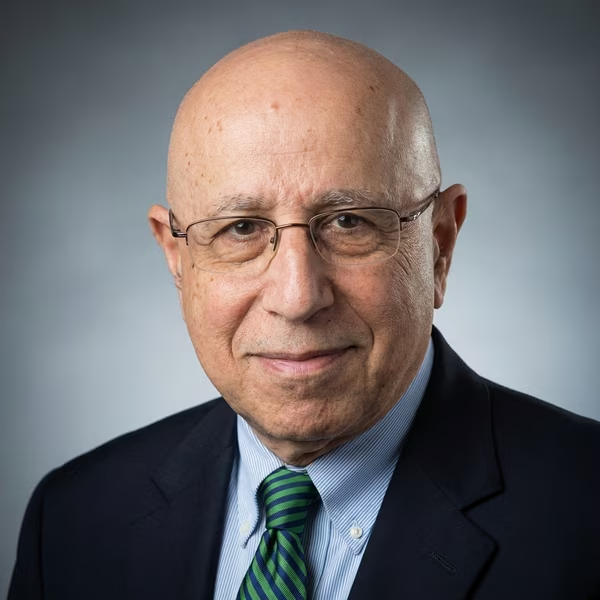
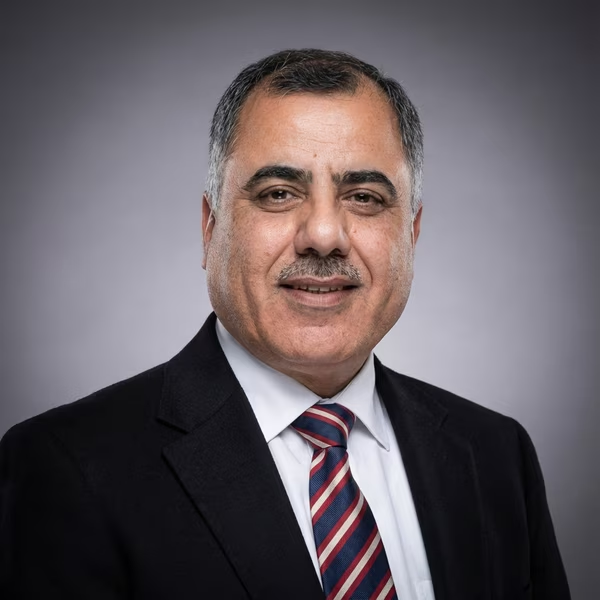
Dr. Saad Nimer: It might be an attempt to elicit a diplomatic Iranian response to reveal its position, but Tehran is adhering to its stance of studying the proposal without pressure. Khalil Shaheen: His statements come in the context of pressuring Iranian decision-making circles, especially those surrounding the Supreme Leader, to push them towards positions closer to American demands. Dr. Tamara Haddad: Rubio's statements are closer to announcing the entry of US-Iranian relations into a new phase of mutual pressure rather than a final declaration of diplomatic failure. Dr. Hussein Al-Deek: They reflect the negotiation path reaching a dead end and may open the door to more complex and intertwined options in the coming period. Dr. Saeed Shaheen: Rubio's statements reflect the extent of frustration within the Trump administration and fears of Iran targeting American assets and military bases, and the possibility of the crisis escalating. Mohammed Al-Rajoub: The American talk about Iran rejecting the agreement might be a prelude to justifying a new escalation phase, especially with increasing military movements in the Gulf. Ramallah - Exclusive to "Al-Quds" - Recent statements by US Secretary of State Marco Rubio, in which he talks about Iran's rejection of the proposed agreement, open a wide door to questions about their motives and repercussions, despite assessments that Tehran has not yet finalized its position and is studying the American proposal with a clear refusal to deal with it under pressure. Writers, political analysts, specialists, and university professors, in interviews with "Al-Quds," believe that American discourse, especially Rubio's statements, carries dimensions beyond describing the negotiating reality, towards an attempt to push Iran to reveal its position or to preemptively hold it responsible for the failure of the diplomatic path, and Washington's desire to increase pressure on Iranian decision-making circles. Tehran has not rejected the American proposal yet. Dr. Saad Nimer, Professor of Political Science at Birzeit University, believes that US Secretary of State Marco Rubio's statements regarding Iran's rejection of the agreement do not reflect the actual reality of the negotiation path, stressing that Tehran has not rejected the American proposal yet, but is still in the process of studying the American paper and has not provided an official response to it. Nimer explained that the delay in the Iranian response is linked to Tehran's desire to confirm that it is not operating under any kind of American pressure, whether political, military, or media pressure, pointing out that US President Donald Trump had spoken of a short deadline for Iran to respond to the American proposal, but the Iranian leadership chose to take more time to study the paper, to send a message that it does not respond to dictates or imposed deadlines. Nimer indicates that Iran also linked the postponement of its response to the recent military escalation, after the United States moved some destroyers towards the Strait of Hormuz, and the subsequent Iranian response through its naval forces, which Tehran considered an unacceptable military pressure attempt that prompted it to postpone the response and not appear as the party negotiating under threat. Nimer points out the possibility that Iran may delay its final position until after the anticipated meeting between Trump and the Chinese President, hoping that Beijing will contribute to pushing towards positions or understandings that may help address some outstanding issues within the American paper. Nimer believes that Rubio's statements about "Iran rejecting the agreement" may be an attempt to elicit a diplomatic Iranian response or push Tehran to reveal its position, but the Iranians have adhered to their declared position of continuing to study the proposal without pressure before providing an official response. The Internal American Position Regarding potential scenarios, Nimer largely rules out going towards a new American war against Iran, based on a set of internal American factors, including rising prices and declining public support for war, pointing out that opinion polls show more than half of Americans oppose any new military escalation. Nimer points to additional political and logistical considerations, including the United States' readiness to host major international events such as the World Cup, as well as legal restrictions related to the need for congressional approval if military operations continue for a longer period. Israel is the biggest beneficiary of any escalation. On the military level, Nimer believes that the chances of success of any American attempt to forcibly open the Strait of Hormuz appear limited, due to field complexities related to implementation capabilities and the shortage of American ammunition and missile stockpiles compared to the size of the potential confrontation. Nimer indicates that the biggest beneficiary of any new military escalation may be Israel, which may exploit the confrontation to target vital Iranian sites and facilities with the aim of weakening the Iranian regime and disrupting its ability to rebuild itself, and perhaps pushing internal conditions towards protest. Nimer believes that the possibility of war still exists in theory, but it seems distant at the current stage, while acknowledging that the nature of Trump's decisions makes it impossible to completely rule out any sudden shift. War of Attrition Political writer and analyst Khalil Shaheen explains that the scene related to the escalating crisis in the Strait of Hormuz and the US-Israeli conflict with Iran remains open to converging possibilities, given the difficulty of predicting the course of events, between the possibility of US President Donald Trump making a political turn leading to an agreement with Tehran, or going towards further military escalation that may open the door to a wider and more complex war in the region. Shaheen points out that the current situation has become very similar to a "war of attrition" that many within the United States warned against, noting that the so-called "Freedom Project" that the American administration tried to use to forcibly open the Strait of Hormuz with the aim of pressuring Iran, ended in deep failure as a result of Iranian readiness and the harsh response that targeted American naval forces in recent days. Crisis Management through Pressure Shaheen notes that the current stage does not reflect a decisive resolution of the conflict as much as it reflects a pattern of "crisis management" through generating more political and military pressure on Tehran, whether through threatening to reuse force to open the Strait of Hormuz with more violent methods, or through continued naval blockade. According to Shaheen, these pressures do not only affect Iran, but also rebound on the United States and global energy markets, with rising fuel prices and the widening economic confusion related to the security of energy supplies. Shaheen points to the existence of Israeli security assessments, especially within the Israeli Mossad, pushing towards the military option as the most effective, by targeting Iranian energy facilities and infrastructure with the aim of weakening Iran in the long term and creating internal conditions that may lead to political and social unrest threatening the stability of the Iranian regime. The Logic of American Interests Despite this, Shaheen suggests that Trump will ultimately prioritize the logic of American interests, by seeking an "interim agreement" that gives him a political exit that can be marketed domestically as an achievement. According to this scenario, as Shaheen sees it, the agreement may begin with reopening the Strait of Hormuz in exchange for lifting the blockade on Iranian ports and a ceasefire, followed by entering into negotiations extending for a month or more on more complex issues, most notably the nuclear program and the fate of enriched uranium, within a transitional formula that gives both parties an opportunity to cool down the crisis. Shaheen explains that the American administration also faces increasing time and political pressures, including Trump's anticipated meeting with the Chinese President, as Washington does not want to go to this meeting while the Gulf front is inflamed, especially since China is the largest importer of Iranian energy and its interests are directly affected by any blockade or disturbance in the Strait of Hormuz. America Hosting the World Cup Shaheen points out that the approaching US hosting of the World Cup, in addition to the potential decline in Republican popularity as the midterm elections approach, represents additional pressure factors on Trump, especially in light of the significant rise in fuel prices and the economic repercussions of the economic war on the American citizen. Shaheen stresses that Trump's personality and his decision-making style make it difficult to predict his political behavior, as he may agree to a temporary transitional agreement, but he may also rush towards a "crazy" escalation based on a policy of playing on the edge of the abyss by repeating attempts to exert military pressure on Iran, which could lead to an all-out war that includes Iranian targeting of American, Gulf, and Israeli interests. Pressure on Iranian Decision-Making Circles Shaheen explains that some American statements, including Rubio's statements regarding Iran's rejection of the potential agreement, come in the context of pressuring Iranian decision-making circles, especially those surrounding the Iranian Supreme Leader, to push them towards positions closer to American demands, at a time when Iran faces difficulty in accepting conditions it considers a violation of its sovereignty, despite the significant losses incurred by Iranian infrastructure, energy, and economy during the previous round of escalation. Shaheen indicates that the proposed scenarios range between an interim agreement that reduces tension, or the continuation of a state of "no war, no peace" resembling a long war of attrition, or sliding into an open confrontation that may have serious repercussions for the Gulf and the global economy, stressing that the region has effectively entered a phase of "finger-biting," where the loser will be the party that screams first. The Possibility of Preparing Public Opinion for a Potentially More Tense Phase Political writer and researcher Dr. Tamara Haddad believes that Rubio's statements about the rejection, by promoting Iran's rejection of the agreement, inherently carry indications of the continuation of the US "maximum pressure" policy towards Tehran, in addition to attempts to reposition politically and prepare internal and external public opinion for a potentially more tense phase in the relationship between the two sides. According to Haddad, the region is currently experiencing a state of "fragile and undeclared tactical calm" between the United States and Iran, a calm characterized by a high degree of fragility amidst the intertwining of military calculations with political and regional interests, which makes any political or field development capable of returning the scene to the circle of escalation. Haddad explains that Rubio's statements that Iran rejected the agreement indicate the US administration's endeavor to hold Tehran responsible for the failure of the diplomatic path, especially after weeks of talk about a temporary calm and attempts to open indirect negotiation channels through regional and international mediators, who sought to bridge viewpoints and try to reach a framework agreement between the two parties. Reshaping the Political Narrative Haddad explains that this type of statement is usually used to reshape the political narrative for the American domestic audience and Washington's European allies, allowing the American administration to present itself as a party that gave diplomacy a chance, while Iran bears responsibility for closing the door to understanding. Haddad indicates that Tehran's rejection does not seem final or categorical towards any future settlement, but rather may fall within an attempt to improve negotiation terms, especially since the latest American proposal, which included 14 points, does not meet - according to Iranian estimates - the minimum demands related to lifting sanctions or providing political and security guarantees that prevent Washington from backtracking on any future agreement. Haddad explains that the mutual escalation in political rhetoric reflects a noticeable decline in the level of trust between the two parties, and the gradual transition of the relationship from a phase of "managing engagement" to "managing escalation," amidst American attempts to pressure Iran and prevent it from gaining time until the US midterm elections, in contrast to Tehran's endeavor to show that it still possesses cards of strength that allow it to resist pressures and not make strategic concessions. The Battle of Psychological and Strategic Deterrence Haddad stresses that political discourse has become part of the "battle of psychological and strategic deterrence," at a time when the region is witnessing high levels of tension, which increases the possibilities of sliding into wider confrontations. Regarding potential scenarios, Haddad suggests the continuation of "limited escalation" through mutual strikes and security or military operations, with continued tension in the Strait of Hormuz without reaching an all-out war, considering this scenario the most likely, given both parties' awareness of the high political, economic, and military costs of any open confrontation. Haddad points to the possibility of the current fragile truce continuing with indirect communication channels remaining, while the most dangerous scenario remains the collapse of the calm due to a major field incident that could ignite multiple fronts whose repercussions extend to Gaza, Lebanon, Iraq, and international navigation. Haddad believes that Rubio's statements seem closer to announcing the entry of US-Iranian relations into a new phase of mutual pressure, rather than a final declaration of diplomatic failure, warning that the shrinking margin of maneuver and the rising level of tension place the region on "highly flammable ground" that could explode due to any miscalculation in political or military calculations. Prioritizing Escalation over Opportunities for Calm Dr. Hussein Al-Deek, Professor of Political Science and specialist in American affairs and international relations, believes that Rubio's statements regarding Iran's rejection of the agreement were not surprising, but rather come in the context of accumulated indicators that were pushing towards prioritizing the escalation scenario over opportunities for calm and reaching an agreement between Washington and Tehran. According to Al-Deek, the current scene is gradually moving away from the possibilities of signing a political agreement, in favor of approaching the option of military confrontation or entering the "gray zone" based on the equation of "no war, no peace" between the United States and Israel on the one hand, and Iran on the other. A Strong Current in Iran Rejects Concessions Al-Deek explains that one of the most prominent reasons for the failure of the agreement is the existence of a strong current within Iran, led by leaders in the Iranian Revolutionary Guard, that rejects making any fundamental concessions to the United States. According to Al-Deek, this current looks with concern at the "day after" any potential agreement, fearing that it might open the door to internal demands for radical political, economic, and social reforms, which could push Iranian citizens to the streets to demand a redefinition of the relationship between the state and society, and to bring about changes in the nature of the ruling system. Al-Deek indicates that Rubio's statements reflect the negotiation path reaching a "dead end," and may open the door to more complex and intertwined options in the coming period. Executing a Limited Military Operation Al-Deek suggests that the most likely scenario is the execution of a limited military operation that has been agreed upon between the American and Israeli leaderships, with a clear target bank that includes vital facilities related to Iranian infrastructure, energy, and economic facilities, with the aim of paralyzing the Iranian economy and reducing the influence of the Revolutionary Guard. Al-Deek points out that another scenario is the continuation of the American naval blockade and economic pressures to force Iran to make concessions, in parallel with the continuation of mediations, but the chances of this scenario seem weaker compared to the option of a limited strike. A Wide American Operation to Open the Strait of Hormuz Al-Deek proposes a third possibility, which is the United States carrying out a wide military operation to forcibly open the Strait of Hormuz and control strategic Iranian sites and islands in the Gulf, within the framework of what is known as "Operation Freedom 2," considering it a viable option but less likely than the scenario of a limited military strike. Al-Deek believes that Washington and Tel Aviv are currently seeking to break the political and military stalemate through a "quick and decisive" strike aimed at achieving a field breakthrough that forces Iran to make concessions, thereby strengthening the position of the moderate Iranian current led by the Iranian President, while reducing the influence of the Supreme Leader and the Revolutionary Guard. A Conflict of Wills Al-Deek believes that the current crisis has become a "conflict of wills" on two levels; internally between the conservative and moderate currents in Iran, and externally between the American-Israeli will seeking to impose the terms of a new agreement, and the Iranian position rejecting what it considers an "agreement of submission," considering that the United States is acting as a power seeking to impose the terms of the victor, while the course of events remains dependent on the results of any potential field confrontation that may redraw the features of the next political agreement. The Extent of Frustration within the Trump Administration Dr. Saeed Shaheen, Professor of Political Communication at Hebron University, believes that Rubio's statements about Iran's rejection of the latest American proposal reflect the extent of the dictates and conditions it contains, considering that these conditions are close to achieving the American-Israeli goal of imposing something akin to a "declaration of surrender" on Tehran, which is unattainable given the nature of the Iranian position and the complexities of the ongoing conflict. According to Shaheen, the current Iranian position cannot be separated from previous experiences in the relationship with the United States, pointing out that Iran had previously signed an agreement with Washington in 2015, and also engaged in other rounds of negotiations after withdrawing from the nuclear agreement, and was on the verge of reaching a new agreement hours before the outbreak of war, but the pressures of Israeli Prime Minister Benjamin Netanyahu pushed towards starting a new round of military escalation, hoping to overthrow the Iranian regime and end its military capabilities related to the missile and nuclear programs. Shaheen indicates that US Secretary of State Marco Rubio's statements regarding Iran's rejection of the proposal reflect, in part, the extent of frustration within the Trump administration, in light of increasing international and Gulf pressures, and growing fears of Iran potentially targeting American assets and military bases deployed in Gulf countries, which could exacerbate the global economic crisis and create a state of rejection within American society for war, especially with rising fuel prices and their economic repercussions. Throwing the Ball into Tehran's Court Shaheen believes that Rubio's statements carry a political dimension aimed at holding Iran responsible for any potential escalation or new wave of fighting, by throwing the ball into Tehran's court and portraying it as a party that rejects the proposed solutions. Despite his assessment that Trump currently does not wish to go towards a wide military escalation and prefers to maintain economic pressures, especially the naval blockade imposed on Iran, Shaheen warns that the region is on "hot coals" that could indeed lead to a wider regional war, considering that this scenario intersects with the Israeli vision seeking to complete what it considers the mission of eliminating the Iranian regime and reshaping a Middle East dominated by Israel. Shaheen believes that the "maximum pressure" policy pursued by the Trump administration, along with Netanyahu's efforts to resume the war, creates a political and security environment that could push the region towards further destruction and instability, should efforts to contain the escalation fail. The Possibility of Going Towards an Open Military Confrontation According to Shaheen, Iran's rejection of the American proposal opens the door to several potential scenarios, the first of which is going to an open military confrontation between the United States and Israel on the one hand, and Iran on the other, targeting what remains of the second tier of the Iranian leadership, in addition to re-targeting security and military sites and oil facilities. Shaheen indicates that the second scenario is the involvement of other parties alongside Washington and Tel Aviv, under the pretext of self-defense in the face of Iranian attacks that may target Gulf countries and the American bases deployed there. As for the third scenario, according to Shaheen, it is based on completely closing the Strait of Hormuz, in parallel with tightening the American blockade with the aim of suffocating the Iranian economy and pressuring the Iranian street to move against the regime. Towards the Edge of Controlled Explosion Academic and researcher in public administration and political science, Mohammed Al-Rajoub, believes that Rubio's statements regarding Iran's rejection of the agreement indicate a shift in the relationship between the two parties from a phase of "tension management" to a phase of "the edge of controlled explosion." Al-Rajoub indicates that Rubio's statements reflect a new negotiating setback, and reveal the depth of the structural crisis governing the relationship between the United States and Iran, explaining that the crisis is no longer linked to the Iranian nuclear file alone, but has become connected to the nature of the entire Iranian regional project, including its political and military influence and regional alliance networks. Al-Rajoub explains that recent American statements, whether from Rubio or US President Donald Trump, did not come in a normal negotiating context, but rather reflect a political and security environment characterized by escalating indirect military engagement, especially in the Strait of Hormuz region, amidst mutual threats and rising tension in the Gulf, in addition to continued disagreements related to the Iranian nuclear program and the network of influence that Tehran has built over the past two decades. A Qualitative Shift in the American Approach According to Al-Rajoub, Rubio's statements reveal a qualitative shift in the American approach, as Washington no longer views the nuclear file as a technical issue related to preventing uranium enrichment or producing a nuclear weapon only, but rather considers it part of an integrated regional power project. Al-Rajoub indicates that the American administration links any future agreement to other files including ballistic missiles, Iranian military influence in Iraq, Syria, Lebanon, and Yemen, as well as the network of regional allies whom Washington considers Iranian pressure tools. Al-Rajoub believes that this shift means the United States moving from a policy of "containing the nuclear program" to a policy of "re-engineering Iranian behavior," by attempting to reduce Tehran's regional influence and readjust its political and military trajectory. For These Reasons, Iran May Reject the Agreement In contrast, Iran understands, according to Al-Rajoub, that accepting American conditions does not merely mean making technical concessions, but could lead to dismantling the deterrence tools on which it built its regional project over the years, which explains its rejection of the agreement and its insistence on separating its nuclear file from other military and political developments. Al-Rajoub indicates that the American rhetorical escalation also reflects the existence of an influential current within the American administration that believes that economic and military pressure is the only way to push Iran towards strategic concessions. Justifying a New Phase of Escalation Al-Rajoub believes that talk of rejecting the agreement may be a political and media prelude to justifying a new phase of escalation, especially in light of continued American sanctions and increasing military movements in the Gulf, while keeping a negotiation window open under strict American conditions. Al-Rajoub believes that the most dangerous aspect of the current scene is the region entering a state of "fragile mutual deterrence," where Iran has the ability to threaten global navigation and energy through the Strait of Hormuz, while the United States and its allies have military superiority capable of inflicting widespread damage on Iranian military and economic infrastructure, making the existing balance closer to a temporary truce that could collapse at any moment. A Message Directed to the International Community Al-Rajoub explains that Rubio's statements also carry a message directed to the international community, especially Europe, Gulf countries, and American public opinion, with the aim of holding Iran responsible for the failure of the negotiation process and portraying Washington as a party that offered an opportunity for a diplomatic solution, while Tehran refused to respond, which provides political and moral cover for any potential military escalation or additional sanctions. Al-Rajoub indicates that the region appears to be facing three potential scenarios, the first of which is a return to indirect negotiations through regional mediators to reach temporary understandings, the second is the continuation of the "gray war" through sanctions, limited strikes, and naval attacks, while the most dangerous scenario is an uncalculated slide towards a wide regional confrontation as a result of a military error or strategic miscalculation.