





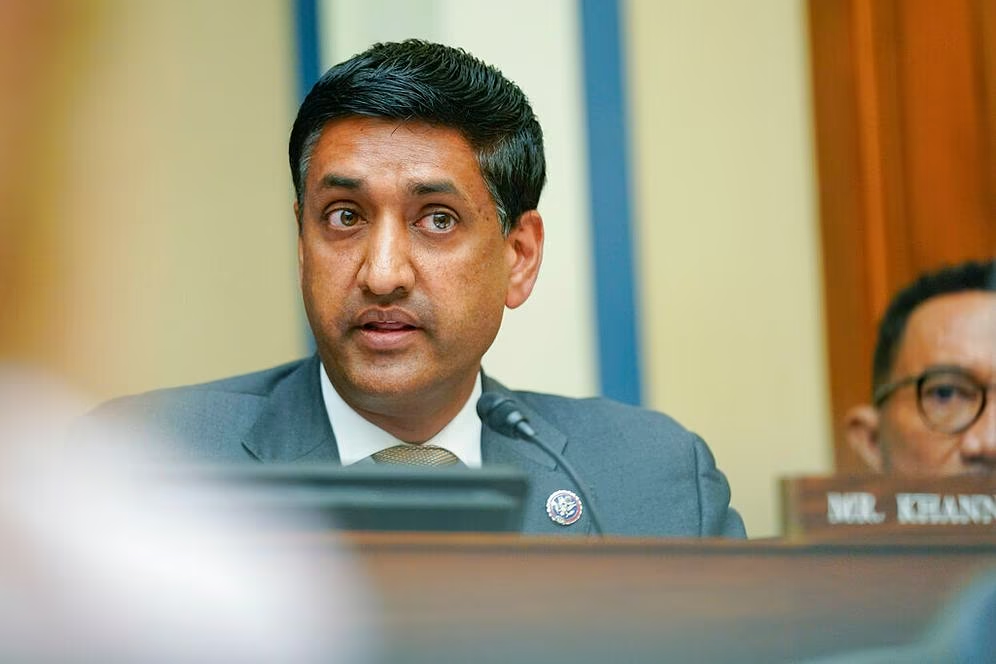
Dr. Raed Abu Badawiya: The direct experience of an American official with settler violence gives the issue greater weight because it is a personal experience that is difficult to ignore or underestimate its implications.Daoud Kuttab: What happened with Ro Khanna, despite its importance, will not, at the current stage, curb settlers amidst the heated Israeli election atmosphere.Dr. Saad Nimer: Targeting an American political figure sends a message that settlers act with the conviction of their ability to impose their will even on Israel's closest allies.Dr. Saeed Shaheen: The incident is not the first of its kind but falls within a series of attacks that have affected foreign delegations, figures, and American citizens in various capacities.Talal Awkal: The experience of the American congressman may push him to adopt positions and policies less supportive of Israel and settlers and more understanding of the reality experienced by Palestinians.Dr. Fadi Jumaa: The discussion about settlements and settler violence now relies on direct observation by members of Congress, which may change the nature of the debate within Washington.Ramallah - Exclusive to "Al-Quds" - The detention of US Democratic Congressman and potential presidential candidate Ro Khanna by armed settlers during his visit to Zanuta village south of Hebron, marks a significant turning point that brings the issue of settler attacks in the West Bank back into the spotlight, as this time the incident involved a high-ranking American official.Writers, political analysts, specialists, and university professors, in separate interviews with "Al-Quds", confirm that the incident goes beyond being a fleeting field incident, as it reflects the growing audacity of settlers and the expanding scope of their attacks. It may also push for a broader discussion within the United States regarding the implications of settlements and violence in the West Bank on American interests and relations with Israel.While they expect the incident to add momentum to criticisms and calls for stricter measures against settlers, they believe that its practical impact will remain limited unless accompanied by political pressure and effective measures to stop the attacks and put an end to settlement expansion.An Indicator of Important ShiftsDr. Raed Abu Badawiya, Professor of International Law and International Relations at the Arab American University, confirms that what happened to the American congressman and potential Democratic presidential candidate for the 2028 elections, Ro Khanna, during his visit to Zanuta village south of Hebron, should not be treated as merely a friction between settlers and a foreign delegation, but rather as an indicator of the transformations that have occurred in the West Bank in the nature of the relationship between the Israeli state and the settlement movement.Abu Badawiya explains that the settlers' behavior in this incident reflects a high level of confidence, as they did not act as an outlaw entity, but rather as capable of imposing a fait accompli, given their confidence in official protection or tolerance, or their ability to override state authority in some cases.The Incident Involves a High-Ranking FigureAbu Badawiya points out that the political importance of the incident is not limited to its details, but is also linked to the identity of the person who was subjected to it, as the narrative comes from a US Congressman, not from a Palestinian or a human rights organization whose testimony can be questioned.Abu Badawiya emphasizes that the direct experience of an American official with settler violence gives the issue greater weight within the United States, because it moves it from the framework of reports and accusations to a personal experience that is difficult to ignore or underestimate its implications.Abu Badawiya believes that the incident also reveals that settler violence is no longer just a local issue related to the Palestinian-Israeli conflict, but has begun to affect the interests of Israel's allied countries, which may lead to expanding the circle of international attention to this phenomenon.A New Element in the Path of Pressure on SettlersRegarding the possibility that the incident could help curb settlers, Abu Badawiya explains that it may add a new element to the increasing pressure on the settlement movement, but it alone will not be enough to bring about a radical change, because policies do not change due to a single incident, but as a result of the accumulation of facts and their impact on the perception of decision-makers.Abu Badawiya believes that the incident may become an additional reference within Congress and the US administration to prove that settler violence no longer threatens only Palestinians, but has become a challenge to regional stability and may affect American interests, which may give momentum to calls for imposing sanctions on settlers involved in violence, and tightening oversight on the use of US military aid.Abu Badawiya stresses that the actual impact of the incident will remain linked to Washington's willingness to move from statements of concern to exercising real political pressure on the Israeli government, considering that its importance lies in adding new evidence that is difficult to ignore in the growing American debate about the limits of unconditional support for Israel and its responsibility to curb settler violence.Continuation of Extremist ApproachWriter and political analyst Daoud Kuttab explains that what happened to prominent US Congressman and potential presidential candidate for the Democratic Party, Ro Khanna, is of great importance, not because the incident is unprecedented, but because this time the target is a high-ranking American political figure, which gives the incident political dimensions that go beyond the usual attacks targeting Palestinians or foreign visitors.Kuttab believes that the incident reflects the continuation of the extremist approach practiced by groups of settlers, along with members of the occupation army, considering that targeting an American figure at this level may draw greater international attention to the nature of the settlement movement's practices in the West Bank.The Incident and the Israeli Election AtmosphereAccording to Kuttab, the incident, despite its importance, will not, at the current stage, curb settlers, amidst the heated Israeli election atmosphere, where political competition is fierce, and Israeli Prime Minister Benjamin Netanyahu continues to seek to remain in power and expand his base of supporters to avoid prosecution, which pushes him to attract various forces that support him, including pro-settlement currents.Kuttab believes that any serious attempts to limit the influence of settlers may be postponed until after the elections, when the composition of the new coalition government and the nature of the forces participating in it become clear.Settlers Do Not Distinguish Between Palestinian or ForeignerDr. Saad Nimer, Professor of Political Science at Birzeit University, confirms that the detention of US Congressman and potential Democratic presidential candidate Ro Khanna during his visit to the West Bank sheds unprecedented light on the nature of settler behavior, their ideas, and the practices they carry out against Palestinians.Nimer believes that targeting an American political figure sends a clear message that settlers do not distinguish between Palestinian or foreigner, and that they act out of conviction of their ability to impose their will even on Israel's closest allies.The Nature of the Ideology Governing the Settlement MovementNimer explains that the incident reveals a mentality based on the belief that settlers represent the "chosen people," and that everyone must submit to their will, including the United States, which is Israel's biggest supporter.Nimer points out that this incident reflects the nature of the ideology governing the settlement movement, noting that if this is the method used with an American congressman, then what Palestinians experience daily is even harsher.Nimer explains that this conviction is not new, citing previous statements by Israeli officials who called for disregarding the American position, considering that this is consistent with the mentality behind settler behavior in the West Bank.Direct Targets for SettlersNimer points to the attack on the CNN crew during their coverage in the West Bank, saying that settlers attacked the team with stones, sticks, and knives, despite their clear identity as American journalists, which reflects that anyone who tries to document what is happening in the West Bank may become a direct target of settler attacks, regardless of their nationality or status.Nimer believes that these incidents may expose settler policies to American and international public opinion, thereby strengthening popular criticism of Israel if they receive widespread media coverage within the United States, but he rules out that this will affect the official American position, given the continued political support provided by American administrations to Israel.Nimer stresses that American policy, especially during the era of US President Donald Trump, provided clear support for Israel by recognizing Jerusalem as its capital, moving the US embassy there, and recognizing Israel's sovereignty over the Golan, as well as statements calling for Israel's expansion, considering that these policies reflect continued official support for the settlement project.Official Israeli Policy Supporting SettlementNimer emphasizes that the problem is not limited to settler groups, but is linked to an official Israeli policy that supports and protects settlements, with the participation of state institutions and the army.Nimer believes that any measures limited to imposing sanctions on a limited number of settlers or some settlement organizations remain insufficient, stressing that responsibility lies with the Israeli government, which provides political and security cover for the continuation of settlements and attacks in the West Bank.Escalation of Encroachment Driven by Racist IdeologyDr. Saeed Shaheen, Professor of Political Communication at Hebron University, confirms that what happened to US Congressman and potential Democratic presidential candidate Ro Khanna, comes in the context of escalating Israeli encroachment driven by a racist ideology adopted by the Israeli government, with the aim of implementing its expansionist plans to seize Palestinian lands, create an environment that expels Palestinians, and prevent any voice that seeks to expose or confront the violations in the West Bank.He explains that the incident is not the first of its kind, but falls within a long series of attacks that have affected foreign delegations and figures, in addition to American citizens in various capacities, citing previous incidents that included American activist Rachel Corrie, journalist Shireen Abu Akleh, media crews including CNN, and foreign solidarity activists, leading up to the Ro Khanna incident.Shaheen stresses that these facts reflect the indifference of settlers and the occupation forces that provide them with protection to any foreign delegations or figures, pointing out that this occurs under policies and directives adopted by Israeli officials, and also criticizes the position of the US Ambassador to Israel, Mike Huckabee, considering that he does not provide sufficient protection even for American citizens.Continued International SilenceShaheen affirms that the continued international silence regarding serious violations in the West Bank, and the absence of accountability and punitive measures against perpetrators, contribute to the escalation of attacks, in the absence of the application of international humanitarian law.Regarding the repercussions of Ro Khanna's detention, Shaheen believes that the incident will not cause embarrassment or concern for the current Israeli government, because it feels it has political cover from the administration of US President Donald Trump.Shaheen points out that the crimes committed by settlers in the West Bank have reached unprecedented levels, yet they are not met with any effective international action to deter them, which encourages the continuation of attacks, even when targeting official or parliamentary figures or foreign delegations.Long History of Settler PracticesPolitical writer and analyst Talal Awkal believes that the incident of the detention of US Democratic Congressman and potential presidential candidate, Ro Khanna, by armed Israeli settlers with American-made rifles, during his visit to Zanuta village south of Hebron, before his release after the intervention of occupation forces and Israeli police, represents a remarkable development that may have political repercussions beyond the incident itself, especially at the level of American positions on settlements.Awkal explains that what happened to Khanna is not an isolated incident or the first of its kind, but rather comes within a long series of prohibitions, harassments, and insults practiced by settlers, often under the eyes of the occupation army, pointing out that these practices do not exclude anyone, whether a political official, diplomat, human rights activist, journalist, or foreign national.Lack of Immunity for Officials and Foreign VisitorsAwkal points out that previous facts confirm the absence of any effective immunity for foreign officials and visitors, citing the way Israeli authorities dealt with American journalist Tucker Carlson, as well as the incident of the occupation army firing at a European diplomatic delegation that tried to visit Jenin to see the field conditions.Awkal believes that the experience of the American congressman may push him to adopt positions and policies less supportive of Israel and settlers, and more understanding of the reality experienced by Palestinians.Awkal believes that the incident raises questions about whether international officials must be directly exposed to such violations in order to realize the extent of suffering experienced by Palestinians for decades.Awkal affirms that what happened will contribute to expanding and deepening the increasing shifts within the Democratic Party and American society towards the Palestinian issue, likely strengthening calls for stricter measures and sanctions against settlers, amidst increasing international criticism of the occupation and settler practices in the West Bank.Increasing Settler Confidence in Their CrimesDr. Fadi Jumaa, Professor of Political Science at the Arab American University, confirms that what happened to US Congressman and Democratic Representative Ro Khanna, his detention by armed settlers during his visit to the West Bank, cannot be read as a separate security incident, but rather comes in the context of a continuous scene witnessed in the West Bank for years, which escalated unprecedentedly after the events of October 7, 2023, with increasing settler violence and the expanding scope of their attacks against Palestinians.He explains that field developments in recent months have shown a significant increase in the level of settler confidence in what they do, which has pushed them to carry out more audacious practices, in parallel with the acceleration of settlement expansion and the displacement of Palestinians, especially in the areas south of Hebron, the Jordan Valley, and Masafer Yatta, pointing out that these manifestations have also begun to extend to other areas such as Jenin.Jumaa stresses that what gives the incident special importance is that the person who was detained is not a Palestinian activist, journalist, or member of a local delegation, but a US Congressman representing Israel's most prominent ally, considering that this reflects the level of confidence with which settler groups are operating, to the extent that they did not hesitate to intercept an American delegation while carrying weapons, in a scene resembling gang practices, but it occurs with a feeling of existing cover that allows such actions.A Significant Shift Within the American Democratic PartyJumaa emphasizes that the American congressman's narrative, in which he stated that the intervention of Israeli forces was not immediate, gives the incident an additional dimension, as the delayed intervention allowed settlers to continue detaining the delegation for 90 minutes, which reflects the nature of the field environment in which these groups operate.Jumaa believes that the incident may represent a significant shift within the American Democratic Party, explaining that the discussion about settlements and settler violence previously relied primarily on reports from human rights organizations and diplomatic documents, but today, members of Congress are witnessing these events directly, which may change the nature of the debate within Washington, because personal experience is more impactful than written reports.An Important Incident, But It Does Not Curb Their ViolenceIn his assessment of the likelihood that the incident will contribute to curbing settler violence, Jumaa believes that it may add new momentum to political pressure, but it alone will not be enough to bring about actual change.Jumaa points out that the United States and a number of European countries have recently imposed sanctions on some settlers, and issued reports addressing attacks and forced displacement in the West Bank, but these measures have not led to tangible results on the ground.Jumaa notes that what distinguishes this incident is that the affected party is a US Congressman, which may give it greater weight within decision-making circles in Washington, and may be used in discussions related to American political and economic support for Israel, but he rules out that this alone will curb settlers.Jumaa stresses that stopping settler attacks fundamentally requires an Israeli political decision, considering that the incident may constitute a turning point in the evolution of American discourse towards what is happening in the West Bank, but it will not be enough to change settler behavior unless there is political will within Israel, which is more complex than to be decided by a single incident, no matter its political and media importance.

PALESTINE
Tue 14 Jul 2026 10:10 am - Jerusalem Time
The Ninety-Minute Incident... "Zanuta" Exposes Settler Crimes and Fuels Sympathetic Narratives
Tags
MORE FROM PALESTINE
Katz boasts about Gaza's destruction and announces a plan to establish military outposts in the northern Strip
Director of Jabalia Police and Other Officers Martyred in Israeli Massacre North of Gaza
Shilo: We call for the establishment of a “Friends of China Group Worldwide” to enhance media and intellectual cooperation and dialogue among civilizations
Share your opinion
The Ninety-Minute Incident... "Zanuta" Exposes Settler Crimes and Fuels Sympathetic Narratives