







Washington's Message
Washington – Said Arikat – 29/6/2026
An analytical report by the American website "Axios" revealed that Israel is facing an unprecedented political shift within the Republican Party, its most steadfast traditional ally in the United States, with increasing signs of a decline in Israel's popularity among Republicans, especially among younger generations, after the devastating war on the Gaza Strip, and then the disputes that erupted between Israeli Prime Minister Benjamin Netanyahu and US President Donald Trump during the crisis with Iran.
The report indicates that Netanyahu, who spent about fifteen years compensating for his continuous loss of support within the Democratic Party by strengthening his alliance with Republicans, now finds himself facing a new challenge: the erosion of that support within the camp he long believed was his political guarantee in Washington.
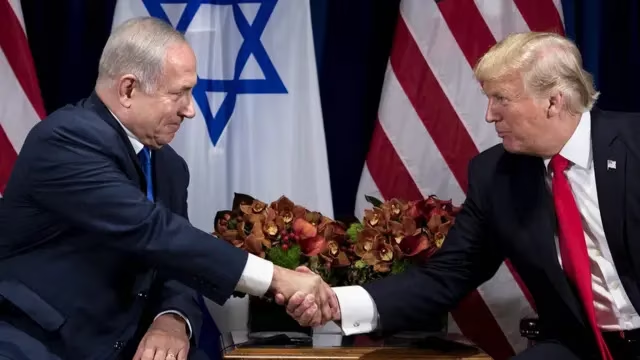
It appears that the crisis has extended beyond opinion polls to reach the highest echelons of Republican leadership. According to the book "Regime Change" by journalists Maggie Haberman and Jonathan Swan, Trump exerted direct pressure on Netanyahu during negotiations to stop the war in Gaza, warning him that his continued refusal to compromise would lead to a "divorce" between the United States and Israel, an expression reflecting the extent of the tension that began to creep into the personal and political relationship between the two men.
Axios also reported that Trump described Netanyahu as "crazy" in one of his private conversations, considering that his policies contribute to increasing Israel's international isolation, before later reaffirming that his relationship with the Israeli Prime Minister was "good," but added in a striking tone: "We have to keep him a little balanced."
The criticisms were not limited to Trump alone, as Vice President J.D. Vance publicly criticized Israeli officials who attacked the American understanding with Iran, saying that no Israeli government should attack "its only remaining strong ally in the world," a message considered a departure from the traditional discourse that has long given Israel unconditional support.
In parallel, the influence of the "America First" movement, which opposes foreign interventions, has grown within the Republican Party, where prominent media and political figures, such as Tucker Carlson, Megyn Kelly, and Marjorie Taylor Greene, led a sharp campaign of criticism against Israel, considering that American interests have become hostage to the priorities of the Israeli government.
Carlson went so far as to accuse Netanyahu of deceiving Trump and pushing him towards a war with Iran, describing the American president as having become a "captive" of the Israeli prime minister, while the popularity of conservative media personality Ben Shapiro declined among the right-wing audience due to his adherence to the traditional defense of Israel, at a time when an increasing portion of the Republican base is moving towards a discourse more skeptical of the utility of American support for Tel Aviv.
The report indicates that Israel has become a new benchmark for internal conflict within the American right, where emerging right-wing figures accuse traditional Republican Party leaders of prioritizing Israel over American national interests, a discourse that until recently was confined to the political margins, but has begun to gain increasing presence within conservative platforms and among young voters.
Opinion polls clearly reflect this shift. A Pew Research Center poll showed that four out of ten Republicans hold a negative view of Israel, while the percentage rises to 57% among Republicans under the age of fifty. A Quinnipiac University poll also revealed that one in five Republicans believes the United States provides excessive support to Israel, a number that has multiplied several times compared to what it was after the events of October 7, 2023.
Polls conducted by the University of Maryland also showed that less than half of Republicans consider Israeli military operations in Gaza justified, while only 22% of Republicans aged 18 to 34 supported them, indicating a widening generational gap within the party.
Despite these indicators, the traditional Republican current still maintains a supportive stance towards Israel, as a Gallup Institute poll showed that 70% of Republicans sympathize more with Israelis than with Palestinians, although this percentage has decreased by ten points compared to 2024, which reflects the beginning of a gradual shift rather than a complete reversal in the political mood.
The report suggests that the most important question is not only about Netanyahu's declining popularity, but whether Israel's image itself has begun to change within the Republican Party, especially with the upcoming Israeli elections, and whether this shift will remain linked to Netanyahu's person, or will turn into a deeper review of the nature of the American-Israeli alliance, which has for decades been one of the constants of American foreign policy.
These indicators reveal that the ongoing shift within the Republican Party is not just a personal disagreement with Netanyahu, but reflects the rise of a new vision that considers foreign policy should be measured exclusively by how well it serves direct American interests. With the growing influence of the "America First" movement, Israel is for the first time being subjected to a test of political and strategic utility, after decades of being immune to any discussion within conservative circles. This shift, if it continues, could reshape the nature of the relationship between Washington and Tel Aviv over the next decade.
The numbers for young Republicans carry implications that go beyond the poll results themselves, because they reflect a cultural and media change in the sources of conservative public opinion formation. New generations no longer rely solely on traditional party discourse or evangelical institutions, but receive their information through social media platforms and digital media, where images of destruction in Gaza and critical discussions of American support for Israel are widespread. From here, this change could turn into a long-term factor that traditional Republican leaders will find difficult to contain.
Although major Republican institutions remain committed to defending Israel, the continuation of the war in Gaza, and repeated frictions between Netanyahu and the US administration, may push more Republican politicians to reposition themselves to avoid losing young voters. This does not necessarily mean the collapse of the American-Israeli alliance, but it could mean the end of a phase of absolute unconditional support, and the beginning of a phase where this support becomes linked to more complex electoral and strategic calculations, and to the ability of Israeli governments to avoid repeated clashes with Washington.
Share your opinion
Unprecedented Rift in the Pro-Israel Republican Base… Has Washington Begun to Redraw its Relationship with Tel Aviv?