






Dr. Dalal Erekat: The value of any transformation is measured by its ability to turn a ceasefire into a political path that guarantees the rights of the Palestinian people, not just arrangements similar to the Deal of the Century.
Akram Atallah: The divergence that prevailed in the relationship between Trump and Netanyahu following the repercussions of the war with Iran and the decline in its political results may generate a new approach to the Palestinian issue in Washington.
Dr. Reham Owda: A memorandum of understanding is likely to be signed between the "Peace Council" and the Authority, outlining a roadmap for Gaza's administration in parallel with the reopening of the PLO office in Washington.
Mohammed Joudeh: Washington faces a central dilemma related to the absence of a Palestinian party capable of managing the "Day After" phase in Gaza, which pushes it to search for a reliable partner.
Dr. Hussein Al-Deek: Washington has not found a political alternative to deal with because the Palestine Liberation Organization is the legitimate representative of the Palestinian people, which prompted it to reopen communication channels.
Nu'man Tawfiq Al-Abed: Fears of using these contacts to show the existence of a negotiation path without actual results on the ground, which could be used to market normalization with Israel.
Ramallah - Exclusive to "Al-Quds" -
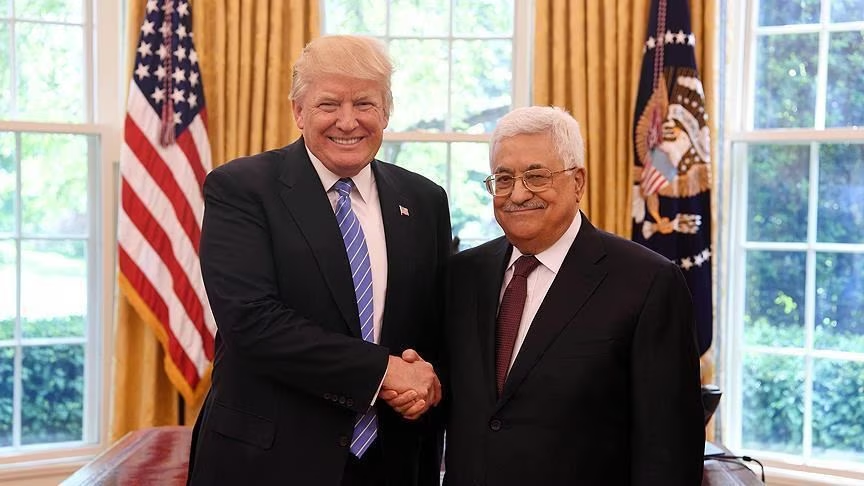
Amidst reports circulated by "The Times of Israel" about strengthening the relationship between the United States and the Palestinian National Authority, estimates suggest that this movement may reflect an American trend to reintegrate it into post-war arrangements in the Gaza Strip, ensuring the presence of a Palestinian party that can be dealt with in governance and reconstruction files, amidst warnings that this could come at the expense of reviving the normalization process in the region.
Writers, political analysts, specialists, and university professors, in separate interviews with "Al-Quds," believe that this trend is also linked to the expansion of the Abraham Accords, as reactivating the relationship with the Authority could provide political cover that facilitates the progress of regional normalization and alleviates the complexities of the Palestinian issue within the new equations in the region.
The scenarios, according to writers, analysts, specialists, and university professors, range from a gradual opening that raises the level of coordination and political and economic support without a comprehensive settlement, to the possibility of granting the Authority a role in managing Gaza within transitional arrangements under international supervision, versus the possibility of the relationship remaining within the framework of crisis management if regional understandings falter.
They believe that these moves may reflect a phase of political repositioning for the Palestinian Authority within American calculations, where the future of Gaza intertwines with regional normalization without a clear resolution of the shape of the next phase.
The Authority is an indispensable party
Dr. Dalal Erekat, Professor of Diplomacy and Conflict Resolution at the Arab American University, believes that the circulating information about the United States' intention to strengthen its relationship with the Palestinian Authority holds some accuracy in terms of the general direction, even if its final details are not confirmed, considering that the ongoing discussions fall within a broader political context related to the future of the Gaza Strip, reconstruction, and the expansion of the Abraham Accords.
Erekat explains that the American administration, influenced by regional partners, primarily Saudi Arabia, views the Palestinian Authority as an indispensable party in any arrangements concerning the "Day After" the war, whether in Gaza or within any new regional political path, noting that what is being circulated so far relates to deliberations and contacts, not final decisions, which is consistent with American trends that have emerged in recent months.
She warns against treating these leaks as complete facts, as they may also be used as pressure tools and political messages directed at multiple parties, including the Palestinian Authority, Israel, Arab countries, and American public opinion, emphasizing that the previous and current American administrations adopt a comprehensive approach to managing the Palestinian issue, and that any political path linked to previous UN resolutions places the Authority's role within the framework of sustaining the ceasefire and transitioning to a strategic path towards stability.
Limited Opening
Regarding potential scenarios, Erekat explains that the first scenario is a "limited opening" through improving relations between Washington and the Palestinian Authority, by reopening communication channels, increasing economic support, and enhancing political coordination without reaching significant political recognition or substantive initiatives, which is the most likely scenario in the current phase.
The second scenario, according to Erekat, is a "broader political partnership" if the United States succeeds in establishing post-war arrangements in Gaza and linking them to the expansion of the Abraham Accords, where the Palestinian Authority may be reintegrated into the political and regional scene in exchange for implementing internal reforms, with the possibility of reopening the PLO office in Washington or the American consulate in Jerusalem, ensuring the preservation of the two-state solution as a reference framework.
Erekat indicates that the third scenario is the continuation of crisis management, which is a possibility given the current Israeli government, settlement expansion, and the absence of political will for a final settlement, which may keep the American-Palestinian relationship within tactical improvements without a strategic shift, with the Palestinian issue continuing to be treated as a security and humanitarian file rather than a liberation and self-determination issue.
Erekat stresses that the fundamental question is not only about the possibility of improving the relationship between Washington and the Authority, but whether this relationship will translate into an American political will to address the roots of the conflict and end the occupation, or whether it will remain a framework for crisis management and tool rearrangement.
Erekat affirms that the value of any transformation is measured by its ability to turn a ceasefire into a political path based on international law and the right of the Palestinian people to self-determination, not just temporary or economic arrangements within previous approaches similar to the Deal of the Century.
Positive Political Signal
Political writer and analyst Akram Atallah believes that relations between the Palestinian National Authority and the United States began to witness renewed momentum since the Authority approved US President Donald Trump's plan to end the war in the Gaza Strip, which the American administration considered a positive political signal that opened the door for the restoration of some communication channels.
Atallah explains that one of the most prominent indicators of this rapprochement was President Trump's approval of Egyptian President Abdel Fattah El-Sisi's invitation to President Mahmoud Abbas to attend the Sharm El Sheikh summit months ago, which saw the announcement of the initiative in Trump's presence, noting that these developments constituted the beginning of a new relationship between the two sides.
Internal American Factors
Atallah points out that internal American factors, especially the need for electoral votes in the Republican Party's midterm elections, in addition to the role of the active Palestinian community in the United States, have contributed to bridging the views between Washington and the Palestinian Authority during the recent period.
Atallah notes that the divergence that prevailed in the relationship between Trump and Israeli Prime Minister Benjamin Netanyahu, following the repercussions of the war with Iran and the decline in its political results, may generate a new approach to the Palestinian issue in Washington, in addition to the increasing Arab role that pushes for reactivating the Authority's role, either through a previous Arab summit or by proposing reforms for the Authority and linking them to its return to administering the Gaza Strip.
Atallah indicates that these interactions may open the door for limited scenarios of change in American policy, especially given the growing conviction among regional and international parties that there is no practical alternative to the Palestinian Authority in managing the Gaza Strip, considering it the "lesser of evils" for the United States and its Arab partners.
Atallah believes that these developments do not mean significantly raising Palestinian expectations, but they may reflect the beginning of a gradual shift in some American policies, driven by the convergence of regional interests and changes in the internal political scene in Washington and Tel Aviv.
Not New Goals
Political writer and analyst Dr. Reham Owda believes that proposals regarding a potential role for the Palestinian Authority in the Gaza Strip after implementing internal reforms are not new, but rather are based on previous official conceptions within the framework of the "Peace Council," which was discussed as a transitional mechanism for managing the Strip during the next phase.
Owda explains that the Peace Council's envoy to Gaza, Mladenov, had stated on more than one occasion that the Council would eventually hand over the administration of the Strip to the Palestinian National Authority, provided it committed to a series of internal reforms including developing institutional performance and enhancing the effectiveness of security and administrative agencies.
Owda indicates that President Mahmoud Abbas's announcement of a date for legislative and presidential elections constituted a positive indicator in this context, reflecting the Authority's seriousness in moving towards political and democratic reforms, which contributed to opening the door for the American administration to re-evaluate the relationship with the Authority, in preparation for supporting and rehabilitating it to take over the administration of the Gaza Strip in the future.
Owda believes that there is no practical or realistic alternative to the Palestinian Authority for managing the Gaza Strip after the temporary role of the Peace Council ends, warning that its absence could lead to a political and security vacuum that opens the way for militia control, a scenario that none of the international or regional parties involved in the file desire.
Signing a Memorandum of Understanding with the Authority
According to Owda, the likely scenario is the signing of a memorandum of understanding between the Peace Council and the Palestinian Authority, outlining a roadmap for the stages of Gaza's administration, in parallel with the reopening of the Palestine Liberation Organization office in Washington, allowing the American administration to directly follow up on the file through diplomatic channels with the Authority's representative in the American capital.
The vision, according to Owda, also includes the introduction of international forces into what is known as the "Yellow Zone," and an attempt to push Hamas to surrender its weapons to a national committee, in addition to discussing mechanisms for transferring frozen Palestinian clearance funds to support the Peace Council's operations in Gaza, with a portion allocated to paying the salaries of Authority employees.
Possibility of Gradual Deployment of International Forces
In another scenario, Owda points to the possibility of a gradual deployment of international forces in the Gaza Strip with the activation of the Gaza management committee, until Palestinian elections are held, based on which the American administration will determine its future Palestinian partner, while the international envoy may maintain a coordinating relationship with the current Authority without reaching a final agreement before the elections.
Logical Trends
Political writer and analyst Mohammed Joudeh believes that dealing with what is being raised about the new American policy trends for positive engagement with the Palestinian Authority should not be limited to the accuracy of the information reported by "The Times of Israel," but rather to its consistency with the general course of American policy in the current phase, noting that these trends seem logical within the context of regional developments after the Gaza war.
Joudeh explains that the United States faces a central dilemma related to the absence of a Palestinian party capable of managing the "Day After" phase in Gaza, which pushes it to search for a reliable political and administrative partner.
At the same time, Joudeh believes that expanding the Abraham Accords normalization agreements requires keeping the Palestinian issue within political calculations, and not completely bypassing it in any new regional arrangements.
According to Joudeh, talking about strengthening the relationship with the Palestinian Authority does not necessarily reflect a radical shift in American policy or a trend towards a final settlement, but rather may be a functional tool to achieve two main goals: managing the situation in the Gaza Strip, and creating a regional environment that allows the continuation of the normalization process with Arab countries.
Joudeh indicates that strengthening the relationship does not necessarily mean recognizing a Palestinian state or launching a decisive political path, but rather often focuses on raising the level of political, security, and economic coordination, and rehabilitating the Authority to be an acceptable partner in any future regional and international arrangements.
Four Main Paths
Regarding potential scenarios, Joudeh proposes four main paths; the first is to provide greater political and financial support to the Authority and gradually integrate it into post-war arrangements in Gaza without a fundamental change in the structure of the conflict. The second, according to Joudeh, is to transform the Authority into a key party in managing Gaza in the future through new administrative formulas supported by Arabs, despite the obstacles it faces related to Palestinian legitimacy and the Israeli position.
The third scenario, according to Joudeh, is linked to an attempt to link the Arab normalization path with limited political steps for the benefit of Palestinians, in exchange for Israel making partial concessions, a path that remains subject to complex political balances, while he indicates that the fourth scenario is the failure of these trends due to Israeli or Palestinian rejection or due to field escalation that undermines any potential arrangements.
Joudeh believes that the core of the issue is not only about Washington's will, but also about the willingness of regional parties, including Israel, the Authority, factions, and Arab countries, to engage in an integrated political path, which is still undecided.
Not Surprising
Dr. Hussein Al-Deek, Professor of Political Science and specialist in American affairs and international relations, believes that what "The Times of Israel" reported, that the United States is considering strengthening its relations with the Palestinian Authority as part of its efforts to advance post-war arrangements in the Gaza Strip and expand regional normalization agreements, is not surprising.
Al-Deek explains that contacts between the Palestinian leadership and the United States have not been completely severed in recent years, despite political tension, decisions to stop aid, and the closure of official communication channels, pointing to continued contacts through the American embassy and repeated interventions in files related to Palestinian funds held by Israel, in addition to meetings between American officials and representatives of the Palestinian leadership.
Reopening Communication Channels
Al-Deek indicates that Washington, despite its previous policies towards the Palestinian Authority, has not found a political alternative to deal with, considering the Palestine Liberation Organization and the Palestinian National Authority as the legitimate representative of the Palestinian people, which pushes the American administration to reopen communication channels after realizing that any political or regional arrangements cannot be made in isolation from the official Palestinian side.
Al-Deek points out that the next phase may witness three main scenarios, the first of which is the gradual return of Palestinian-American relations in light of continuous Arab pressure on Washington to re-engage with the Palestinian Authority.
A Phase of De-escalation and Settlements
The second scenario, according to Al-Deek, is related to the region entering a phase of de-escalation and political settlements, which necessitates the presence of the Palestinian Authority in any new regional arrangements due to its relations with Arab and European countries, which may be reflected in a gradual political and diplomatic rapprochement with the American administration.
Al-Deek points to the third scenario, which is the continuation of the status quo without development in relations, but it remains a weak possibility, especially with the increasing divergences between American and Israeli positions on a number of regional issues.
Al-Deek explains that Israeli Prime Minister Benjamin Netanyahu has sought since his return to power in 2009 to achieve two main goals: confronting Iran and expanding the circle of normalization with Arab countries, especially Saudi Arabia.
Normalization and the Pledge to the Political Path of the Palestinian Issue
Al-Deek believes that any progress in the Saudi-Israeli normalization path will remain linked to the existence of a political horizon for the Palestinian issue and guarantees leading to the establishment of a Palestinian state, although the American administration has not yet put forward any clear initiative in this direction.
Regarding the future of the Gaza Strip, Al-Deek confirms that the United States has realized the limited options available for managing the Strip after the war, given the failure of previous initiatives and the lack of any real breakthrough.
Al-Deek points out that Washington sees only two options: the return of the Palestinian Authority to Gaza or the imposition of direct Israeli military rule, an option that Israel does not want to bear its political, economic, and security costs, which makes the return of the Palestinian Authority the most realistic option despite continued Israeli rejection of it.
Amendments to American Laws Related to Palestinians
Al-Deek touches upon a movement within the US Congress that includes amendments to draft laws that will be discussed in the coming period, including the reopening of the American consulate dedicated to Palestinians in Jerusalem, the resumption of funding for the United Nations Relief and Works Agency for Palestine Refugees (UNRWA), and the allocation of about $400 million for the reconstruction of Gaza, in addition to proposals to restore diplomatic relations with the Palestinian Authority. In contrast, Al-Deek points to counter-amendments pushed by supporters of Israel, including adopting the name "Judea and Samaria" instead of the West Bank.
Despite his belief that the chances of approving these proposals are still limited, Al-Deek considers that merely raising them reflects a renewed American movement towards the Palestinian issue and a possible repositioning in American policy during the next phase.
Difficulty of Implementing Any Plan Without Involving the Authority
Political writer, researcher, and international relations specialist Nu'man Tawfiq Al-Abed believes that the United States has realized the difficulty of implementing any political plan in the region without involving the Palestinian National Authority, as it is an internationally recognized entity that emerged as a result of political agreements, and enjoys recognition from a number of European countries, in addition to being an arm of the Palestine Liberation Organization.
Al-Abed explains that the absence of the Authority from any arrangements in the West Bank and Gaza Strip makes it difficult to achieve results that serve the American vision, including US President Donald Trump's plans or any future approaches related to the region, suggesting that there are ongoing dialogues between Washington and the Palestinian Authority, especially in light of the presence of active regional parties, led by Saudi Arabia, pushing for the Authority's involvement in any reform or political path.
He indicates that these contacts, if press reports about them are true, do not necessarily mean a fundamental political shift, but may be limited to specific economic and administrative files, noting that there is no official Palestinian or American confirmation yet about tangible results of these dialogues.
Al-Abed rules out the current American administration's ability to impose any real political path in light of the presence of Benjamin Netanyahu's government, which adopts hardline policies towards the West Bank and Gaza Strip, and faces internal pressures related to the upcoming Israeli elections, which makes making any political concessions extremely difficult.
Al-Abed points out that within the American administration itself there are multiple currents, some of which do not support the involvement of the Palestinian Authority in any future settlement, but rather adopt positions consistent with or more hardline than the Israeli vision, citing the statements of the American ambassador to Israel as an example of this trend.
Fears of Politically Exploiting These Contacts
Al-Abed warns of fears of attempting to politically exploit these contacts to show the existence of a negotiation path without actual results on the ground, which could be used to market normalization with Israel, considering that the Palestinian Authority should not fall into the "trap of political symbolism" without guaranteeing real results that serve the Palestinian cause.
Al-Abed believes that what is happening, if proven, does not go beyond limited management of the Palestinian reality through economic support and keeping the Authority in a state of "unstable political life," without any fundamental progress in the political path, in light of the continued Israeli rejection of any settlement, and the impossibility of making concessions under the internal electoral conditions in Israel.
Share your opinion
Washington's Relationship with the Authority.. Is it Paving the Way for a New Approach to the Palestinian Issue?