






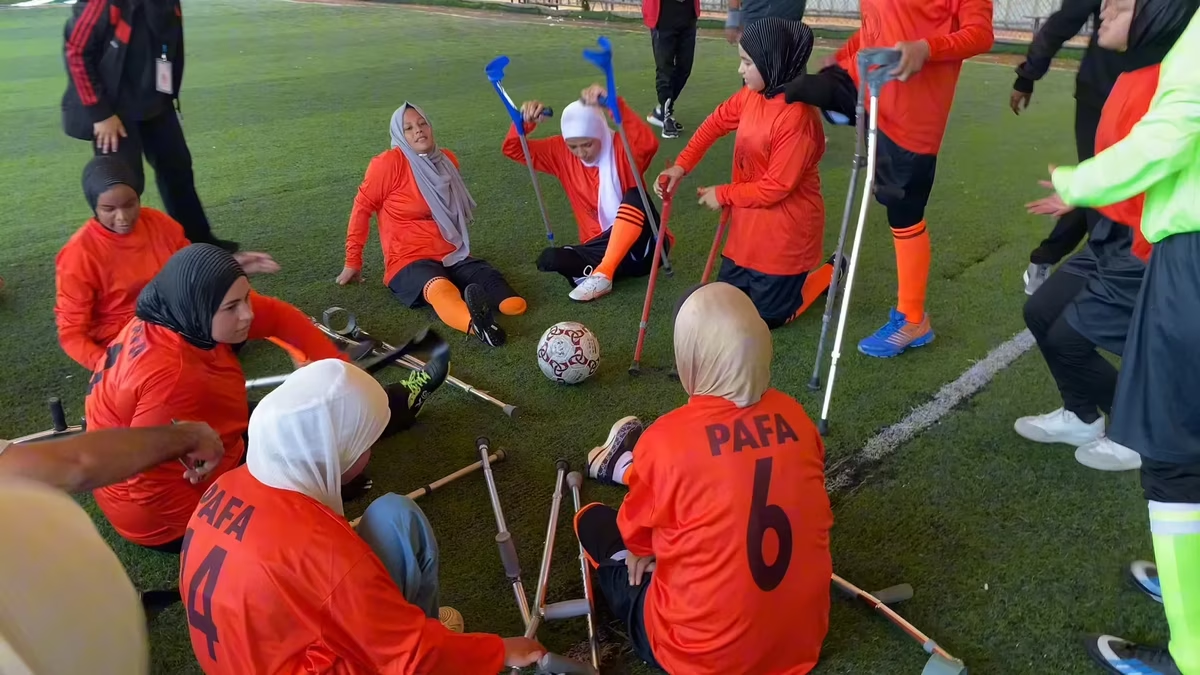
In the heart of the besieged Gaza Strip, where war leaves its harsh marks on the bodies of Gazans, a unique story of defiance emerges from the city of Deir al-Balah, starring girls who lost their limbs but not their passion. On a grassy pitch that survived the shelling, the players of the amputee football team gather, kicking the ball and with it, memories of pain and displacement.
This team was founded under the umbrella of the Palestine Amputee Football Association, and its organizers aim to build the nucleus of a national team to represent Palestine in international tournaments. This initiative is a vital outlet for girls who have found in sports a way to prove that physical disability does not mean the end of ambition or isolation from society.
Rozan Khaira, a 24-year-old woman, used to run before an airstrike changed the course of her life in November 2023. Rozan recounts how she lost her leg in a bloody moment, but today she stands on her crutches to pass the ball to her teammates, asserting that the will to live is stronger than the occupation's missiles.
Rozan grew up in the historic Daraj neighborhood of Gaza amidst a sporty family and never imagined she would one day play football with one leg. Despite the bitterness of displacement and the difficulty of movement, the young woman insists on committing to training, dreaming of wearing the Palestinian national team jersey and raising her country's flag in international stadiums.
As for Kifah Al-Fakhouri, she lost her leg and her companions in a raid that targeted a cafe on the Gaza beach in June of last year. Kifah woke up in the hospital to find herself facing a new and painful reality, but she quickly decided to turn her sadness into positive energy by joining the women's team.
Kifah considers playing football a form of psychological and physical resistance that enables her to regain her lost balance. She says that the laughter that echoes during training is the most eloquent response to attempts to break the will of Gazans, as she found in the team a second family that shares the same challenges.
In the goalkeeper position, 16-year-old Aisha Al-Abadla stands out, having been born with an underdeveloped arm. Aisha indicates that her health condition was a result of her mother inhaling white phosphorus during the 2008 war, while she was still a fetus in her womb.
Aisha loved football since her childhood, and her congenital disability did not prevent her from brilliantly protecting her team's goal. She wears her glove on her only right hand and stands confidently between the three posts, expressing her hope of becoming the primary goalkeeper for the Palestinian amputee national team in the near future.
Coach Lamia Musleh supervises the girls' training, emphasizing that football in Gaza has transcended being merely a sport to become a space for psychological release. The coach observes a significant improvement in the players' morale, as physical activity contributes to boosting their self-confidence and social integration.
Musleh adds that the goal is not only to win matches but to instill a spirit of determination in the girls who have suffered severe traumas. Every kick of the ball is a message to the world that amputating the body does not mean amputating the dream, and that the Palestinian will is capable of performing miracles from amidst the rubble.
For his part, Fouad Abu Ghalyoun, head of the Palestine Amputee Football Association, indicates that the association has resumed its activities despite the widespread destruction of sports facilities. He affirms that work is being done in a dangerous environment and with very modest capabilities, due to the continuous siege and the repercussions of the recent war.
Official statistics issued by the Ministry of Health indicate that there are about 6,000 amputation cases in the Gaza Strip due to the ongoing aggression. Children and women represent a large percentage of these cases, which necessitates long-term rehabilitation programs to help them adapt to their new reality.
Abu Ghalyoun seeks through this team to provide a nurturing environment for amputees, helping them overcome physical and psychological obstacles. He believes that sports are the shortest way to integrate people with disabilities into society and make them active and productive members despite all surrounding circumstances.
Between Rozan's ambitions, Aisha's saves, and Kifah's determination, a picture of resilience is drawn on Gaza's exhausted pitches. These girls are not just running after the ball; they are running after their right to life and international representation, carrying a message that Gaza will continue to pulsate with hope, no matter the sacrifices.
The occupation's fires amputated our bodies, but they did not stop our dreams and our will to live.
Share your opinion
With amputated legs and strong will... Gaza's girls chase World Cup dream from amidst the rubble