






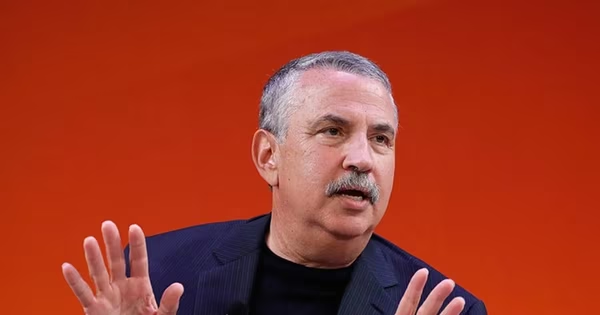

Prominent American writer Thomas Friedman launched a fierce attack on President Donald Trump, stating in an article published by the 'New York Times' that his political behavior completely deviates from the responsibilities of the Commander-in-Chief of the Armed Forces. Friedman explained that Trump has begun to act like the leader of a group seeking to achieve sectarian gains, instead of working to unite the United States' domestic front in the face of increasing external challenges.
The article pointed to the stark contradiction in the performance of the American administration; while tens of thousands of American soldiers are deployed in areas of tension near Iran, the President is preoccupied with stirring up internal divisions. Friedman believes that the highest priority in such strategic circumstances should be to close ranks, but Trump has failed to deliver a unifying speech that reduces the intensity of polarization with political opponents.
Friedman accused the American President of attempting to harness state institutions to serve his personal agenda, pointing to an attempt to create a massive secret political fund worth $1.776 billion in coordination with the Department of Justice. This fund was intended, according to the article, to compensate Trump loyalists who faced legal prosecution, especially those involved in the January 2021 Capitol riot.
These moves sparked angry reactions even within the Republican Party, with Friedman quoting former Senate Republican leader Mitch McConnell describing the plan as 'pure folly and a moral error.' This internal debate prompted the federal judiciary to intervene and temporarily halt the plan, ultimately forcing the administration and the Attorney General to withdraw the proposal under the weight of political and legal pressure.
In the context of foreign policy, Friedman strongly criticized the decline in American support for Ukraine in its war against Russia, considering that integrity would have dictated directing funds to support European democracy instead of rewarding political supporters. He affirmed that Ukrainian forces are fighting a decisive battle to defend the old continent, at a time when American military aid is shrinking in a way that raises concern among allies.
The article touched upon the issue of financial conflicts of interest within the White House, where media reports revealed thousands of financial transactions related to shares of companies affected by political decisions. Press sources reported that Trump conducted extensive buying and selling operations in stock markets during the first quarter of the year, including major companies in the defense sector, raising questions about the exploitation of office for financial gain.
The criticism was not limited to the financial aspect but also included Trump's military orientations, as he decided to reduce the presence of American forces in NATO countries. Friedman considered this approach a free gift to Russian President Vladimir Putin, who sees the decline of the American role as an opportunity to achieve field and political progress in his conflict with the West.
These policies have led to a radical shift in how European capitals view Washington, as trust in the traditional American role as a guarantor of global security has gradually eroded. Friedman quoted geopolitical experts as saying that some countries have begun to view 'Trump's America' as a factor of instability, prompting them to seek alternative strategies to protect their interests away from the American umbrella.
In this regard, expert Nader Mousavizadeh pointed out that deterring the volatility of American policy has become a priority for some countries, on par with deterring Russian threats. This sense of danger has pushed countries like Germany, Sweden, France, and Britain to take practical steps to strengthen their independent defense capabilities, including deploying military units in strategic areas such as Greenland.
Friedman believes that European reliance on American technology and defense has begun to undergo a comprehensive re-evaluation as a result of the uncertainty imposed by the Trump administration. European countries no longer trust the stability of American positions and are now moving to secure themselves against any sudden withdrawal or change in international alliances that have been stable for decades.
The writer concluded his article by warning that the continuation of this approach will cost the United States a heavy price in the short and long term, as the international order established after World War II is being undermined. Weakening the American role as a guarantor of stability not only harms allies but also weakens Washington's standing and its ability to influence major global issues.
The picture Friedman painted of Trump reflects deep concern among the American political and media elite about the presidency becoming a tool for narrow interests. According to the article, history will judge this period based on the extent of the damage it inflicted on internal democratic institutions and on the international reputation of the United States as a leader of the free world.
With each passing month of his presidency, Trump acts more like a leader of America's gang than the Commander-in-Chief of the Armed Forces.
Share your opinion
Friedman attacks Trump: Acts like a 'gang leader' and undermines international alliances