







Book Review
By: Said Arikat - Washington
March 25, 2026
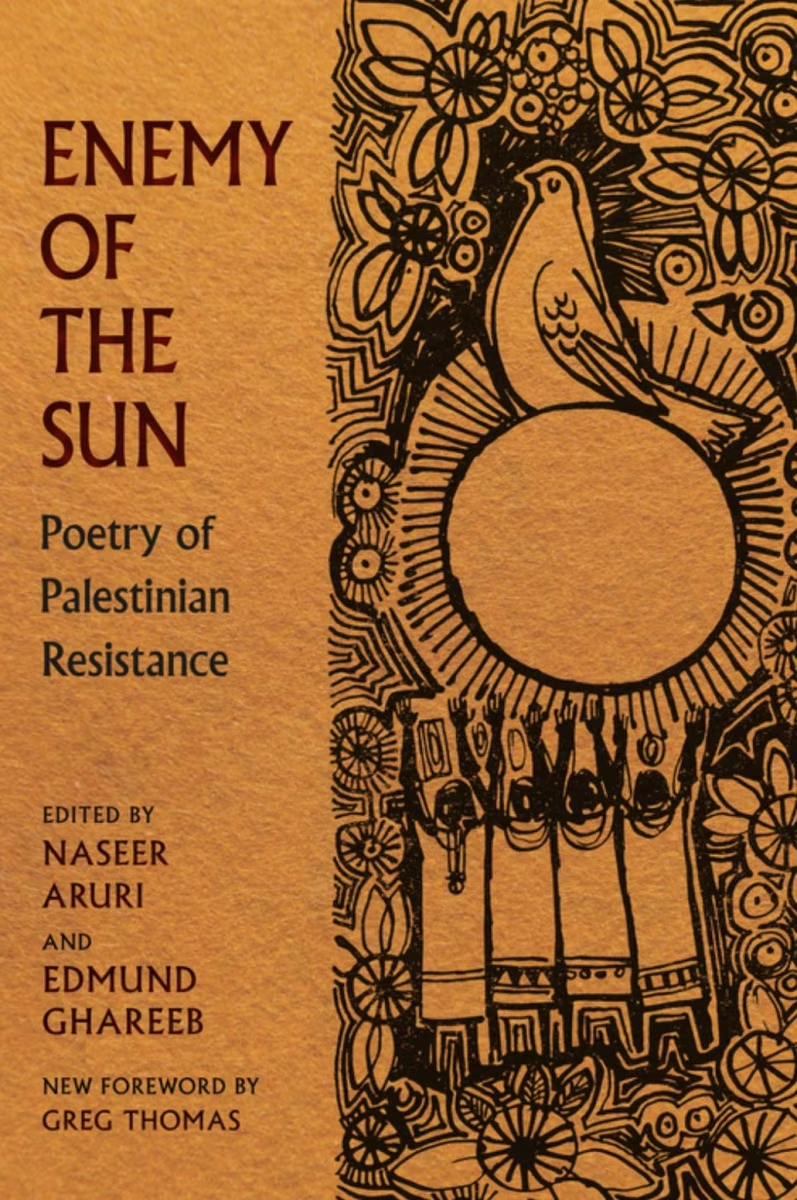
“Enemy of the Sun: Palestinian Resistance Poetry,” by academics Naseer Aruri and Edmund Ghareeb, is one of the most prominent works at the intersection of literature and politics, presenting poetry not merely as an aesthetic expression, but as a living tool of resistance, a means of preserving identity, and a platform for expressing the continuous aspiration for freedom. Since its first publication in 1970, and its expansion in subsequent editions, this work has established its place as a comprehensive anthology of multiple Palestinian poetic voices, united by the experience of occupation and exile, and bound by a steadfast insistence on dignity and the right to self-determination.
The book's title derives its symbolic meaning from the poem “Enemy of the Sun,” also known as “Speech in the Unemployment Market,” by the great Palestinian poet Samih al-Qasim, which is considered one of the most prominent texts of resistance poetry in the 1970s. This poem has become a literary and political icon, with its tone of defiance and absolute rejection of compromise, and a deep embodiment of the idea of steadfastness in the face of occupation. It is enough to recall al-Qasim's words: “O enemy of the sun… but… I will not compromise / And until the last pulse in my veins… I will resist,” to realize how the book's title intersects with its general spirit, where poetry becomes an existential declaration of adherence to land and identity.
The book does not present Palestinian suffering as a state of attrition or defeat, but rather rephrases it within a resistant cultural horizon, transforming pain into an expressive energy capable of endurance. Poetry here is not a linguistic luxury, but an act of survival, and a means of confronting attempts at symbolic and cultural erasure. Through this perspective, the anthology transcends the boundaries of documentation, becoming a living testimony to the power of the word to resist annihilation.
The importance of the work is evident in its historical scope, as it places the Palestinian experience within a broader global context of liberation movements, of which the 1970s was one of the most prominent stages. From this perspective, Palestinian poetry does not appear isolated, but rather engaged in a universal human discourse calling for justice and freedom. Furthermore, the additions in subsequent editions reflect the continuity of this voice across generations, where new generations inherit the traditions of resistance, and rephrase them to suit the transformations of reality, without losing their connection to their roots.
At the content level, resistance occupies the heart of most texts, yet it does not appear in a single form, but varies between quiet contemplation and direct expression. There are poems that internalize and deconstruct pain, and others that declare it clearly and boldly. In both cases, the human presence remains dominant, where the individual's experience intersects with the fate of the group, in a cohesive emotional unity.
The vocabulary of land, identity, memory, and return emerge as essential semantic keys in this poetry, but they are not used as mere indicators of loss, but rather transform into expressions of belonging and continuity. The land, for example, is not just a place, but a symbolic entity that transcends geography, becoming synonymous with existence itself. Hence, its evocation in poetic texts becomes an act of resistance in itself, confronting attempts at cancellation and uprooting.
One of the striking features of this anthology is its focus on the collective voice, where the editors reduce the presence of individuality in favor of highlighting a shared experience. This choice does not negate the specificity of each poet, as much as it emphasizes that what unites these voices is greater than what divides them. Resistance, in this context, is not an isolated personal experience, but a collective act extending through time, inherited by poets as it is inherited by generations.
Stylistically, the poems are characterized by a degree of clarity and directness, which makes them accessible to a wide audience, without losing their artistic value. This characteristic suggests an urgent sense of the necessity of speaking, and the desire for poetry to remain accessible and influential at the same time. At the same time, the texts are not devoid of rhetorical figures and metaphors that reflect a deep aesthetic sense, where artistic expression intersects with the political dimension in a striking harmony.
Recent additions have enriched this work, reflecting the transformations of Palestinian reality, while maintaining a close connection to the pivotal issues that formed the essence of this poetry. These texts confirm that resistance poetry is not a static discourse, but a living entity capable of renewal and absorbing new experiences, without compromising its fundamental vision.
Although the intensity of the political and emotional dimension may pose a challenge to some readers, it is at the same time a source of strength for this work, as it encourages an interactive reading that goes beyond superficial reception, towards a deeper understanding of both historical and human contexts. From this perspective, the book becomes a bridge for communication, opening a wider horizon for empathy and understanding.
In conclusion, “Enemy of the Sun: Palestinian Resistance Poetry” presents a living example of poetry's ability to transcend the boundaries of language, becoming an act of survival. It reminds us that the word, no matter how difficult the circumstances, remains capable of preserving identity, keeping hope alive, and formulating a collective vision for freedom. Thus, poetry transforms from a mere record of suffering into an active force in confronting it, and from a memory of pain into an open horizon of hope.
Share your opinion
"Enemy of the Sun": Palestinian Memory Between Pain and Hope