






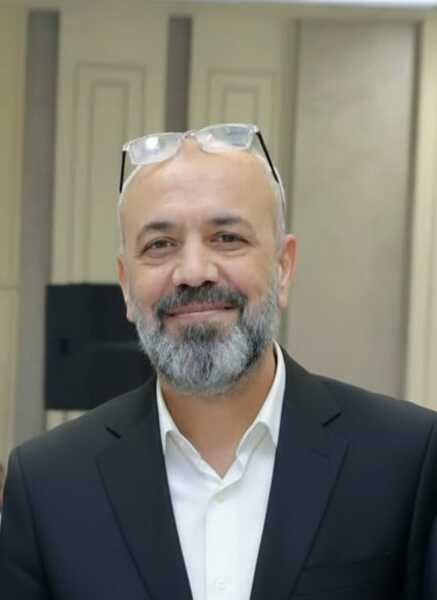

In a national moment fraught with anxiety, I listened with deep interest – not as a fleeting protocol – during a visit that brought me together with the Minister of Education, Dr. Amjad Barham, and the Undersecretary of the Ministry, Dr. Basri Saleh, to a frank and open discussion about the reality of education in Palestine. The conversation was neither cosmetic nor defensive, but a direct confrontation with a question many avoid: Are we still managing education, or are we managing a crisis?
What I concluded is that our educational crisis is not merely administrative, nor solely union-related, nor exclusively financial. We face a structural gap between the student's right to education and the teacher's right to a salary and professional dignity. The imbalance begins when one of these rights becomes a tool to pressure the other. Education should not be reduced to a salary item, just as the teacher should not be asked to bear the burden of financial collapse alone. The issue is deeper: it is an equation of national balance.
Let's speak in numbers before emotions. In Palestine, there are about 1.4 million male and female students in schools, within approximately 3,200 schools, supervised by nearly 62,000 male and female teachers. In the West Bank alone, the number of public school students exceeds 600,000. Any disruption in the regularity of education does not affect an institution; it affects society as a whole.
When attendance turns into two or three days a week, we lose approximately 40–50% of the actual instructional time. This is not a gap in the timetable, but a gap in the future of the economy, in societal awareness, and in the youth's ability to endure. A school is not just a roof and walls; it is a daily social contract between the state and society.
Amidst this scene, a fundamental conviction emerges: the school principal is the pivot point. They are the true leader within the institution, educationally and ethically. But we demand leadership from them without providing them with sufficient tools. We place them in confrontation with societal anger, union pressure, and administrative complexity, then demand that they perform miracles. We cannot place a leader on a burning front without clear powers and solid institutional support.
In light of the disruption and instability, talking about a perfect, complete program becomes unrealistic. What is required is to manage a "smart minimum" of education: strict focus on basic skills – Arabic, English, Mathematics, Science – especially in the early grades. Saving the basics is saving the cognitive structure of an entire generation.
Among the practical proposals to reduce losses is to utilize experienced retirees and volunteers with a sense of national duty to support classroom and extracurricular activities, without infringing upon the rights of regular teachers. Palestinian society historically has not abandoned its school when it felt it was in danger, but volunteering must be organized and framed, not emotional improvisation.
As for higher education, the picture is no less sensitive. We have more than 220,000 university students distributed among over 50 higher education institutions. Universities primarily rely on tuition fees for funding. With delayed salaries or partial payments, thousands of families become unable to pay installments. Here, the student does not just lose a lecture; they lose an entire life path.
The cost of salaries for the education sector reaches tens of millions monthly, as the cost of one academic semester alone can be about 40–45 million shekels in salaries. In a chronic liquidity crisis, the regularity of education becomes dependent on limited and threatened financial capacity.
But we must put things in their broader context: we manage education under occupation. An occupation that controls resources, restricts movement, deducts revenues, and keeps the economy in a state of permanent fragility. In such a reality, traditional solutions are not enough. An exceptional situation cannot be confronted with ordinary tools.
Here, the importance of creative solutions emerges. One of the important steps taken by the Ministry, under the guidance of its minister, is to reactivate the payment of tuition fees for children of public employees in universities. This is not a grant or administrative luxury, but a proactive intervention to protect thousands of students from academic failure. Protecting university students is not a social service; it is a direct investment in social stability and the preservation of human capital. And under occupation, every student we protect from dropping out is a form of quiet civil resistance.
Creativity in managing education under occupation means financial flexibility that protects students from interruption, supportive community partnerships for schools, reordering priorities towards basics, empowering school leadership, and reforming university governance by defining leadership terms and preventing the reproduction of positions without renewal or accountability.
Moreover, the discussion about strikes must be managed with a cool head. The right to unionize is legitimate, but when it turns into an uncontrolled tool, the student is the first loser. Restoring legitimacy through transparent elections and renewing mandates restores the balance between legitimate pressure and national responsibility.
There is a cultural dimension that cannot be ignored. When education transforms from a national mission into a temporary negotiating file, we lose our compass. In previous intifadas, the school was a symbol of steadfastness, and today it must remain so. The teacher who sees the student as their child, the principal who sees their school as a trust, and the ministry that seeks creative solutions despite scarce resources – these form the real line of defense.
Let's be frank: if we lose the regularity of education for years, we will face a deep knowledge gap, higher unemployment, greater emigration, and more dangerous societal fragility. The issue is not academic, but societal security and national stability. Education in Palestine is not a budget item, but a field of daily steadfastness. And if we lose the school, no national speeches will compensate us for that. Managing educational survival is not an option, but a sovereign duty that cannot be postponed.
Share your opinion
When Education Becomes the Last Line of Defense for the Homeland